
- UL 9540 Listing: Viridi's RPSLinkIN battery system achieved the UL 9540 Listing from TÜV Rheinland, passing stringent fire safety tests for indoor use.
- 90 Hours of Backup Power: The system provided up to 90 hours of reliable backup power in a wastewater pumping station, replacing diesel generators.
- 600 kWh Indoor System: Deployed at the Hauptman-Woodward Medical Research Institute, marking one of the first large-scale indoor battery installations in an occupied building.
Experts view Viridi's UL 9540 certification as a breakthrough in battery safety, enabling safer indoor energy storage deployments and unlocking new opportunities for energy resilience and decarbonization in critical infrastructure.
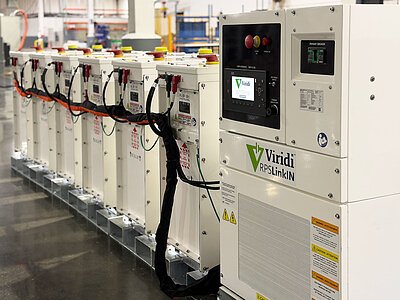
Viridi Battery Tech Achieves Top Safety Rating, Unlocking Indoor Use
BUFFALO, N.Y. – April 16, 2026 – Buffalo-based energy storage company Viridi has secured a landmark safety certification for its RPSLinkIN battery system, a development poised to remove one of the final barriers to the widespread adoption of indoor battery energy storage. The company announced its 480V system has received the UL 9540 Listing from TÜV Rheinland, a globally recognized testing and certification body.
This certification is not just another compliance check; it was awarded after the system successfully passed the most stringent fire safety testing protocols available for residential indoor use. The achievement signals a paradigm shift for where and how battery systems can be deployed, potentially unlocking new opportunities for energy resilience and decarbonization in occupied buildings like hospitals, data centers, and multi-family high-rises where safety is non-negotiable.
Redefining the Standard for Battery Safety
The core of Viridi’s achievement lies in its performance under the UL 9540A, Edition 5 test method. While the UL 9540 standard provides a system-level certification for safety and equipment integration, the UL 9540A test is a rigorous trial-by-fire designed to evaluate what happens when a battery cell is forced into thermal runaway—an uncontrolled, self-heating state that can lead to fire and gas release in conventional lithium-ion batteries.
Viridi’s system was subjected to the unit-level test under conditions specified for residential, indoor, floor-mounted applications, considered the most demanding scenario. The results were definitive: the test showed no smoke, no hazardous gas release, and no fire propagation. Crucially, there was no detectable increase in heat in adjacent battery packs, proving the effectiveness of the company’s proprietary “fail-safe” and “anti-propagation” technology. This means that even if a single cell were to fail, the event would be contained and would not cascade into a larger, dangerous incident.
This outcome allows the RPSLinkIN system to be installed in commercial and industrial settings without requiring the costly and complex fire suppression systems—such as sprinklers, clean-agent gas systems, or fire-rated containment rooms—that are typically mandatory for indoor lithium-ion battery installations.
“Safety has been one of the primary barriers to scaling battery storage, particularly in critical infrastructure and occupied environments,” said Jon M. Williams, CEO of Viridi, in a statement. “With RPSLinkIN, we're enabling organizations to deploy indoor energy storage systems where it wasn't previously possible—unlocking new opportunities for resilience, cost savings, and decarbonization, and representing a fundamental shift in how and where battery systems can be deployed.”
From Codebooks to Construction: The Practical Impact
The UL 9540 listing has profound implications for architects, engineers, and building owners. Major fire safety codes, including NFPA 855 (Standard for the Installation of Stationary Energy Storage Systems) and the International Fire Code (IFC), rely heavily on UL 9540 certification. For Authorities Having Jurisdiction (AHJs), such as local fire marshals and building inspectors, a system that has passed the most rigorous UL 9540A tests greatly simplifies the permitting and approval process.
By eliminating the need for ancillary fire suppression, Viridi’s technology directly addresses major sources of cost, complexity, and space constraints in project development. This could dramatically lower the barrier to entry for facilities looking to install backup power, participate in demand response programs, or reduce their carbon footprint. The certification provides a clear, data-backed pathway for deploying energy storage inside existing, space-constrained buildings, a challenge that has long hampered the market.
Furthermore, the reduced risk profile is expected to have a positive impact on insurance underwriting. Insurers have been cautious about covering indoor lithium-ion battery systems due to fire risk, often requiring significant premiums and extensive safety measures. A system with a proven fail-safe design presents a much lower risk, potentially leading to more favorable insurance terms and broader market acceptance.
Powering Critical Infrastructure Where It Matters Most
Viridi’s technology is already being proven in the field across a range of mission-critical environments. The company has highlighted deployments at the U.S. Department of Energy's Oak Ridge National Laboratory and a 600 kWh indoor system at the Hauptman-Woodward Medical Research Institute—one of the first large-scale indoor battery installations of its kind in an occupied building.
In Erie County, New York, an RPSLinkIN system was installed at a wastewater pumping station, providing up to 90 hours of reliable backup power. The battery system replaced aging diesel generators, simultaneously reducing maintenance costs, eliminating on-site emissions, and dramatically improving the resilience of the critical municipal service against power outages. These real-world applications underscore the system's ability to operate safely and reliably in sensitive environments where traditional battery systems would have faced significant regulatory and safety hurdles.
The system's scalability allows it to be configured for a wide array of commercial and industrial applications, from industrial manufacturing and hospitals to hotels and educational institutions, all of which stand to benefit from cleaner, more reliable on-site power.
A Blueprint for Innovation Fueled by Regional Investment
This technological milestone is also a significant win for New York's burgeoning clean energy economy. Viridi’s progress was supported in part by funding from New Energy New York (NENY), a regional initiative designed to establish a national hub for battery innovation, manufacturing, and supply chain development.
Led by Nobel Laureate M. Stanley Whittingham, a key figure in the development of lithium-ion batteries, NENY aims to accelerate the commercialization of next-generation energy technologies. The support provided to Viridi exemplifies the initiative's strategy of bridging the gap between laboratory research and market-ready products that can solve real-world problems.
“New York is building a national hub for next-generation battery innovation, and Viridi is a strong example of that progress in action,” Whittingham noted. “Advancements like UL 9540 listing are critical to enabling broader adoption of safe, scalable energy storage technologies across critical infrastructure and commercial applications.”
As the demand for energy storage continues to accelerate, driven by grid instability and decarbonization goals, the scrutiny on battery safety will only intensify. With its newly certified fail-safe architecture, Viridi has positioned itself to meet this demand by providing a solution that addresses the industry’s most pressing safety challenges head-on, paving the way for a cleaner and more resilient energy future.