
- US$6 billion: Potential capital inflows following Vietnam's market upgrade, including passive and active funds. - 89%: Vietnamese businesses with formal ESG commitments (up from 80% in 2022). - 171%: Surge in green bond issuance in 2024.
Experts agree that ESG compliance is now essential for Vietnamese companies to attract global investment and achieve sustainable growth, though execution remains a key challenge.
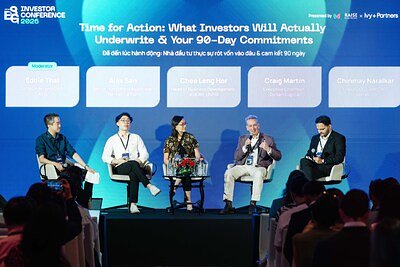
Vietnam's Green Leap: ESG Becomes a Passport to Global Investment
HO CHI MINH CITY, Vietnam – May 29, 2026 – The message from the global investment community is echoing loud and clear through Vietnam's bustling economic corridors: Environmental, Social, and Governance (ESG) principles are no longer a niche consideration but a mandatory filter for attracting capital. This was the central theme at the 4th annual Vietnam ESG Investor Conference, which concluded this week, signaling a pivotal shift for one of Asia's fastest-growing economies.
The two-day event, co-organized by Raise Partners and Ivy+Partners, brought together over 250 delegates and 40 experts who reinforced a unified view: for Vietnamese companies, demonstrating ESG compliance is now the "passport" to accessing demanding international markets and the long-term funding required for sustainable growth.
The Emerging Market Catalyst
Fueling this urgency is Vietnam's impending graduation to a higher-tier market. FTSE Russell has confirmed the nation's upgrade from a Frontier to a Secondary Emerging Market, a reclassification set to take effect on September 21, 2026. This long-awaited move follows years of significant regulatory reforms aimed at improving market access and transparency for foreign investors.
The upgrade is expected to be a game-changer, potentially unlocking an estimated US$1.5 billion in passive investment inflows, with total potential capital, including active funds, reaching as high as US$6 billion. However, with this new status comes heightened scrutiny. As Vietnam prepares to join the ranks of major emerging markets, its companies are facing unprecedented pressure to meet stricter international standards for transparency, governance, and operational excellence.
"Vietnam has already left the starting line and the pace of change is unrelenting," said Ms. Mimi Vu, Co-Founder of co-organizer Raise Partners. "Now it's on businesses to stop treating ESG like a compliance exercise and start using it as the competitive advantage that it truly is. Companies that turn ESG into real execution will be the leaders in unlocking capital and writing Vietnam's next chapter."
From Awareness to Action
The dialogue in Vietnam has decisively shifted from why ESG is important to how it can be implemented effectively. According to PwC's 2025 ESG Progress Tracker, an overwhelming 89% of businesses in the country have either made or plan to make a formal ESG commitment, a significant rise from 80% in 2022. This trend is backed by a burgeoning sustainable finance market projected to grow from over US$25 billion in 2024 to nearly US$104 billion by 2033.
This momentum is visible in the financial markets. Green bond issuance surged by 171% in 2024, and the State Bank of Vietnam's green credit program has channeled significant funds into renewable energy and green agriculture. International investors are taking note.
"As a manager of a fund deeply embedded in the Vietnamese economy for the past 20 years, we have witnessed a significant shift in the ESG awareness of local enterprises," stated Mr. Craig Martin, Chairman of Dynam Capital. "Investors do not expect perfection from the outset; rather, we look for a genuine willingness to transition and improve over time. For us, ESG is characterized by transparency, robust governance, and proactive engagement with stakeholders."
Despite this growing commitment, speakers at the conference repeatedly highlighted that the primary hurdle is no longer a lack of intent but a deficit in execution capability. The main challenges lie in a shortage of verifiable data, robust governance systems, and the capacity to integrate ESG standards into daily operations.
Bridging the Implementation Gap for SMEs
This execution gap is most pronounced among Vietnam's small and medium-sized enterprises (SMEs), which form the backbone of the economy, constituting 98% of all businesses. For many, the perceived cost and complexity of ESG implementation, coupled with a lack of specialized knowledge and clear data-collection protocols, remain significant barriers.
Recognizing this, a multi-pronged support system is emerging. Government-backed initiatives, such as the USAID ESG Initiative Vietnam, are providing technical assistance packages to help SMEs develop sustainable business models. The S.T.A.R. Accelerator Program, a collaboration between the Ministry of Finance and the Global Reporting Initiative (GRI), aims to equip SMEs with practical tools for ESG reporting. Furthermore, financial incentives are being rolled out, including a 2% annual interest rate subsidy on green loans for ESG-compliant projects, designed to lower the capital cost for sustainable transitions.
Policy and Partnerships Forging the Path
Underpinning this entire movement is a strong foundation of government policy. Vietnam's ambitious pledge to achieve net-zero emissions by 2050 has set a clear direction, supported by a National Green Growth Strategy and plans to launch a pilot carbon market by 2025. The State Securities Commission is working to align corporate disclosure rules with global standards like those from the ISSB and GRI, ensuring that the data investors need becomes more readily available.
The conference itself served as a microcosm of the collaborative approach required. The partnership between government bodies, financial institutions, and private-sector organizers like Ivy+Partners demonstrates a collective will to build a robust ESG ecosystem.
Ms. Kate Wallace, Australian Consul-General in HCMC, whose government has been a long-term partner of the event, emphasized this point. "As Vietnam integrates deeper into global markets, ESG is now core to investor confidence... The opportunity before us is to ensure that the capital we invest today delivers growth that is cleaner, fairer, more resilient, and more inclusive."
Ms. Ivy Nhi Chau, Founder & CEO of co-organizer Ivy+Partners, noted the shift in conversations at this year's event. "Businesses have engaged in deeper discussions on how ESG directly impacts operations, markets, and fundraising capabilities through real-life stories... which implies that the dialogue on ESG in Vietnam is moving from awareness to action." As global capital grows more selective, Vietnamese enterprises are learning that verifiable ESG performance is the new benchmark for competition and long-term success.