
- 100 nanoseconds: The ePRTC360+ meets the ITU-T G.8272.1 standard, ensuring less than 100 nanoseconds of drift over 14 days.
- 7 years: Cesium clocks have a finite lifespan of about seven years, requiring costly replacements and hazardous disposal.
- Cost reduction: VIAVI claims its Cesium-less solution delivers Cesium-level accuracy at a fraction of the cost.
Experts in precision timing and infrastructure security are likely to view VIAVI's Cesium-less ePRTC360+ as a groundbreaking advancement, offering a cost-effective, resilient alternative to traditional Cesium clocks that enhances the security of critical global infrastructure.
VIAVI Unveils Cesium-Free Clock, Disrupting Precision Timing Market
CHANDLER, AZ – February 17, 2026 – In a significant development for global infrastructure security, VIAVI Solutions today launched a patent-pending technology that challenges the decades-long reign of Cesium atomic clocks in high-precision timing. The new Cesium-less ePRTC360+™ holdover solution is being hailed as the first and only alternative to Cesium clocks capable of meeting the rigorous ITU-T G.8272.1 standard, a critical benchmark for safeguarding the world’s most essential services.
For years, the ultra-stable Cesium clock has been the undisputed gold standard for providing the precise time synchronization required by 5G networks, power grids, financial markets, and defense systems, especially when primary GPS/GNSS signals are lost. Now, VIAVI claims its innovation can deliver the same level of accuracy and reliability at a fraction of the cost and without the significant operational drawbacks associated with Cesium technology. This breakthrough could fundamentally reshape how nations and corporations protect their critical infrastructure against the escalating threat of timing signal disruptions.
A New Standard in Precision Timing
The challenge of maintaining precise time is governed by stringent international standards. The International Telecommunication Union's G.8272.1 standard for an enhanced Primary Reference Time Clock (ePRTC) demands exceptional stability during a loss of signal, known as holdover. Specifically, it mandates a time drift of less than 100 nanoseconds over 14 days, a feat of accuracy previously achievable only through the complex physics of a Cesium atomic clock.
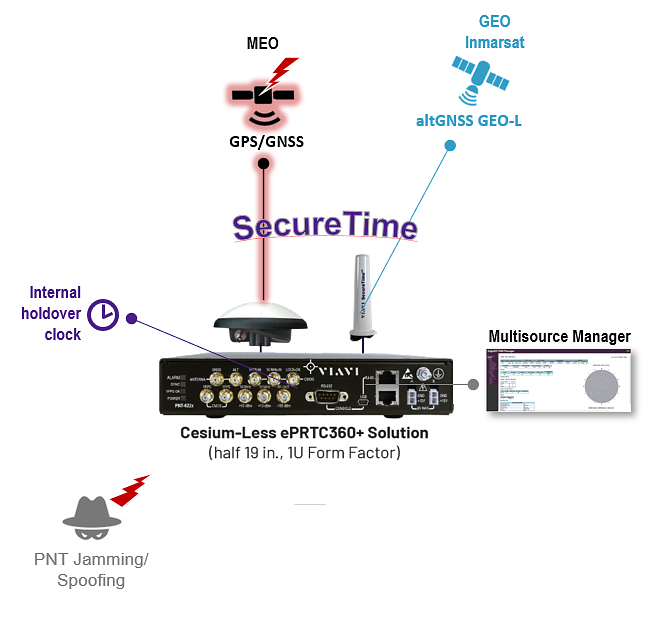
VIAVI's ePRTC360+ achieves this benchmark without using Cesium. Instead, it employs a sophisticated, multi-layered approach. At its core is a high-performance internal Rubidium oscillator, which, while highly stable, cannot meet the long-term drift standard on its own. The breakthrough lies in augmenting this oscillator with a resilient, independent timing feed from the company's proprietary altGNSS GEO-L service.
Unlike conventional GNSS signals, which are broadcast omni-directionally from medium-earth orbit and are notoriously susceptible to low-power jamming, the GEO-L service utilizes highly directional, encrypted L-band signals from geostationary satellites. This architecture, combined with a specialized VIAVI SecureTime GEO anti-jamming antenna, creates a robust timing reference that is far more difficult to disrupt. This system provides a continuous, secure stream of timing information to discipline the Rubidium oscillator, allowing it to maintain Cesium-level accuracy indefinitely, even during prolonged GNSS outages caused by jamming, spoofing, or sophisticated meaconing attacks.
"The Cesium-less ePRTC360+ exceeds leading-edge Cesium-level holdover performance and does this for significantly lower price," said Doug Russell, Senior Vice President and General Manager of Aerospace and Defense at VIAVI. "This enables deployment across the sync network, particularly at edge sites which were previously cost-prohibitive with Cesium holdover clocks."
Fortifying Infrastructure Against a Growing Threat
The launch of the ePRTC360+ is timely, arriving amid growing international concern over the vulnerability of services dependent on GNSS timing. Modern society runs on a synchronized clock, and that clock is largely set by satellites. Power grids use precise timing for synchrophasors that prevent blackouts, 5G mobile networks require nanosecond-level accuracy to coordinate data transmission between cell towers, and AI data centers need perfect synchronization for massive parallel processing tasks. A disruption to GNSS timing can have cascading and catastrophic effects.
Reports from cybersecurity agencies and defense organizations have repeatedly warned of the increasing frequency and sophistication of GNSS jamming and spoofing incidents, both accidental and malicious. These threats can disable navigation, corrupt data, and destabilize entire networks. VIAVI's solution is designed as a direct countermeasure to this vulnerability.
By providing a timing source independent of conventional GNSS and fortified against interference, the technology offers a crucial layer of resilience. Having been successfully tested in live-sky defense and commercial jamming environments, the system ensures that even if primary GPS signals are completely denied, critical infrastructure can continue to operate safely and effectively. This move from a single point of failure (GNSS) to a multi-layered, resilient timing architecture represents a critical step forward in securing national and economic interests.
Disrupting the Market with Lower Costs and Simplified Logistics
Beyond its technical performance, the most disruptive aspect of the ePRTC360+ may be its economic and operational advantages. For decades, the high cost and complexity of Cesium clocks have limited their deployment primarily to the core of networks, leaving the vast and growing network edge vulnerable.
VIAVI's Cesium-less approach dismantles these barriers. The press release highlights a long list of logistical challenges associated with Cesium clocks that the new technology eliminates. Cesium clocks are notoriously sensitive to shock and vibration, requiring delicate handling. They involve multi-day startup procedures and can require up to 40 days of learning from a GNSS signal to achieve full accuracy. Furthermore, their classification under Export Control Classification Number (ECCN) 3A001.i creates significant regulatory hurdles and paperwork for international deployment.
Perhaps most significantly, the Cesium tubes at the heart of the clocks have a finite lifespan of about seven years. Their replacement is costly, and the disposal of the old tubes is classified as a hazardous materials issue, adding further to the total cost of ownership (TCO). The ePRTC360+ eliminates all of these issues, offering a solution that is more robust, faster to deploy, and free from complex export and disposal regulations.
This dramatic reduction in TCO and operational friction enables network operators to deploy high-precision, resilient timing not just at the core, but throughout their networks, including at remote edge sites. This creates the potential for a more robust, meshed timing infrastructure where clocks can back each other up via network PTP feeds, significantly enhancing end-to-end reliability against localized or regional threats.
The new technology, which has been integrated into VIAVI's SecurePNT™ 6200 product series, is designed for rapid integration into any vendor's grandmaster clock system. The company will be demonstrating the ePRTC360+ for the first time at the upcoming Mobile World Congress (MWC) in Barcelona from March 2-5, 2026, offering the industry its first look at what could be the future of secure and accessible precision timing.
Topics & Related
Threat Landscape
Geopolitical Risk
Data Breaches
Cybersecurity
Related Company Pulse