
- 95% less water per pound of produce compared to conventional field farming
- 20 million pounds of annual production capacity after merger with Soli Organic
- $200 million in projected first-year revenues from nationwide microgreens expansion
Experts would likely conclude that 80 Acres Farms' nationwide microgreens expansion demonstrates the viability of vertical farming at scale, combining technological innovation with sustainability to meet growing consumer demand for fresh, pesticide-free produce.
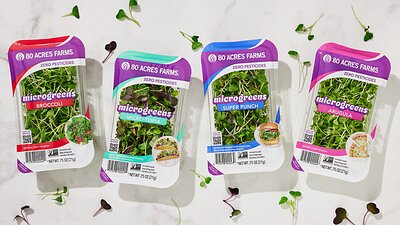
Vertical Farming Leader 80 Acres Farms Launches Microgreens Nationwide
HAMILTON, OH – January 05, 2026 – In a significant move that signals the growing mainstream acceptance of indoor agriculture, 80 Acres Farms announced today a major nationwide expansion of its microgreens line. The pesticide-free, nutrient-dense greens are now rolling out to the produce aisles of major grocery chains across the United States, including Albertson's, Safeway, Walmart, H-E-B, and Meijer, with more retailers expected to follow soon.
This expansion marks a pivotal moment for the vertical farming industry, demonstrating that its long-promised potential for large-scale, sustainable food production is becoming a reality. The move not only strengthens 80 Acres Farms' relationships with its retail partners but also makes these specialty greens, once confined to high-end restaurants and farmers' markets, accessible to a broad base of American consumers. The products will also be available to the restaurant industry through a partnership with U.S. Foods, one of the nation's largest foodservice distributors.
The Technology Fueling the Growth
At the heart of this national rollout is a sophisticated technological foundation that allows for unprecedented consistency, efficiency, and scalability. 80 Acres Farms operates a network of next-generation "smart farms" powered by proprietary technology from its subsidiary, Infinite Acres. This platform, known as GroLoop™, is an integrated system of hardware, software, automation, and AI-driven controls that manages every aspect of the growing cycle.
"From the beginning, our goal has been to design growing systems that actually work in the real world—systems that are reliable, efficient, and adaptable," said Tisha Livingston, cofounder of 80 Acres Farms and CEO of Infinite Acres. "Our technological foundation enables consistent production, quick responses to our partners' needs, and the ability to scale efficiently to meet demand for products like microgreens."
This technology allows the company to make bold sustainability claims that address some of traditional agriculture's most pressing challenges. The farms reportedly use up to 95% less water per pound of produce compared to conventional field farming, a figure consistent with industry benchmarks for closed-loop hydroponic systems that recycle water. Furthermore, the company states its facilities are powered by 100% renewable electricity, tackling the high energy consumption often cited as a challenge for the vertical farming sector. By growing indoors in a controlled environment, the company also eliminates the need for any pesticides.
Riding a Wave of Consumer and Retail Demand
The expansion is strategically timed to capitalize on surging consumer interest in both microgreens and sustainably sourced food. The global microgreens market, valued at over $3.1 billion in 2024, is projected by industry analysts to grow at a compound annual growth rate of over 10% through the next decade. This growth is fueled by health-conscious consumers drawn to the concentrated nutritional value of microgreens, as well as a broader shift towards plant-based diets and local food systems.
Retailers, in turn, are responding to these trends. For large grocery chains, partnering with a scaled vertical farming operator like 80 Acres Farms offers a solution to several supply chain vulnerabilities. It provides a reliable, year-round source of fresh produce that is immune to weather events and climate disruptions. The proximity of indoor farms to distribution centers also reduces transportation costs and food miles, resulting in a fresher product with a longer shelf life—a key differentiator in the competitive grocery sector. The ability to offer a consistent, high-quality, pesticide-free product provides a compelling value proposition for retailers looking to meet the demands of an increasingly discerning customer base.
A Strategy of Consolidation and Market Leadership
This national rollout is not merely an operational expansion; it is the culmination of a deliberate business strategy centered on consolidation and capital-efficient growth. A key catalyst was the company's landmark merger with Soli Organic in the third quarter of 2025. The move created one of the largest indoor farming companies in the world, combining 80 Acres' technological prowess with Soli Organic's deep-rooted expertise in organic growing and its extensive retail network.
The combined entity, operating under the 80 Acres Farms brand, now serves over 17,000 retail locations and boasts an annual production capacity of up to 20 million pounds of produce. With projected first-year revenues approaching $200 million, the merger provided the scale and financial footing necessary for such an ambitious national launch.
"Microgreens deliver some of the most concentrated flavor and nutrition you'll find in fresh produce, which is why they've been an important part of our business for years," said Mike Zelkind, cofounder and CEO of 80 Acres Farms. "This expansion demonstrates our retail partners' confidence in our ability to deliver that quality and consistency at scale."
Further evidence of this strategy came in March 2025, when the company acquired three indoor farms from the struggling competitor Kalera, located in Georgia, Texas, and Colorado. By retrofitting these existing facilities with its own GroLoop™ technology, 80 Acres Farms demonstrated an agile approach to increasing its geographic footprint without the time and capital expenditure required to build from the ground up.
With seven distinct microgreen varieties—including Arugula, Broccoli, and a spicy mix called Nice 'N Spicy—now reaching a nationwide audience, 80 Acres Farms is solidifying its position as a leader in a rapidly maturing industry. The move represents a clear bet that the future of fresh produce lies in the synergy of technology, sustainability, and strategic scale.