
- Overall Response Rate (ORR): 68.5% in clinical trials
- Median Overall Survival: 40.7 months with Eratrectinib
- Brain Metastases ORR: 87.5% for hard-to-treat patients
Experts would likely conclude that Vcare's approval of Eratrectinib marks a significant milestone in China's pharmaceutical industry, demonstrating its growing capability to compete globally with innovative, AI-driven drug development.
Vcare's Cancer Drug Win Signals China's New Pharma Power Play
NANJING, China – June 05, 2026
The mechanics of power and profit in the global pharmaceutical industry are undergoing a seismic shift, and the latest tremor comes from Nanjing. On June 4, Jiangsu Vcare PharmaTech, a relatively new but ambitious player, secured Chinese marketing approval for Eratrectinib, a next-generation cancer therapy. While the press release celebrates a victory for patients, the subtext is a declaration of strategic intent. This approval is more than just a new drug hitting the market; it’s a validation of a distinctly Chinese model of biotech innovation and a clear signal that the nation's firms are no longer content to just follow the West.
Eratrectinib targets a specific genetic flaw—NTRK gene fusions—that drives a wide range of aggressive solid tumors. For Vcare PharmaTech, a company founded just 16 years ago, this approval represents the culmination of a high-stakes bet on indigenous research and development, positioning the firm as a formidable competitor in the lucrative, high-stakes oncology market.
A Clinical Leap Forward
To understand the significance of Eratrectinib, one must first appreciate the challenge it addresses. NTRK gene fusions, while rare in the general cancer population, create highly aggressive tumors with a grim prognosis. For patients with advanced disease, median survival without targeted therapy hovers around a single year. First-generation TRK inhibitors, while effective, often see their utility wane as cancers develop resistance or spread to the brain.
This is where Vcare's drug makes its case. The clinical trial data is compelling. In registration studies, Eratrectinib demonstrated an overall response rate (ORR) of 68.5% and a median overall survival of an impressive 40.7 months. But the true measure of a next-generation drug lies in its performance where its predecessors fall short. For patients with brain metastases—a common and devastating complication—Eratrectinib achieved a remarkable 87.5% ORR, showcasing potent central nervous system penetration. Furthermore, in patients whose cancer had progressed despite treatment with a previous TRK inhibitor, the drug still produced a 47.4% response rate. These are not incremental improvements; they represent a meaningful clinical advance for the hardest-to-treat patients.
Vcare attributes this success to the drug's unique cyclic molecular structure, a product of what it calls its "AI for differentiated de novo drug design" platform. This design, distinct from the linear structure of first-generation drugs, is engineered to overcome known resistance mutations and reduce off-target side effects, a claim supported by a favorable safety profile in its trials.
Navigating a Crowded Field
While Eratrectinib's clinical profile is strong, it does not enter an empty arena. The market for TRK inhibitors is already populated by global giants. Bayer's Larotrectinib (Vitrakvi) and Roche's Entrectinib (Rozlytrek) were the first-generation pioneers, establishing the tumor-agnostic treatment paradigm in China and globally. Vcare's drug is poised to compete directly with these established players, offering a solution for patients who progress on their therapies.
However, the more immediate competition comes from other next-generation rivals. In a testament to the rapid pace of innovation, another domestic firm, InnoCare Pharma, secured Chinese approval for its own next-generation TRK inhibitor, Zurletrectinib, in December 2025. Globally, Bristol-Myers Squibb's Repotrectinib also targets this space and has its own application under review in China. Vcare's claim to be a next-generation pioneer is valid, but it is not alone. This intense competition underscores the high value placed on therapies that can conquer drug resistance, turning the TRK inhibitor space into a dynamic and hotly contested battleground for market share.
The 'Little Giant' with Global Ambitions
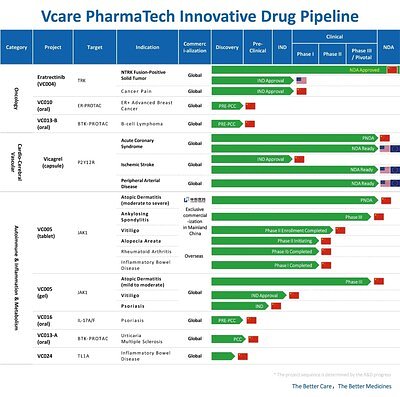
Eratrectinib's approval is the story of Vcare PharmaTech's strategic execution. Designated by the government as a 'National Key Specialized, Refined, Differential and Innovative "Little Giant" Enterprise', Vcare embodies Beijing's strategy of fostering domestic champions in high-tech sectors. Backed by over 1.2 billion RMB in financing, the company has built a full-chain innovation system, from AI-powered discovery to manufacturing, at its sprawling 21,000-square-meter headquarters in Nanjing.
The success of Eratrectinib serves as a powerful proof-of-concept for its entire R&D engine, particularly its much-touted AI platform. For investors, this de-risks the rest of Vcare's diversified pipeline, which includes promising candidates for cardiovascular disease and autoimmune disorders. As one analyst noted, "A successful launch in a competitive field like oncology gives credibility to the entire platform. It's a signal that their discovery and development process works."
This victory is not just a domestic play. The company has already filed an Investigational New Drug (IND) application for Eratrectinib with the U.S. FDA, signaling clear intentions to compete on the global stage. The approval in China provides a crucial commercial foundation and real-world data to support its international expansion, transforming Vcare from a local innovator into a potential global player.
Unlocking the Market
The final piece of the puzzle is market access. While NTRK fusions are rare, their higher prevalence in East Asian populations means China has an estimated 15,000 new cases annually. This represents a substantial, concentrated market opportunity. However, a drug is only valuable if doctors can identify the patients who will benefit. The recent NMPA approval of Geneseeq Technology's PanTRKare™, China's first pan-solid tumor NGS-based companion diagnostic test for NTRK fusions, is a critical enabler. This development streamlines the process of finding the right patients, effectively unlocking the market for Eratrectinib and its competitors.
For Vcare PharmaTech, the road ahead involves navigating pricing negotiations for inclusion in China's National Reimbursement Drug List (NRDL), a crucial step for mass-market adoption. But with a powerful new drug, a validated R&D platform, and a supportive national strategy, the company has successfully moved from the lab to the front lines of the global pharmaceutical industry.