
- €3.1 million in seed funding secured for VajaTrack™ technology
- 25-50% higher revenue claimed vs. traditional fixed-mount installations
- 45% annual growth in Arctic solar capacity (IEA-PVPS, March 2026)
Experts would likely conclude that Vaja's vertical solar tracker technology presents a promising innovation for expanding solar energy viability in higher latitudes, though its long-term success will depend on real-world performance and scalability.
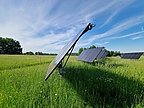
Vaja's Vertical Solar Gamble: A New Dawn for Energy in the North?
STOCKHOLM, SWEDEN – June 15, 2026
In the world of renewable energy, the sun has always played favorites. The flat, sun-drenched deserts near the equator have been the ideal home for vast solar farms, where panels track the sun across the sky on a horizontal axis, maximizing their daily dose of light. But what about the other half of the planet? For regions above 30° latitude—encompassing all of Europe, most of North America, and large parts of Asia—the economics of solar have been more challenging. The sun hangs lower, the winters are longer, and snow can blanket panels for months.
A Swedish startup, Vaja AB, has just secured €3.1 million in seed funding to challenge this geographical bias. The investment, led by The Footprint Firm with participation from node.vc, brings Vaja's total capital to €6 million. The money isn't for just another solar panel; it's for VajaTrack™, a technology that fundamentally rethinks how we capture the sun's energy in the parts of the world that need it most.
A New Axis for Solar Power
For the past decade, horizontal single-axis trackers became the global standard, transforming the economics of solar power in lower latitudes. Vaja is betting that its vertical single-axis tracker will do the same for the rest of the world. Instead of lying flat and tilting, VajaTrack™ systems stand panels up vertically, like a fence, and rotate them to follow the sun from its rise in the east to its setting in the west.
The design seems counterintuitive at first glance, but the data tells a compelling story. Vaja claims its system can deliver 25-50% higher revenue compared to traditional fixed-mount installations. The secret lies in two key advantages. First, the vertical orientation is far more effective at capturing energy during the morning and evening, when the sun is low on the horizon. This is a critical economic benefit, as electricity prices are often highest during these peak demand hours. Second, when paired with bifacial panels—which capture light on both sides—the system can harvest reflected light from the ground, especially when it's covered in snow, which acts like a giant reflector.
This approach aligns with recent findings from industry bodies like the IEA's Photovoltaic Power Systems Programme (IEA-PVPS). A March 2026 report noted that bifacial vertical arrays are a key innovation driving the rapid expansion of solar power in Arctic regions, where installed capacity has been growing by over 45% annually in some areas. The vertical design also naturally sheds snow, a major cause of production loss for conventional panels in colder climates, and minimizes the impact on the land, making it ideal for agricultural settings—a practice known as agri-PV.
Following the Smart Money North
The €3.1 million investment isn't just a vote of confidence in a piece of hardware; it's a strategic bet on a massive, underserved market. The global solar tracker market is dominated by giants like Nextpower and Gamechange Energy, whose products are optimized for the sunny belt. Vaja is carving out a niche where these conventional solutions underperform.
Jakob Wichmann, Co-founder and Partner at lead investor The Footprint Firm, sees this clearly. "Solar is fundamental to a credible energy transition, and the companies that will define the next decade are the ones solving the parts that are still genuinely hard," he said in a statement. "VajaTrack solar tracking technology unlocks substantially higher energy where conventional solutions have historically underperformed."
Investors are looking at the numbers. The European tracker market alone saw record shipments of 25 GWdc in 2025. With the EU aiming to get 42.5% of its energy from renewables by 2030, much of that new capacity will have to be built in the very northern latitudes Vaja is targeting. By solving the unique engineering challenges of these regions—from low sun angles to harsh weather—Vaja is positioning itself as an essential enabler of Europe’s energy goals.
The Geopolitical Power Play
This story is bigger than just a clever piece of engineering. In the wake of recent geopolitical instability, energy security has become a top priority for Europe. The continent's REPowerEU plan is a multi-hundred-billion-euro strategy to wean itself off imported fossil fuels by 2027. Achieving this requires a massive and rapid expansion of domestic renewable energy production.
This is where Vaja's technology moves from a business-to-business product to a tool of geopolitical significance. By making solar power more economically competitive and productive in places like Sweden, Germany, and Poland, VajaTrack™ can directly accelerate the transition away from imported energy. Each percentage point of increased efficiency from a technology like Vaja's reduces the continent's reliance on volatile global energy markets and strengthens its energy independence.
"Over the next decade, we believe that vertical solar tracking can emerge as the dominant form of solar installation beyond 30° latitude," said Vaja's CEO, Henrik Eskilsson. If he's right, the technology could become a cornerstone of Europe's new energy infrastructure.
A Tale of Two Entrepreneurs
Behind this ambitious vision is a founding team that combines deep-tech prowess with hard-won market experience. CEO Henrik Eskilsson is a serial entrepreneur who previously co-founded and ran Tobii, a global leader in eye-tracking technology, for two decades. His background is in taking a complex, sensor-based technology from a niche application to a global standard—an experience that maps directly onto Vaja's mission.
He is paired with co-founder Anders Olsson, the founder of the solar installation company Soldags. While Eskilsson brings the high-tech scaling playbook, Olsson brings the ground-level reality of the solar market. Soldags was a fast-growing installer that was acquired in 2019 but ultimately declared bankruptcy in early 2026 amidst market challenges. That experience, while difficult, provides an invaluable understanding of the real-world complexities of solar deployment, customer acquisition, and profitability—lessons that are now being baked into Vaja's strategy.
This combination of a visionary technologist and a seasoned operator who has navigated both the booms and busts of the solar industry is what gives investors like Wichmann confidence. With strong demand already materializing, Vaja is now opening additional installation slots for 2026, a sign that its vertical gamble may be starting to pay off.