
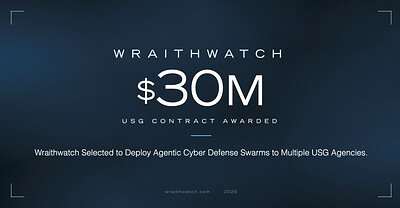
- $30.5M Contract: The U.S. Department of Homeland Security awarded Wraithwatch a $30.5 million contract for its AI defense platform.
- 2023 Founded: Wraithwatch was established in 2023 by veterans from elite special operations and tech firms.
- AI Swarming: The platform uses AI agents that 'swarm' to hunt threats and simulate attacks in a digital twin of government networks.
Experts agree that AI-driven 'hyper-autonomy' is essential to counter the escalating threat of automated cyberattacks, emphasizing the need for rapid deployment of defensive AI systems to match offensive capabilities.
US Taps AI Vets for $30M Cyber 'Hyper-Autonomy' Push
AUSTIN, TX – February 20, 2026 – The U.S. government is betting $30 million on a new generation of artificial intelligence to defend its most critical digital assets. Wraithwatch, a cybersecurity startup founded by veterans of America’s most elite special operations and technology firms, has been awarded a major federal contract to deploy its autonomous AI defense platform across multiple government agencies.
The contract, a one-year delivery order valued at $30.5 million and awarded by the Department of Homeland Security's Office of the Chief Information Officer, signals a significant federal investment in a defensive strategy known as 'hyper-autonomy.' This approach aims to counter the rapidly growing threat of AI-augmented cyberattacks with defensive systems that can operate at machine speed, without direct human intervention.
Founded in 2023, the Austin-based company brings together a team with formidable pedigrees from Joint Special Operations Command (JSOC), SpaceX, Palantir, and Anduril. Their mission is to create a defensive counterpressure to what they see as an impending tidal wave of automated offensive cyber capabilities.
The New AI Arms Race
The core of the challenge, as articulated by experts and government officials, is that the same AI breakthroughs powering advancements in medicine and logistics can also be weaponized. Malicious actors are increasingly leveraging AI to discover vulnerabilities, craft sophisticated phishing campaigns, and automate attacks at a scale and speed that is impossible for human-led security teams to manage.
"Recent developments in frontier AI, allowing for capabilities like recursive self-improvement, swarming, and exploit discovery, mean that the capacity for offensive attack automation is going vertical with no corresponding defensive counterpressure," said Nik Seetharaman, Founder and CEO of Wraithwatch, in a statement. "Wraithwatch is that counterpressure."
Seetharaman's warning reflects a growing consensus in the national security community. "Frontier AI labs, independent researchers, and DARPA itself are all arriving at the same conclusion," he noted. "We need to rapidly field capabilities involving hyper-autonomy for defense to counter the coming hyper-autonomy of offense."
Wraithwatch's platform is designed to do just that. It employs AI agents that work together, or 'swarm,' to hunt for threats across an organization's network. The system creates a continuously updated 'digital twin'—a perfect virtual replica of a government agency's IT environment. Within this digital twin, the AI can run countless attack simulations, identifying potential weaknesses and attack paths without ever touching the live production systems. When a credible threat is identified, the platform can compute and deploy defensive measures in real time, neutralizing threats before they can be exploited by adversaries.
From Elite Operators to Tech Founders
Wraithwatch’s rapid ascent from a fledgling startup to a key federal contractor is largely attributed to the unique and deep-seated experience of its founding team. The company secured an $8 million seed funding round in late 2023 from prominent investors including Founders Fund and XYZ Capital, but its true currency is the operational expertise embedded in its DNA.
CEO Nik Seetharaman previously served as the Chief Information Officer at Anduril Industries, another defense-tech unicorn, where he was responsible for securing the company's own systems and its advanced weapons platforms. His career also includes leading cybersecurity operations at SpaceX and managing international cyber defense programs for Palantir Technologies. Before entering the private sector, Seetharaman was an Advance Force Operator at JSOC, conducting high-stakes cyber warfare and reconnaissance missions.
This blend of experience is mirrored across the founding team. Co-founder and President Grace Clemente spent six years at SpaceX, where she developed the insider threat programs for both SpaceX and Anduril. CTO and Co-founder Carlos Más was a Principal Security Engineer at SpaceX. Their collective resume, which also includes stints at Google and Morgan Stanley, is a testament to a career spent defending some of the world's most sensitive assets, from rockets and satellites to critical national security infrastructure.
Securing America's Digital Frontier
The $30 million contract is not an isolated event but a key component of a broader, government-wide strategy to harness AI for national security. The President's AI Action Plan and CISA's Roadmap for AI both emphasize the urgent need to integrate advanced artificial intelligence into the nation's cybersecurity framework to protect critical infrastructure from state-sponsored attacks and other advanced threats.
The federal market for AI-driven cybersecurity is becoming intensely competitive. Wraithwatch enters a field with established players like Darktrace Federal, which has already achieved a FedRAMP High Authority to Operate, allowing it to provide its own self-learning AI defense platform to government clients handling sensitive data. This competition underscores the high demand for solutions that can automate threat detection and response.
However, the government's path to AI adoption is not without its challenges. A May 2025 Government Accountability Office (GAO) report found that while most civilian agencies are exploring AI, few have fully implemented the necessary risk management practices. The GAO has repeatedly highlighted agency struggles with insufficient budgets, a lack of technical resources, and outdated policies for governing a technology that evolves at a blistering pace.
Proponents of hyper-autonomy argue that these systems are essential for augmenting overburdened human security teams, not replacing them. By automating the repetitive and time-consuming tasks of threat hunting and alert correlation, AI allows human experts to focus on higher-level strategy, threat intelligence analysis, and managing the AI systems themselves. As the digital battlefield becomes faster and more complex, the partnership between human strategists and their autonomous AI guardians will be critical in defending the nation's digital frontier.