
- 42% AI adoption rate among Brazilian industrial firms in 2024, up from 17% in 2022
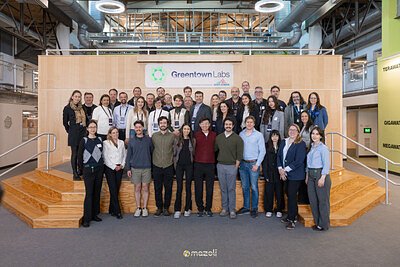
- 26 Brazilian industrial leaders visited Greentown Labs to explore 'self-driving factories'
- 6 continents where Laminar's physical AI platform is deployed, including clients like AB InBev, Coca-Cola, and Unilever
Experts agree that the integration of US physical AI technology with Brazil's industrial modernization efforts represents a transformative shift in global manufacturing, offering significant gains in efficiency, sustainability, and competitiveness.
US Physical AI Woos Brazil's Industrial Leaders for Factory of the Future
BOSTON, MA – May 07, 2026 – A quiet revolution in manufacturing is taking shape inside Greentown Labs, North America's largest climatetech incubator. Here, Boston-based startup Laminar recently hosted 26 industrial leaders from Brazil, offering a glimpse into a future where factories operate themselves. The visit, far from a simple technology showcase, signals a pivotal moment in global industry: the fusion of American AI innovation with the ambitious modernization goals of one of South America's largest economies.
The delegation, organized by the Federation of Industries of the State of Paraná (FIEP), represented a cross-section of Brazilian industry, from food and beverage to cosmetics and construction. Their mission: to understand the practical realities of building an AI-first company and witness the technology that promises to create "self-driving factories."
The Dawn of the Self-Driving Factory
The term "self-driving factory" evokes images of a distant, fully robotic future, but for Laminar, it's a present-day reality built on the concept of "physical AI." This isn't the AI of chatbots or data centers; it's intelligence embedded directly into the manufacturing process. Physical AI uses advanced sensors and machine learning to perceive, interpret, and act upon the physical world in real-time, transforming rigid, manual processes into adaptive, autonomous operations.
"The 'We've Always Done It This Way' era is over for manufacturing," said Annie Lu, Laminar's Chief Executive Officer and Co-Founder, during the event. She emphasized that the technology is moving beyond pilot projects to deliver significant financial returns. "As physical AI solutions like Laminar unlock profound EBITDA impact, manufacturing leaders must embrace a mindset shift that starts at the C-suite and spans all the way to the factory floor."
This shift moves beyond traditional automation, which excels at repetitive, pre-programmed tasks. Physical AI thrives in the complex, variable environments of real-world production. It allows a system to, for example, analyze the residue inside a vat using spectral sensors and decide precisely how much water and chemicals are needed for cleaning, rather than running a fixed, often wasteful, timed cycle.
David Lu, Laminar's Chief Technology Officer and Co-Founder, framed it as a competitive necessity. "Manufacturing leaders like the FIEP delegation know that physical AI is the solution that will turn an average factory into an elite performer," he stated. "The Laminar team is accelerating adoption of physical AI in the world's largest manufacturers."
A Strategic Partnership for a New Industrial Era
The delegation's visit is strategically timed. Brazil is in the midst of a major industrial push, backed by its "Nova Indústria Brasil" (New Industry Brazil) policy launched in 2024. A key pillar of this national strategy is digital transformation, with a focus on integrating AI to boost competitiveness and reverse decades of de-industrialization. Recent data shows AI adoption among Brazilian industrial firms has surged, climbing from 17% in 2022 to nearly 42% in 2024.
FIEP, as the leading industrial voice in the major hub of Paraná, is at the forefront of this movement. Through its executive education arm, UniSenai, the organization is focused on developing leaders who can navigate this new technological landscape. "FIEP's mission is to strengthen the industry in our region and promote the socioeconomic development of Paraná," a statement from the delegation confirmed, highlighting the role of UniSenai in connecting industry with global innovation.
The visit, supported by the U.S. Department of Commerce, also underscores a broader trend of technology diplomacy, connecting American innovators with international partners to solve global challenges. For Brazil's manufacturers, this means tackling rising raw material costs, capturing institutional knowledge before it's lost to retiring workforces, and meeting urgent sustainability targets.
From Pilot to Production: Proving the Value
For any new technology to gain traction in the risk-averse world of manufacturing, it must demonstrate undeniable value. Laminar has been systematically building its case, moving from a promising startup to a recognized industry player with a roster of high-profile clients and accolades.
The company's platform is already deployed in factories across six continents, trusted by global giants like AB InBev, Coca-Cola, and Unilever. This real-world validation is further bolstered by a series of prestigious awards. In 2026, Laminar earned the Gold Edison Award for Manufacturing & Logistics. This followed AB InBev's 2024 Cheers Award for outstanding startup partnership and Unilever's 2023 Supplier Startup of the Year award.
Perhaps the most significant validation comes from its presence in World Economic Forum (WEF) Lighthouse factories. The WEF's Global Lighthouse Network is a highly selective group of manufacturing sites recognized for their leadership in adopting and integrating Fourth Industrial Revolution technologies at scale. To be deployed in one of these facilities means a technology has proven its ability to deliver step-change improvements in productivity, sustainability, and resilience. This is the gold standard for industrial innovation, confirming that Laminar's solutions are not just theoretical but are actively powering the world's most advanced production environments.
The Technology Behind the Transformation
At the heart of Laminar's platform are its patented spectral sensors and a comprehensive library of machine learning models. These sensors act as the "eyes" of the system, going beyond what human operators or simple timers can perceive. They analyze materials and processes at a molecular level, feeding vast amounts of data into AI models that have been trained on specific manufacturing tasks.
The result is a closed-loop system that can automate and optimize complex processes that were previously entirely manual. This includes applications like "Self-Driving Clean-in-Place" (CIP), which dramatically reduces the water, energy, and chemicals used to clean equipment between production runs. Other applications optimize product changeovers, reduce product loss during batch processing, and perform real-time quality control, catching deviations before they lead to waste.
By transforming these manual, often inefficient operations into self-driving processes, Laminar's technology provides a rare combination of benefits. It delivers measurable efficiency gains that directly impact a company's bottom line while simultaneously achieving significant reductions in a factory's environmental footprint. This dual impact on profitability and sustainability is what makes physical AI such a compelling proposition for the future of manufacturing, a future that, for a group of Brazilian industrialists in Boston, now seems much closer to reality.