
- 150+ American clergy rallied in Tokyo to support the Unification Church.
- 30,000+ complaints filed against the church, with damages exceeding $800 million.
Experts view the dissolution of the Unification Church as a clash between religious freedom advocacy and legal accountability for alleged financial exploitation, with no clear consensus on the appropriate balance.
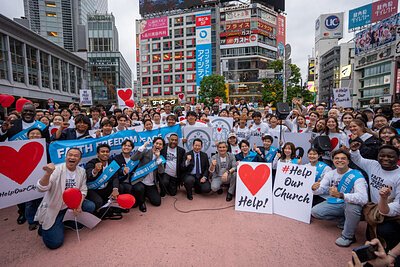
US Clergy Rally in Tokyo for Unification Church Amid Legal Firestorm
TOKYO, Japan – May 01, 2026 – In a striking display of international religious solidarity, more than 150 American Christian clergy and youth gathered in Tokyo this week, holding banners and singing hymns in a vocal defense of the Family Federation for World Peace and Unification. The delegation arrived to protest a landmark Japanese court ruling that ordered the dissolution of the organization, a move they decry as a grave threat to religious freedom. However, their visit highlights a deep chasm between international religious freedom advocacy and a domestic legal battle rooted in decades of financial controversy and public harm in Japan.
Organized by the Family Federation USA, the American contingent’s presence in Tokyo’s bustling Shibuya district was a carefully orchestrated event. It aimed to send a clear message to the Japanese government: the world is watching.
A Trans-Pacific Show of Faith
The American delegation, which included pastors from various Christian denominations, framed their mission as a spiritual, not political, endeavor. Through public forums and prayer rallies, they offered messages of hope and resilience to their Japanese counterparts, who now face the loss of their organization's legal and financial privileges.
"When persecution comes, it's always for expansion and for growth," Bishop Ron Thomas declared to a crowd of supporters. "I'm here to encourage the next generation…for the expansion and the growth…for the kingdom of God on earth."
This sentiment was echoed by other leaders who drew parallels to historic struggles for justice. Referencing the American civil rights movement, Bishop Leonard Dew stated, "Faith is seeing the staircase even when you can't take the first step…today we're here taking the first step." Another pastor, Bishop Abram Dixon, offered words of encouragement, saying, "If we would just believe that God's hand is upon Japan, you will prevail."
The central argument from the visiting clergy is that a government action to dissolve a church, regardless of the justification, infringes upon the fundamental right to believe. "You are the church anywhere," Bishop John Watts told Japanese members, emphasizing that faith transcends legal corporate status. The message was one of spiritual endurance against what they perceive as state-sponsored persecution.
Decades of Controversy and a Nation's Reckoning
While the American delegation focuses on religious liberty, the Japanese government and a vast majority of the public view the issue through a different lens—one of consumer protection and legal justice. The Tokyo High Court's recent decision to uphold the dissolution order against the Family Federation, formerly known as the Unification Church, was not based on its theology but on what the court deemed were decades of systematic and malicious fundraising practices.
Since the 1980s, the organization has been embroiled in controversy over "spiritual sales," where followers were allegedly pressured to buy expensive artifacts like vases and personal seals for exorbitant prices to absolve ancestral sins. A national network of lawyers assisting victims claims to have documented over 30,000 complaints, with financial damages exceeding 120 billion yen (approximately $800 million).
The issue exploded into the national and international consciousness in July 2022 after the assassination of former Prime Minister Shinzo Abe. The suspected assassin cited his mother's financial ruin, caused by massive donations to the church, as his motive. The tragedy unearthed deep, long-standing ties between the Family Federation and Japan’s ruling Liberal Democratic Party (LDP), sparking a political firestorm and a precipitous drop in public support for the government.
In response to immense public pressure, Prime Minister Fumio Kishida's administration launched a formal investigation, culminating in the request for the dissolution order. The government has consistently argued that its actions are a legitimate response to widespread civil law violations and are necessary to protect the public welfare, not an attack on religious belief.
A Clash of Interpretations
The arrival of the American clergy crystallizes the core conflict: Is the dissolution of the Family Federation a case of religious persecution or a lawful act of state regulation? Supporters of the church, including some UN human rights experts, have warned that the move could violate international covenants on religious freedom and set a dangerous precedent for state interference with minority faiths.
They argue that dissolving a religious corporation is an extreme measure, one that strips the organization of its tax-exempt status and allows for the liquidation of its assets to compensate victims, effectively crippling its ability to operate. The Family Federation has stated it implemented compliance reforms in 2009, but the courts found these measures insufficient to stop the ongoing harm.
Conversely, Japanese legal experts and victim support groups maintain that the organization's status as a religious corporation has been used as a shield to deflect scrutiny and accountability for decades of alleged exploitation. For them, the court's decision is a long-overdue step toward justice for thousands of families who have suffered financial and emotional devastation.
The American delegation's presence adds a complex geopolitical layer to this domestic struggle. While they champion a universal principle of religious freedom, their intervention is viewed by many in Japan as an external attempt to interfere in a justified legal process rooted in a specific and painful national history. As the Family Federation pursues a final appeal to Japan's Supreme Court, the standoff between the global language of faith-based rights and the local demand for legal and financial accountability continues to intensify.