
- 125,000 stars on GitHub for YOLO models
- 225 million Python package downloads
- 50 million images uploaded and 150 million annotations created on the Ultralytics Platform
Experts would likely conclude that Ultralytics' end-to-end platform addresses critical bottlenecks in computer vision development, offering a native advantage for YOLO model users and accelerating the transition from prototype to production.
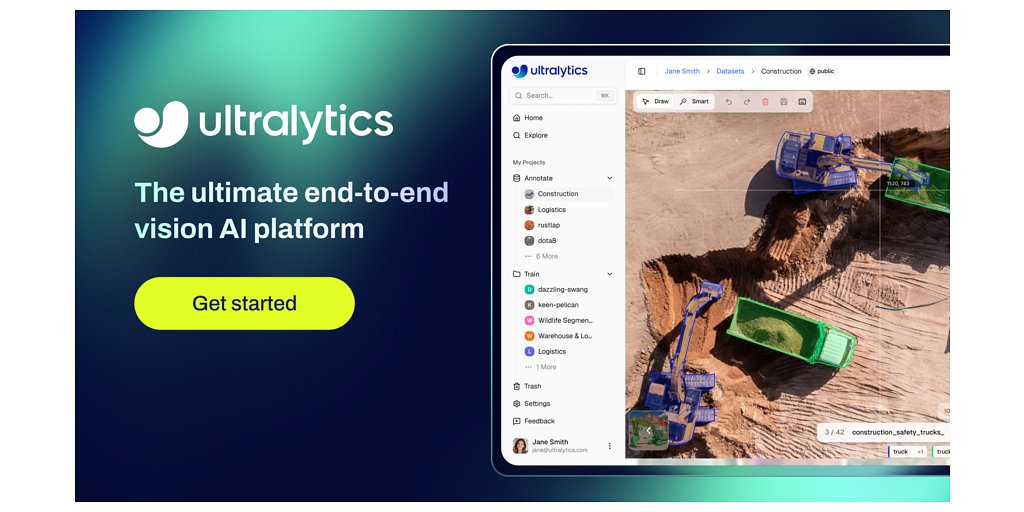
Ultralytics Unifies Vision AI with End-to-End Platform
LONDON, UK – March 18, 2026 – Ultralytics, the company behind the ubiquitous YOLO family of object detection models, has officially entered the end-to-end platform race with the launch of the Ultralytics Platform. The new offering aims to consolidate the often chaotic and fragmented workflow of computer vision development—from data annotation to production deployment—into a single, cohesive environment. The move signals a major strategic evolution for a company that built its reputation on powerful open-source models.
The platform addresses a persistent bottleneck in the AI industry: while models have become incredibly powerful, the process of bringing them into production remains fraught with complexity. Developers often spend weeks stitching together disparate services for labeling data, training models, tracking experiments, and managing deployments, a process that saps momentum and stalls projects.
"Most computer vision projects today never make it past the pilot stage, not because the models aren't good enough, but because the path from experiment to production is still too complex," said Glenn Jocher, Founder and CEO of Ultralytics, in a statement. "We built the Ultralytics Platform to make that path simpler. One platform, from first label to live endpoint."
From Open-Source Powerhouse to Commercial Ecosystem
For years, Ultralytics has been a foundational pillar of the computer vision community. Its YOLO (You Only Look Once) models, including the widely adopted YOLOv5 and YOLOv8, have become the de facto standard for real-time object detection. The models boast staggering adoption metrics, with a collective 125,000 stars on GitHub, over 225 million Python package downloads, and an estimated 2.5 billion daily usages across industries like manufacturing, logistics, and healthcare.
This widespread adoption gave the company a unique vantage point on the struggles of the developers using its tools. The models were ready for prime time, but the surrounding ecosystem was not. The launch of the Ultralytics Platform marks a strategic pivot to capitalize on this massive user base by offering a solution to the very problems they observed. It's a move from providing a critical component to orchestrating the entire assembly line.
The platform integrates tools that developers previously had to source and manage separately: SAM-powered smart annotation, cloud training with 22 GPU options, real-time experiment tracking, and global deployment endpoints across 43 regions. Early adoption figures provided by the company, with users having already uploaded over 50 million images and created 150 million annotations, suggest the community is receptive to this integrated approach.
The 'Native' Advantage in a Crowded Market
The market for AI development platforms is not empty. Ultralytics enters a competitive landscape populated by established players like Roboflow and V7 Labs, as well as cloud giants like Google, Amazon, and Microsoft, which offer their own comprehensive AI/ML suites. Many of these platforms already offer end-to-end workflows and advanced features, including AI-assisted annotation using technologies like the Segment Anything Model (SAM).
Ultralytics is banking on a key differentiator: its platform is built by the creators of the YOLO models, for the YOLO models. This "native" integration is the company's core value proposition. While competitors can integrate YOLO as a third-party model, Ultralytics argues that its platform is engineered from the ground up with an intimate understanding of how these models train, export, and behave in production.
This deep integration manifests in several technical advantages. For example, the platform fully supports the latest advancements in its model family, such as YOLO26, which features an end-to-end NMS-free (Non-Maximum Suppression) architecture. This innovation removes a computationally intensive post-processing step, resulting in faster and more efficient models that are simpler to deploy, especially on edge devices. The platform also leverages the new MuSGD optimizer, designed for more stable and faster training. For developers, this translates to a seamless workflow without format conversions, compatibility headaches, or the performance compromises that can arise from a more generic, one-size-fits-all platform architecture.
"We didn't set out to build another annotation tool or another training service," stated Paula Derrenger, VP of Growth at Ultralytics. “We built the platform that should have existed from the beginning. It's the only end-to-end vision AI platform native to the world's most deployed object detection models."
Accelerating the Path from Prototype to Production
The ultimate goal of the Ultralytics Platform is to drastically reduce the time and complexity involved in moving a computer vision project from an idea to a live, production-ready system. By unifying the MLOps pipeline, the platform directly targets the most common points of failure and delay.
The workflow begins with data. The platform's smart annotation tools, powered by SAM, allow teams to generate precise labels for bounding boxes, masks, and oriented boxes with a few clicks, dramatically accelerating the tedious data preparation stage. From there, datasets flow directly into the training pipeline. Users can train models in the cloud on a wide array of GPUs or on their own local hardware while streaming metrics to the platform for real-time tracking and comparison. Every experiment is automatically logged and organized, ensuring reproducibility.
Once a model is trained, the platform simplifies the notoriously complex deployment phase. It offers one-click deployment to auto-scaling endpoints across dozens of global regions. For teams needing to deploy to specific hardware, the platform supports exporting models to 17 validated formats, including ONNX, TensorRT, and CoreML, enabling native performance on cloud, mobile, and embedded systems. Built-in monitoring provides continuous insight into how the model is performing in the real world.
To ensure broad accessibility, Ultralytics has structured its pricing in tiers. A generous free plan provides signup credits and full access to core features, allowing individual developers and researchers to experiment without cost. A Pro plan unlocks higher limits and team collaboration features for a monthly fee, while a custom Enterprise plan offers a commercial license, dedicated support, and unlimited scale for large-scale organizational deployments. This tiered approach aims to cultivate adoption from the grassroots developer community all the way up to large enterprises, solidifying YOLO's position not just as a model, but as a complete vision AI ecosystem.