
- 1,000x Faster: The new optical switch is 1,000 times faster than current technology.
- 99.9% Energy Reduction: The switch consumes only a thousandth of the energy of traditional switches.
- Data Center Impact: Data centers accounted for 4% of U.S. electricity in 2024, projected to triple to 12% by 2030.
Experts view this optical switch as a disruptive breakthrough that could radically transform data center efficiency, enabling faster, greener AI and high-performance computing.
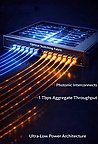
UArizona's Optical Leap: A Switch to Power Green AI and Slash Energy Use
TUCSON, AZ – May 12, 2026 – As the artificial intelligence boom accelerates, a shadow crisis is growing in its wake: the colossal energy and water consumption of the data centers that power it. These massive facilities, increasingly met with local opposition, are pushing electrical grids to their limits. Now, a breakthrough from the University of Arizona promises a radical solution—a new type of optical switch that is 1,000 times faster than current technology while consuming only a thousandth of the energy.
Developed by Post-Quantum Tek and based on foundational university research, the High-Speed Optical Switch (PQT-HOS) represents a potential paradigm shift in how data is managed. By keeping information in the form of light, it bypasses the energy-intensive conversion processes that plague modern data centers, offering a path to a more sustainable and powerful digital future.
The Energy Dilemma of the Digital Age
The insatiable demand for data, driven by cloud computing and generative AI, has turned data centers into one of the fastest-growing consumers of global electricity. According to industry analysis, data centers accounted for approximately 4% of total U.S. electricity consumption in 2024, a figure projected to triple to 12% by 2030. Globally, their consumption could more than double in the same period, straining energy infrastructure and environmental resources.
This immense power draw is largely due to the hardware inside. An AI-optimized server rack can demand over 40 kilowatts of power, compared to just 5-15 kW for a traditional rack. A significant portion of this energy isn't used for computation but is instead lost as heat, which then requires even more energy for massive cooling systems. These systems are also incredibly thirsty, with a single large data center capable of consuming as much water as a small city. This environmental footprint has led to heated community debates and outright opposition to new "Data Farm" projects across the country.
At the heart of this inefficiency lies the data switch. For decades, the industry standard has been an Optical-to-Electrical-to-Optical (OEO) conversion. Data arrives as light through fiber optic cables, is converted into electrical signals for routing by a switch, and then converted back into light to continue its journey. Each conversion step consumes power, generates heat, and creates a speed bottleneck.
A Paradigm Shift in Switching: From Electrons to Pure Light
The PQT-HOS, born from the work of Dr. Pierre-Alexandre Blanche, a Research Professor at the University of Arizona's renowned College of Optical Sciences, sidesteps this entire inefficient process. The technology employs an all-optical, or 'Optical-Optical-Optical' (OOO), architecture. It uses advanced light diffraction technology—akin to a dynamic, high-speed hologram—to redirect light beams directly, without ever converting them into electrical signals.
"Solving the energy crisis in data centers is central to my mission," said Dr. Blanche. "The diffractive (holographic) optical switch sits at the core of a more sustainable path for cloud computing and AI infrastructure."
By eliminating the OEO conversion, the PQT-HOS achieves its remarkable efficiency. With no energy-wasting conversions, heat generation plummets, drastically reducing the need for power-hungry cooling systems. This OOO approach is also protocol-agnostic, meaning it can handle data at any speed or format, making it inherently future-proof as data transmission rates continue to climb.
Validated Breakthrough Ready for a Commercial Leap
This technology is not a distant theoretical concept. The PQT-HOS is a fully patented, bench-proven innovation that has undergone extensive validation. Its performance has been peer-reviewed in a publication from the Institute of Electrical and Electronics Engineers (IEEE) and independently verified by industry giants including Microsoft Labs, the University of California, Berkeley's Computer Science Department, and Texas Instruments. The underlying research has been cited in numerous international patents, underscoring its foundational importance.
Industry experts have already taken note of its disruptive potential. "Post-Quantum Tek's digital switch has the potential to radically change the scope of data centers by switching from an electronic base to a new light layered MEMS switch that represents a major technology breakthrough," commented Hassan Tanbakuchi, a Senior Engineer at Agilent. Salah Uddin, Partner and Co-Founder of Nanoshift LLC, added that such technology "could make for notable enhancements across other industries."
To bridge the gap from lab to market, Post-Quantum Tek is collaborating with the University of Arizona's Tech Launch Arizona, an institute dedicated to commercializing university research. The next step is to develop a commercial-grade prototype, moving the technology from a proven concept to a product ready for the demanding environment of a live data center.
Unleashing the Future of High-Performance Computing
While the 99.9% energy reduction is a groundbreaking environmental and economic proposition, the 1,000-fold increase in switching speed is equally transformative. This dramatic performance leap could unlock new frontiers in AI and scientific research. Faster switching means less latency, allowing for more complex AI models to be trained more quickly and enabling real-time data analytics on a scale previously unimaginable.
The timing is critical. The data center switch market is projected to grow to over $26 billion by 2035, and the industry is facing projected supply shortfalls of high-speed optical components needed to keep pace with AI's growth. A technology like the PQT-HOS, which not only meets but vastly exceeds current performance metrics while solving the core energy problem, is positioned to fill a crucial gap.
By fundamentally re-architecting how data flows, this innovation from the University of Arizona could do more than just make data centers greener. It could provide the foundational speed and efficiency required to power the next generation of artificial intelligence, scientific discovery, and global communication, ensuring the digital revolution can continue its rapid expansion in a sustainable and responsible manner.