
- 68% reduction in workplace injuries claimed by TuMeke's platform, supported by a Fortune 500 case study. - 91% injury reduction reported by pool manufacturer Latham Pools after implementation. - Fully automated assessments and movement analysis beyond posture introduced as industry-first advancements.
Experts agree that AI-powered ergonomic assessments like TuMeke's Risk Suite offer significant efficiency and accuracy improvements in workplace safety, but emphasize the need for ethical deployment to balance safety benefits with employee privacy and trust.
TuMeke's New AI Aims to Fully Automate Workplace Safety Assessments
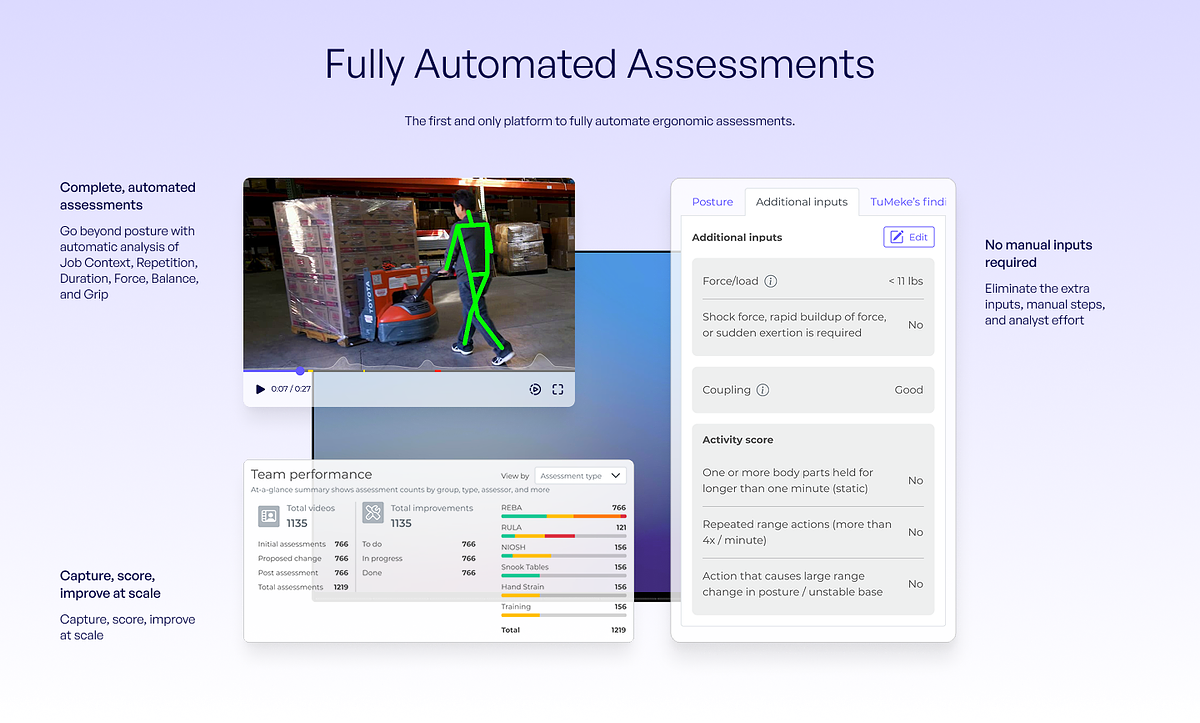
SAN FRANCISCO, CA – April 16, 2026 – TuMeke, a company at the forefront of applying artificial intelligence to workplace safety, today announced the launch of its next-generation Risk Suite platform. The update introduces what the company calls two industry-first advancements—Fully Automated Assessments and Movement Analysis Beyond Posture—designed to fundamentally change how businesses identify and mitigate the risk of employee injury.
By using standard video and computer vision, the platform promises to deliver a faster, more comprehensive, and less labor-intensive approach to ergonomics, a field dedicated to designing safer and more efficient work environments. The announcement signals a major push to move beyond the subjective, time-consuming methods that have long characterized ergonomic assessments and toward a future driven by objective, AI-powered data.
A New Era of Automated Assessment
The centerpiece of TuMeke's announcement is the concept of a fully automated assessment. Historically, ergonomists and safety professionals have spent countless hours manually observing tasks, taking measurements, and inputting data into complex scoring systems like REBA (Rapid Entire Body Assessment) or RULA (Rapid Upper Limb Assessment). This process is not only slow but also prone to human error and subjective interpretation.
TuMeke's Risk Suite aims to eliminate these manual steps entirely. The system analyzes video footage of a worker performing a task and automatically identifies joint movements, calculates angles, and scores the ergonomic risk without human intervention. This shift promises to dramatically accelerate the assessment process, allowing safety teams to evaluate more jobs in less time and focus their efforts on implementing solutions rather than on data collection.
"Ergonomic risk is about more than posture alone, and assessments should not depend on manual inputs that are subjective and slow teams down," said Diwakar Ganesan, Co-Founder and CTO at TuMeke Ergonomics, in the company's press release. "We're introducing a new era in AI Ergonomics by combining fully automated assessments with movement analysis beyond posture, helping teams assess risk more completely and with far less manual effort."
While other companies in the industrial safety space, such as VelocityEHS and Intenseye, also leverage AI and computer vision to streamline ergonomic analysis, TuMeke's claim to be the first and only platform to fully automate the process is its core differentiator. If validated, it represents a significant leap in efficiency for a critical but often under-resourced corporate function.
Seeing Beyond Posture
The second major advancement is the platform's ability to analyze movement beyond simple static posture. Musculoskeletal disorders (MSDs), which include conditions like carpal tunnel syndrome and back injuries, are often caused by a combination of factors. A single awkward posture might not be high-risk, but when combined with high repetition, sustained duration, or significant force, the risk of injury skyrockets.
TuMeke's enhanced Movement Analysis expands its analytical capabilities to include these crucial variables: Repetition, Duration, Job Context, Grip, Force, and even Balance. By creating a multi-faceted risk profile for each task, the platform provides a more holistic and accurate picture of what is actually driving injury risk. This comprehensive approach moves the industry beyond a narrow focus on joint angles and toward a dynamic understanding of how work is performed in the real world.
This expanded analysis allows companies to pinpoint not just that a task is risky, but why it is risky. For example, the AI might determine that the primary risk factor for a warehouse worker is not lifting with a bent back, but the high frequency of lifts combined with a poor grip on the boxes. This level of detail enables more targeted and effective interventions, such as changing the workflow to reduce repetition or providing boxes with better handles.
The Proof is in the Prevention
For businesses, the ultimate measure of any safety technology is its ability to reduce injuries and their associated costs. TuMeke's press release boldly claims its platform can lead to a reduction in workplace injuries by up to 68%. This figure is supported by a case study from a Fortune 500 distribution center, which reportedly saw a 68% drop in MSD-related injuries after implementing the platform.
This is not an isolated success story. The company's website features numerous case studies with compelling results: a global automotive manufacturer achieved a 40% lower MSD rate than the industry average, technology integrator World Wide Technology saw a 57% reduction in MSD risk, and pool manufacturer Latham Pools reported a staggering 91% reduction in injuries.
These figures align with broader academic research, which indicates that AI-driven ergonomic interventions are effective at preventing work-related injuries. Studies have shown that replacing subjective, manual assessments with objective, AI-powered analysis leads to more consistent and accurate risk identification, enabling proactive measures that prevent injuries before they occur. For companies, this translates not only to a safer workforce but also to significant savings in workers' compensation, lost productivity, and insurance premiums.
The Double-Edged Sword of AI Monitoring
Despite the clear safety benefits, the rise of powerful AI monitoring tools in the workplace is not without controversy. The same computer vision technology that identifies risky postures can also be perceived as a form of constant employee surveillance, raising significant ethical and privacy concerns. The idea that every movement is being recorded and analyzed by an algorithm can erode trust and create a culture of anxiety.
Privacy advocates and labor organizations worry that such data could be used for more than just safety, potentially influencing performance reviews, promotions, or even disciplinary actions. There is also the risk of algorithmic bias, where an AI system might unfairly flag certain body types or work styles, leading to discriminatory outcomes.
The legal landscape is racing to catch up. In Europe, regulations like GDPR and the new EU AI Act classify workplace monitoring systems as "high-risk," imposing strict requirements for transparency, proportionality, and human oversight. In the United States, the legal framework is a patchwork of state laws, creating a complex compliance challenge for national employers.
For its part, TuMeke has achieved SOC 2 Type II certification, an important security framework that demonstrates a commitment to protecting customer data. However, experts argue that technical security is only part of the solution. The ethical deployment of this technology hinges on corporate policy and culture. Best practices call for complete transparency with employees about what data is being collected and why, obtaining informed consent, and using the insights to improve systems and workflows, not to punish individual workers.
The successful integration of next-generation AI ergonomics will ultimately depend on a company's ability to balance the pursuit of a safer workplace with the fundamental need for employee privacy and trust. While technology like TuMeke's Risk Suite offers a powerful new tool for preventing physical harm, its implementation must be carefully managed to ensure it fosters a culture of safety without creating an environment of surveillance.