
- $30 billion: The AIOps market is projected to exceed this value by the end of the decade.
- Real-time root-cause analysis: TotalView AI promises this by analyzing complete, high-fidelity network data on-premises.
- Mean Time to Resolution (MTTR): PathSolutions claims their platform can reduce this from hours to minutes.
Experts would likely conclude that PathSolutions' on-premises AI approach challenges the cloud-first AIOps trend by prioritizing data integrity, security, and real-time performance, particularly for mission-critical networks.
PathSolutions Bets on On-Prem AI, Challenging Cloud Network Intelligence
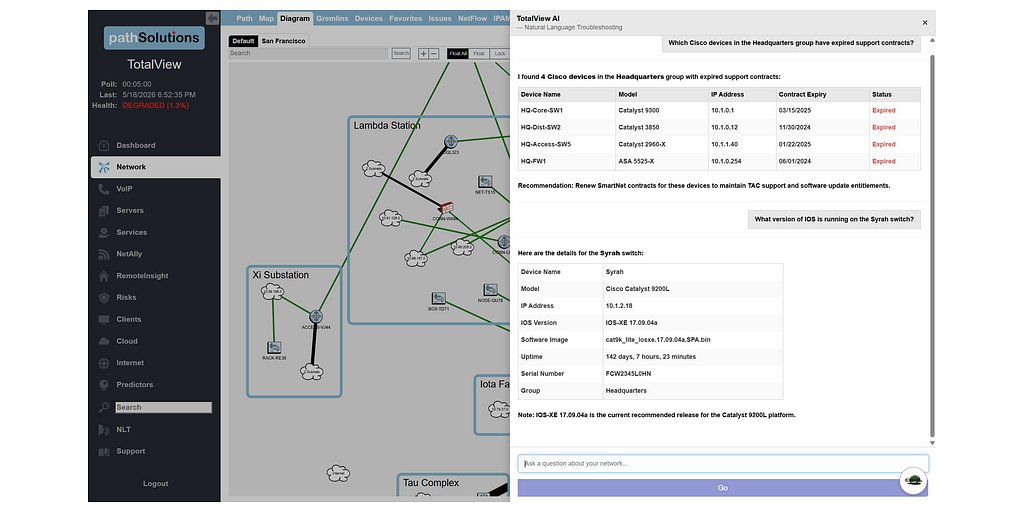
SUNNYVALE, CA – June 01, 2026 – PathSolutions today announced a bold move that pushes against the prevailing tide of cloud-centric artificial intelligence, launching TotalView AI, a network troubleshooting platform that operates entirely on-premises. The new capability, integrated into the company’s flagship TotalView platform, promises real-time, AI-driven root-cause analysis powered by what the company calls "complete, high-fidelity network data" that never leaves the customer's environment. This launch sets up a direct challenge to the dominant AIOps market, forcing a critical conversation about whether the future of network intelligence lies in the cloud or closer to home.
A Counter-Narrative to the Cloud-First AIOps Trend
The AIOps (AI for IT Operations) market, projected to exceed $30 billion by the end of the decade, has been largely defined by a cloud-first mantra. Major observability vendors have championed SaaS platforms that aggregate telemetry from hybrid environments, promising a unified view from a single pane of glass. However, this model is not without its trade-offs. Sending massive volumes of network data to the cloud can introduce latency, incur significant bandwidth and ingestion costs, and raise complex questions about data security and sovereignty.
PathSolutions is betting that these trade-offs are becoming untenable for a growing number of enterprises. TotalView AI is positioned as a "fundamentally different approach" that sidesteps these issues entirely. By keeping both data collection and AI analysis on-premises, the system eliminates transport delays and the need for data sampling, a common practice used to make cloud ingestion more manageable.
“AI is only as effective as the data behind it,” stated Tim Titus, CTO at PathSolutions, in the announcement. “With TotalView AI, we’re not sampling or filtering data to fit cloud pipelines. We’re analyzing the complete dataset locally, which allows us to deliver precise, real-time root-cause analysis.” This statement directly targets a core vulnerability of some cloud-based models: the potential for incomplete data to lead to inaccurate AI-driven conclusions.
The Data Integrity Imperative
The core of PathSolutions' argument rests on the principle of data integrity. The company contends that for an AI to be truly trustworthy in a mission-critical function like network troubleshooting, it needs access to the full story. In the context of a network, this "full story" comprises a vast and continuous stream of telemetry, including SNMP data, flow records, and granular device-level metrics from every switch, router, and firewall.
TotalView AI is designed to process this deluge of information in its raw, full-resolution form. By avoiding downsampling or filtering, the system can detect subtle or transient issues, like microbursts, that sampled data might miss. These fleeting events are often the root cause of perplexing performance problems, such as dropped VoIP calls or lagging applications, which can frustrate users and IT teams alike. The challenge in network operations, as Titus noted, "isn’t just too much data—it’s incomplete data and lack of correlation."
By analyzing the complete dataset locally, TotalView AI can correlate events across disparate parts of the network with higher fidelity. This approach aims to solve the "garbage in, garbage out" problem that can plague AI systems. When an AI model is trained or operates on an incomplete picture, its conclusions are inherently less reliable, potentially leading to false positives that waste engineers' time or, worse, false negatives that allow critical problems to go undetected.
Securing the Digital Fortress: The On-Prem Advantage
Beyond performance, the on-premises model directly addresses mounting concerns over data security and regulatory compliance. For organizations in sectors like government, defense, finance, and healthcare, the physical location of their data is not just a preference but a legal and operational mandate. Regulations such as HIPAA in healthcare, PCI DSS for financial data, and stringent government frameworks like CMMC demand strict control over data residency and access.
TotalView AI's architecture is particularly well-suited for these environments. Its ability to operate in a fully "air-gapped" deployment—completely disconnected from the public internet—is a critical differentiator that cloud-native solutions cannot offer. This makes it a viable option for highly secure facilities and defense contractors where external data transmission is strictly prohibited.
This focus on data sovereignty extends beyond regulated industries. As geopolitical tensions rise and data privacy becomes a global concern, more enterprises are re-evaluating the risks of entrusting their operational data to third-party cloud providers. Keeping sensitive network telemetry—which can reveal detailed information about infrastructure, operational patterns, and security posture—within the organization’s own boundaries provides a level of control and security that is increasingly attractive to CIOs and CISOs.
Empowering NetOps and Redefining Efficiency
The ultimate goal of any AIOps tool is to make network operations more efficient. PathSolutions claims TotalView AI can reduce Mean Time to Resolution (MTTR)—a key performance indicator for IT teams—from hours to mere minutes. By automatically correlating events and pinpointing the true source of an issue, the platform acts as a powerful guide, directing engineers straight to the problem instead of having them manually sift through logs and alerts.
This capability also serves as a force multiplier for NetOps teams. With a persistent skills gap in the IT industry, many organizations struggle to find and retain senior network engineers with deep domain expertise. Tools like TotalView AI are designed to bridge this gap by providing clear, plain-English explanations of complex problems. This empowers less-experienced engineers to diagnose and resolve issues with confidence, freeing up senior staff to focus on strategic initiatives like network architecture and digital transformation projects.
The platform's business model, which favors a one-time perpetual license over a recurring subscription, also presents a different value proposition. While requiring an initial investment in licensing and on-premises hardware, it offers predictable long-term costs and immunity from the variable data ingestion fees that can make cloud-based observability budgets difficult to manage. For organizations looking to stabilize their IT operational expenditures, this can be a compelling financial argument.
With TotalView AI slated for availability in August 2026, PathSolutions is drawing a clear line in the sand. The launch forces IT leaders to weigh the convenience and scalability of the cloud against the security, data integrity, and real-time performance of an on-premises approach. For many, the decision will depend on whether their network is simply a utility or a strategic, mission-critical asset that demands the highest level of control.