
- Expense Ratio Reduction: TSPY's underlying costs cut by 0.0645% (from SPY to VOO).
- Performance: Fund reported a 39.92% total return (April 2025–May 2026).
- Fee Comparison: TSPY's total expense ratio now 0.71%, mid-to-upper range vs. peers.
Experts would likely conclude that TSPY's rebranding and cost reduction enhance its appeal, but its complex strategy and higher fees require careful consideration for income-focused investors.
TSPY ETF Gets a Facelift: A Sharper Look at TappAlpha's Latest Moves
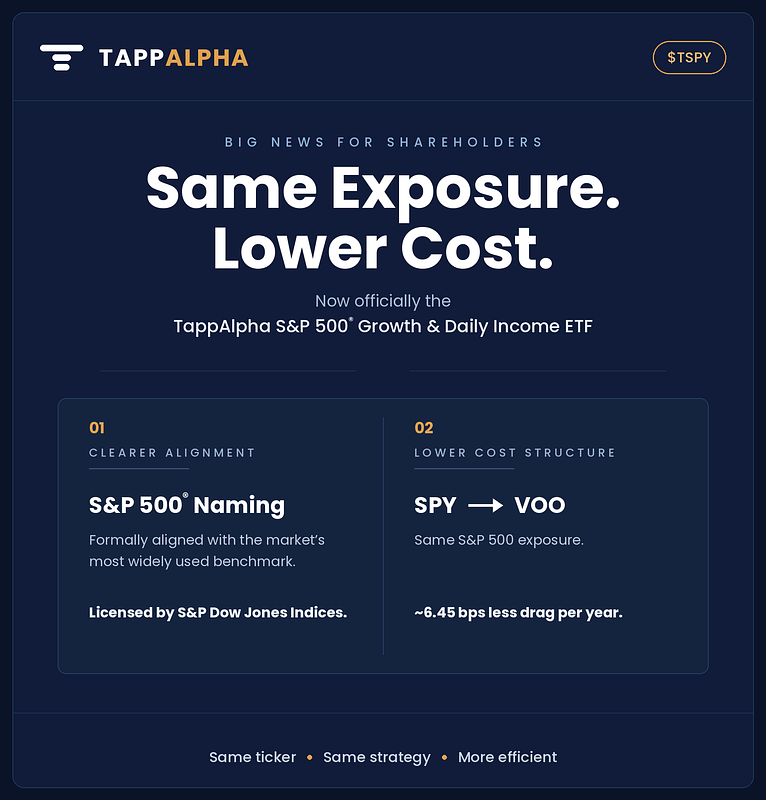
SEATTLE, WA – June 02, 2026 – In a move to sharpen its competitive edge, asset manager TappAlpha has announced two significant enhancements to its flagship Growth + Income ETF, TSPY. The fund will now officially bear the prestigious S&P 500® name through a new licensing deal and will trim its internal costs by transitioning its core holdings to a more efficient Vanguard fund.
Effective immediately, the fund is renamed the TappAlpha S&P 500 Growth and Daily Income ETF. This rebranding, according to the firm, is designed to provide investors with a clearer understanding of the fund's strategy: providing exposure to the S&P 500 while generating income through a daily options overlay. Simultaneously, the fund is shifting its underlying S&P 500 exposure from the SPDR S&P 500 ETF Trust (SPY) to the Vanguard S&P 500 ETF (VOO), a move that promises to pass modest but meaningful cost savings directly to shareholders.
“The S&P 500 is the foundation of many portfolios,” said Si Katara, Founder and CEO of TappAlpha, in the announcement. “This update brings added clarity to how TSPY is positioned — combining that core exposure with a disciplined income overlay.”
While these changes mark a clear effort to bolster TSPY’s appeal, they also invite a closer look. Beyond the new name and the shaved basis points, does the fund's complex engine offer a superior ride for investors, or just a different one?
The Power of a Name and a Price Cut
In the fiercely competitive, multi-trillion-dollar ETF market, perception and price are paramount. TappAlpha's two-pronged update tackles both directly. The licensing agreement with S&P Dow Jones Indices allows TSPY to formally embed “S&P 500®” into its name. This is more than just semantics; it's a powerful branding tool. For many retail investors and financial advisors, the S&P 500 name is a gold standard, signifying a direct, authorized link to the most recognized benchmark for U.S. equities. In a crowded field of complex income products, this official branding can act as a beacon of familiarity and trust, potentially simplifying the decision-making process for investors looking for a core holding with an income-generating twist.
The second enhancement is a tangible, albeit small, financial benefit. By switching from SPY (with an expense ratio of 0.0945%) to VOO (0.03%), TappAlpha is reducing the fund's underlying costs by 6.45 basis points, or 0.0645%. For an investor with a $100,000 position, this translates to an annual saving of $64.50. While not a windfall, it's a permanent reduction that compounds over time. “When we can deliver the same exposure more efficiently, it’s an easy decision — those benefits should flow through to our shareholders,” Katara noted.
This move aligns with an unrelenting industry trend toward fee compression, where even a few basis points can become a key differentiator. It demonstrates a shareholder-friendly posture that is crucial for attracting and retaining assets.
A Crowded Arena for Income Seekers
While the cost reduction is a net positive, it’s essential to place it in the context of the fund's total cost and its competitive landscape. After the change, TSPY's total expense ratio stands at 0.71%. When compared to its direct peers—other ETFs offering S&P 500 exposure combined with a covered call strategy—TSPY lands in the mid-to-upper end of the pricing spectrum.
For instance, the market-leading JPMorgan Equity Premium Income ETF (JEPI) charges a significantly lower 0.35%. Other prominent competitors like the NEOS S&P 500 High Income ETF (SPYI) and ProShares S&P 500 High Income ETF (ISPY) come in at 0.68% and 0.56%, respectively. On the higher end, the Roundhill S&P 500® 0DTE Covered Call Strategy ETF (XDTE) carries a 0.97% fee. Therefore, while TSPY has become more cost-efficient, it is not positioned as a low-cost leader. Its value proposition must be justified by its unique strategy and performance.
The S&P 500 branding helps it stand out, but it enters a field where competitors like SPYI and ISPY already leverage the S&P 500 in their names and strategies. TappAlpha's move is less of a revolution and more of a necessary evolution to achieve parity and compete effectively for the attention of income-focused investors.
Under the Hood: The Daily Options Engine
Beyond the branding and fees lies the core of what makes TSPY tick: its daily covered call strategy. The fund aims to generate income by selling 0DTE (zero days to expiry) call options on the S&P 500 index each day. This strategy is designed to harvest the rapid time decay, or “theta,” of these short-dated options, turning market stillness and volatility into a potential income stream for shareholders.
Since its inception in August 2024, the fund has shown promising performance, reporting a total return of 39.92% between April 2025 and May 2026, outpacing several key competitors during that specific period. This performance highlights the potential of its aggressive income-generation approach.
However, this engine comes with significant trade-offs and risks that are critical for investors to understand. The primary trade-off of any covered call strategy is capped upside. By selling call options, the fund effectively sells away a portion of its potential gains. If the S&P 500 experiences a strong rally, TSPY is designed to capture only a fraction of that growth, lagging the performance of a pure index fund like VOO. As one analyst noted, “These funds are built for income, not for maximizing long-term growth. You are explicitly trading away future appreciation for cash flow today.”
The use of 0DTE options adds another layer of complexity. These instruments are extremely sensitive to intraday price swings, and their liquidity can be challenging, meaning even slight delays in execution can materially impact results. Furthermore, the fund is not a hedge against market downturns. While the income from options can cushion small losses, the fund remains fully exposed to declines in the S&P 500. Investors seeking income should not mistake this for a low-risk or capital preservation strategy.
The enhancements announced by TappAlpha are unequivocally positive steps. The S&P 500® branding lends credibility, and the cost reduction, however modest, directly benefits the bottom line. These changes make TSPY a more polished and competitive product. Yet, they do not alter the fundamental nature of the investment itself. TSPY remains a sophisticated tool designed for a specific purpose: generating high current income from an equity allocation, with the inherent compromise of limited growth potential and exposure to market risk. For investors who understand and accept this trade-off, the newly refined TSPY may be an even more attractive option.