
- $25K PDT Rule Eliminated: After 25 years, the SEC-approved change removes the $25,000 minimum balance requirement for pattern day traders.
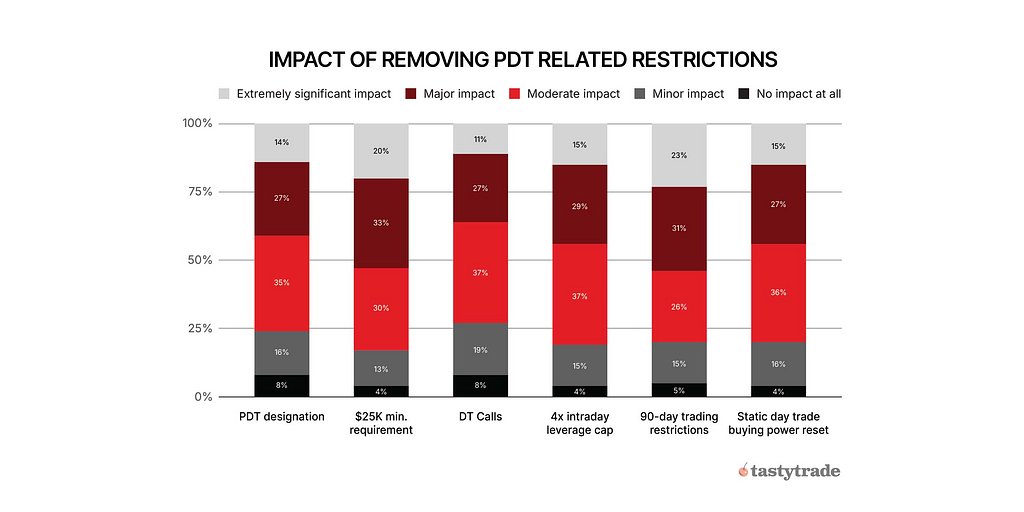
- 53% of Traders Expect Major Impact: A tastytrade survey reveals that over half of active traders believe the change will significantly alter trading habits.
- 76% Plan Strategy Adjustments: A large majority of traders intend to modify their approaches in response to the new risk-based framework.
Experts agree that while the removal of the $25K barrier democratizes trading access, it also shifts risk management responsibilities to individual traders, many of whom lack sufficient financial literacy to navigate the new framework effectively.
Trading's $25K Barrier Falls, Igniting a Race for a New Class of Trader
CHICAGO, IL – June 04, 2026 – A foundational rule that has shaped retail trading for a quarter-century is officially history. As of today, the Pattern Day Trading (PDT) rule, which mandated a minimum $25,000 account balance for anyone making more than three day trades in a five-day period, has been eliminated. The change, approved by the SEC in April, replaces a blunt financial threshold with a sophisticated, risk-based framework, fundamentally altering the landscape for active traders and igniting a strategic scramble among brokerage firms to capture this newly empowered market segment.
Online brokerage tastytrade, which has long catered to active self-directed investors, marked the occasion by highlighting survey data that reveals both high anticipation and significant apprehension among traders. While the door is now open for a new generation of investors previously sidelined by the capital requirement, the path forward is paved with both opportunity and a steep learning curve.
The End of a 25-Year Barrier
First implemented by financial regulators in 2001 in the wake of the dot-com bubble, the PDT rule was designed to act as a guardrail, protecting investors with smaller accounts from the inherent risks of frequent, leveraged trading. But in an era of real-time data and advanced risk-management technology, many in the industry have long viewed the flat $25,000 requirement as an archaic and arbitrary barrier.
Instead of a simple trade-counting system, brokerages will now operate under a modern, risk-based intraday margin framework. This requires firms to monitor an account's market exposure in relation to its equity throughout the day, a system that more accurately reflects a trader's actual risk profile. While the $2,000 minimum to open a margin account remains, the new system untethers trading frequency from account size.
Data suggests the old rule actively distorted trading strategies. A recent survey from tastytrade found that 43% of active traders admitted to modifying their behavior specifically to avoid being labeled a pattern day trader, a figure that jumps to 58% among traders aged 18 to 34. More tellingly, nearly a third of those affected by the $25,000 minimum held positions overnight that they would have preferred to close the same day, introducing a different kind of risk to avoid a regulatory one.
A New Class of Traders: Opportunity Meets Uncertainty
The removal of this barrier is expected to have a seismic impact. According to tastytrade's survey, 53% of active traders believe the change will be 'major' or 'extremely significant,' and 76% plan to alter their trading habits in response. This signifies a major strategic shift for a large portion of the retail market. However, this enthusiasm is tempered by a clear sense of caution.
Among those planning to change their strategies, only 25% feel “very confident” about trading in this new environment, while a majority—56%—say they would welcome more guidance. This confidence gap underscores the dual nature of this regulatory shift. “It democratizes access, which is a significant step forward,” noted one financial behavior analyst. “But it also transfers a greater degree of risk management responsibility directly onto the individual, many of whom are not prepared for it.”
Experts stress that while the rule is gone, the risks of day trading are not. The new framework demands a higher level of financial literacy, as traders must now understand how their intraday positions affect their real-time buying power and margin requirements. “Access without know-how isn’t opportunity, it’s risk,” said Pete Mulmat, Head of Brokerage at tastytrade. “We’ve spent many years building the platform tools and education through tasty brands to close that gap, and many traders are telling us they want exactly that.”
Brokerages Battle for the Active Trader
This new environment has set off a competitive race among brokerages. Firms are not just updating their systems to comply with the new FINRA rule; they are strategically positioning themselves to attract and retain the influx of traders now free to trade more actively. The speed and quality of implementation, coupled with the robustness of educational resources, are becoming key differentiators.
Major players like Charles Schwab and E*TRADE have announced they are moving quickly to eliminate day trade tracking and implement the new real-time margin calculations. The industry-wide pivot signals a recognition that the active, self-directed trader is a valuable and growing demographic. However, brokerages have up to 18 months to fully implement the framework, creating a varied landscape where a trader’s experience could differ significantly from one platform to another.
tastytrade has positioned itself at the forefront, implementing the new standards on day one. The firm is banking on its established ecosystem, which pairs its trading platform with its affiliate educational network, tastylive, to capture market share. “For decades the line between a retail trader and an institutional one was drawn in dollars and access,” said Michael Vaughan, CEO of IG North America, tastytrade's parent company. “This rule change removes the last artificial barrier. The next generation of traders is ambitious, digitally native, and ready to compete, and for the first time they can do it on the same footing as the pros.”
This strategic focus on education and professional-grade tools reflects a broader understanding that in the post-PDT world, the brokers who provide the most effective guidance on navigating risk—not just the lowest commissions—are likely to win the loyalty of this new class of trader. In this new landscape, the most successful traders will be those who embrace not just the freedom to trade, but the responsibility to understand the risks that come with it.