
- 436 AMRs deployed: Toyota is rolling out 436 Autonomous Mobile Robots (AMRs) across multiple Japanese plants.
- Dynamic navigation: Geekplus's AMRs use SLAM and AI for real-time mapping and obstacle avoidance.
- 30% efficiency boost: Similar deployments at Ford and BMW have shown significant productivity gains.
Experts would likely conclude that Toyota's large-scale AMR deployment is a strategic response to Japan's labor shortages and a necessary evolution of its manufacturing philosophy, balancing automation with human empowerment.
Toyota's Robotic Reinforcement: AMRs Tackle Labor and Logistics in Japan
BEIJING, CN – June 10, 2026 – Toyota Motor Corporation, a benchmark for manufacturing efficiency, is embarking on a significant automation upgrade, deploying a fleet of 436 Autonomous Mobile Robots (AMRs) from robotics leader Geekplus across multiple Japanese plants. The move signifies a critical step in the automaker's strategy to combat pressing labor shortages and supercharge its legendary in-plant logistics, revealing how advanced robotics are becoming less of a choice and more of a necessity for industrial titans.
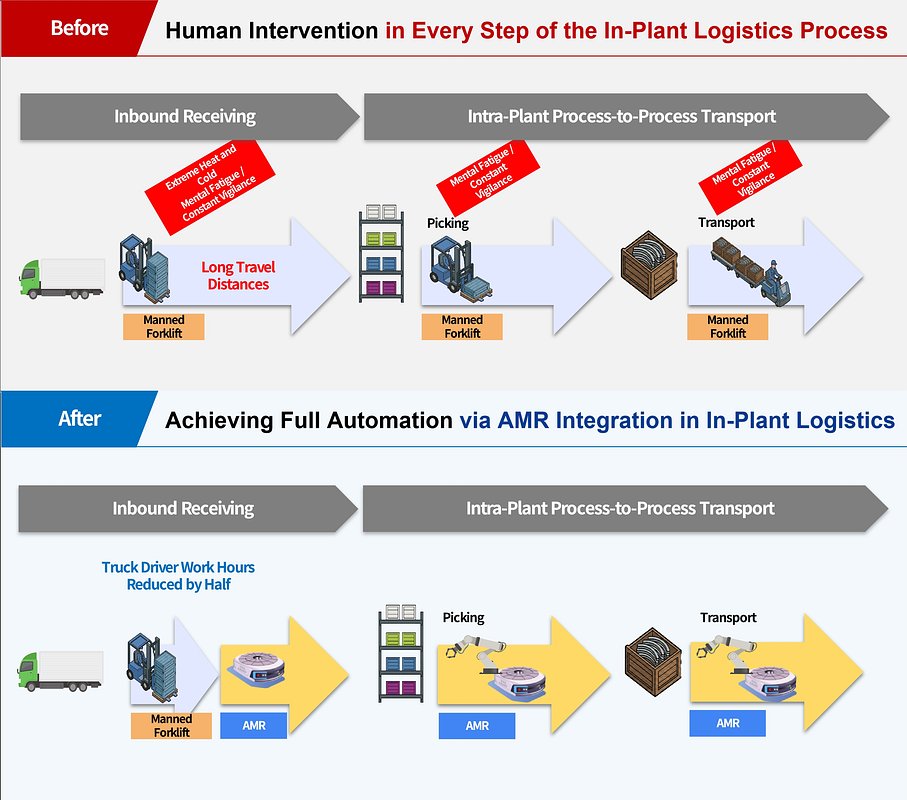
The deployment, scaled to systems of approximately 200 units, automates the movement of goods from receiving docks to processing areas. This initiative directly addresses Japan's dual pressures of a declining workforce and new labor regulations, challenges that threaten to disrupt the very foundation of its manufacturing prowess. By replacing manual transport tasks, Toyota aims not only for labor savings but for a fundamental reimagining of its factory floor.
The Strategic Pivot to Flexible Automation
For decades, the Toyota Production System (TPS) has been the gold standard in manufacturing, built on principles like "Jidoka" (automation with a human touch) and "Just-in-Time" delivery. While Toyota has used robots since the 1970s, its philosophy has traditionally favored human ingenuity, with machines assisting in repetitive tasks rather than replacing workers. This new, large-scale AMR deployment marks a strategic evolution of that philosophy, a leap into what some call "Lean 4.0."
Unlike traditional Automated Guided Vehicles (AGVs) that follow fixed magnetic strips or wires, Geekplus's "moving-type" AMRs navigate dynamically. Using a suite of technologies including SLAM (Simultaneous Localization and Mapping) and advanced AI, these robots can create and update maps of their environment in real-time, maneuvering around unexpected obstacles like forklifts or personnel. This flexibility is paramount in a modern factory where production lines must adapt to high-mix, low-volume manufacturing.
"We take great pride in knowing that our flexible system design and engineering capabilities have been recognized," said Hirokazu Kato, CEO of Geekplus Japan. "It is a privilege to see our solutions contribute to productivity improvements while creating a better working environment for the truck drivers and on-site staff who support these operations."
The benefits extend beyond mere transport. The AMRs accumulate vast amounts of travel data, providing Toyota with an unprecedented "visualization of inventory movement." This data is crucial for optimizing layouts, identifying bottlenecks, and continuously improving efficiency in line with the TPS principle of kaizen (continuous improvement). Furthermore, by reducing the chaotic intersection of human-operated vehicles, the deployment is expected to create a safer workplace.
Robots as a Remedy for a National Challenge
The Geekplus partnership is not merely a technological upgrade for Toyota; it's a strategic response to a demographic crisis. Japan's aging population and shrinking labor pool have created acute shortages in the manufacturing and logistics sectors. This deployment serves as a high-profile case study in how automation can ensure industrial competitiveness in the face of profound societal shifts.
While the introduction of hundreds of robots naturally raises questions about job displacement, the reality on the ground is more nuanced. The goal is less about replacing humans and more about augmenting their capabilities. By automating the physically strenuous and repetitive tasks of moving parts across vast factory floors, Toyota can reallocate its skilled workforce to higher-value activities that require critical thinking, problem-solving, and process oversight—tasks where humans still far outperform machines. This aligns with Toyota's long-standing "Jidoka" principle, where technology serves to empower workers and enhance quality.
Recent academic studies on the impact of robotics in Japan suggest this kind of workforce transformation is common. While some jobs are eliminated, new roles often emerge, particularly in the service and maintenance of these complex automated systems. Geekplus itself is contributing to this by providing ongoing support, operational know-how, and maintenance education to Toyota's on-site personnel, empowering them to manage and improve the robotic systems directly.
A Landmark Deployment for a Market Leader
For Geekplus, this partnership with the world's largest automaker is a powerful validation of its technology and market position. According to market research firm Interact Analysis, Geekplus has held the top global market share for AMRs for seven consecutive years. This deployment reinforces its status as a key enabler of the global shift toward intelligent, flexible logistics.
The technical prowess of Geekplus's solutions is evident in similar deployments. At the FAW Toyota South China Parts Center, the company's "PopPick" shelf-to-person system has already delivered remarkable results. It increased the automation rate for medium and fast-moving parts to 48%, improved space utilization by 40%, and boosted picking efficiency by 20%, all while maintaining a near-perfect accuracy rate of 99.99%. This system uses AI-powered algorithms and 3D storage design to quadruple storage density, a critical advantage in space-constrained industrial environments.
This level of performance sets a new benchmark in a fiercely competitive AMR market that includes industrial giants like ABB and KUKA, as well as specialized firms such as MiR and OTTO Motors, which also count automotive manufacturers among their clients. The success at Toyota will likely accelerate the adoption of similar AMR solutions across the automotive supply chain and beyond, as companies look to replicate the efficiency and resilience demonstrated.
The ROI of Robotics: Beyond the Balance Sheet
While Toyota has not released specific ROI figures for this deployment, data from other automotive leaders highlights the compelling economic case for AMRs. Ford's Kentucky plant, for example, saw a 30% boost in production efficiency after implementing AMRs for parts delivery. At BMW's South Carolina facility, a switch from AGVs to AMRs cut material transport time by 40% and delivered a return on investment in just 11 months.
The financial benefits stem from multiple sources: reduced labor costs, 24/7 operational capability, fewer workflow disruptions, and lower maintenance needs compared to traditional AGVs. Models like Robotics-as-a-Service (RaaS), which allow companies to lease robots instead of purchasing them outright, are further lowering the barrier to entry for automation.
However, the true impact transcends the balance sheet. By creating a safer, more ergonomic work environment, Toyota is investing in its most valuable asset: its people. Freeing workers from the toil of manual transport allows them to focus on quality control and process innovation, reinforcing the culture of excellence that defines the brand. This large-scale AMR deployment is more than just an efficiency play; it is a foundational piece of Toyota's vision for the factory of the future, where human talent and intelligent machines collaborate to push the boundaries of manufacturing.