
- 19 km: Length of the new Line 5 Eglinton LRT, featuring 25 stations and stops.
- 123,000 riders daily: Expected daily ridership capacity of the new line.
- $13 billion: Reported final cost of the project, exceeding the original $12 billion budget.
Experts would likely conclude that while the Eglinton Crosstown LRT represents a significant advancement in Toronto's transit infrastructure, its long delays, cost overruns, and maintenance challenges highlight the need for improved oversight and accountability in large-scale public-private transit projects.
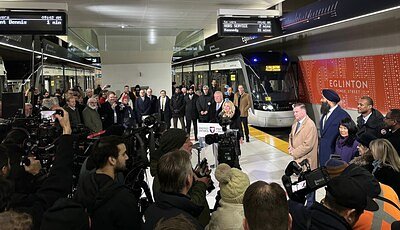
Toronto's Eglinton LRT Opens Amid Cheers & Lingering Questions
TORONTO, ON – February 09, 2026 – After more than a decade of disruptive construction, years of delays, and billions in cost overruns, the cheers that erupted at Eglinton West station on Sunday felt both cathartic and historic. Toronto's long-awaited Line 5 Eglinton, better known as the Eglinton Crosstown LRT, officially opened to the public, with the first of 76 new light rail vehicles (LRVs) gliding into service.
For the hundreds of residents and transit enthusiasts who lined up, some overnight, to be the first to ride, the moment marked the end of a painful chapter and the beginning of a new era for mid-town transit. The 19-kilometre line promises to transform one of the city’s most congested corridors. At the heart of this transformation is Alstom, the global mobility giant that not only built the trains and their advanced signalling system but will also be responsible for keeping them running.
A New Artery for a Growing City
The scale of the new line is impressive. Stretching from Mount Dennis in the west to Kennedy Station in the east, Line 5 features 25 stations and stops, much of it running underground through the city's core before emerging onto a dedicated right-of-way. It's a critical new piece of infrastructure designed to carry up to 123,000 riders daily.
The line is a nexus of connectivity, linking to three existing TTC subway stations, two GO Transit regional rail lines, and 68 separate bus routes. For the first time, commuters have a reliable, rapid east-west transit option across the top of the city, bypassing the notorious gridlock on Eglinton Avenue.
The stars of the new line are the Alstom Flexity™ light rail vehicles. These sleek, zero-emission trains can carry up to 200 passengers and feature a 100% low-floor design for full accessibility. With wide doors, air conditioning, and enhanced passenger information systems, they represent a significant upgrade in rider comfort. As Michael Keroullé, President of Alstom Americas, stated, "Alstom's vehicles and signalling continue to serve as the backbone of a crucial piece of the Greater Toronto Area's transit system."
A Long and Winding Road to Opening Day
While the mood on opening day was celebratory, the project's troubled history was an unavoidable undercurrent. Originally slated for a 2020 launch, the Eglinton Crosstown opened six years behind schedule. Its budget, last approved at nearly $12 billion, is reported to have swelled to over $13 billion, leaving a legacy of frustration among taxpayers and local business owners.
The delays stemmed from a litany of issues. Metrolinx, the provincial transit agency overseeing the project, engaged in protracted legal battles with Crosslinx Transit Solutions, the private consortium responsible for building the line. Disputes centered on everything from pandemic-related work stoppages to hundreds of quality control issues, including improperly laid track and defective concrete discovered in 2023.
The prolonged construction wreaked havoc on communities along Eglinton Avenue, with many small businesses forced to close their doors after years of lost revenue and difficult access. The project's execution under a Public-Private Partnership (P3) model has drawn sharp criticism for a perceived lack of transparency and accountability, prompting ongoing calls from transit advocates and city officials for a full public inquiry into how the project went so far off the rails.
'Made-in-Canada' Technology Takes the Stage
Despite the project's administrative woes, the launch represents a major showcase for Canadian manufacturing. The 76 Flexity LRVs and the accompanying signalling system were manufactured and tested at Alstom's facilities in Kingston, Ontario. Following its acquisition of Bombardier Transportation in 2021, Alstom became the only rolling stock manufacturer in the country, positioning itself as a national champion in urban mobility.
The company employs over 5,000 people in Canada and has become a key supplier for major transit projects from Vancouver to Montreal. The Eglinton Crosstown project underscores this deep integration into Canada's infrastructure ambitions, with the company providing not just the vehicles but also the complex digital brain that makes the system work.
This brain is a state-of-the-art Communications Based Train Control (CBTC) system, the same technology Alstom has deployed on the TTC's Line 1 subway. The CBTC system allows for more frequent and reliable service by maintaining constant communication between the trains and a central control hub, a critical feature for a line expected to operate at high capacity.
Scrutiny on Performance and Maintenance
With the line now operational, the focus shifts from construction to performance. Alstom is also responsible for the end-to-end maintenance of the entire system, a contract that puts the company's reputation for reliability directly on the line. While opening day saw enthusiastic crowds, it also saw minor mechanical problems and service disruptions, a reminder of the complexities of launching a new transit system.
Furthermore, Alstom's maintenance record in Canada has faced public scrutiny. The company is part of the consortium that maintains Ottawa's Confederation Line, an LRT system that has been plagued by significant reliability issues, particularly during harsh winter weather. Problems with train doors, wheels, and power systems have led to frequent shutdowns, creating a cautionary tale for Toronto.
Officials have stated that lessons from other projects are being applied to Line 5. However, the line is beginning with a limited schedule, running from 6 a.m. to 11 p.m., with full service hours not expected for another six months. Key upgrades to give the trains full signal priority at intersections are also not expected to be complete until May, meaning the line is not yet operating at its full potential speed. For now, after years of waiting, the trains are finally moving, and the city is watching closely to see if they can deliver on a decade-old promise.