
- National average tip percentage: 15.46% (2025 JIM Generosity Index)
- Tip fatigue prevalence: 63% of Americans harbor at least one negative view toward tipping
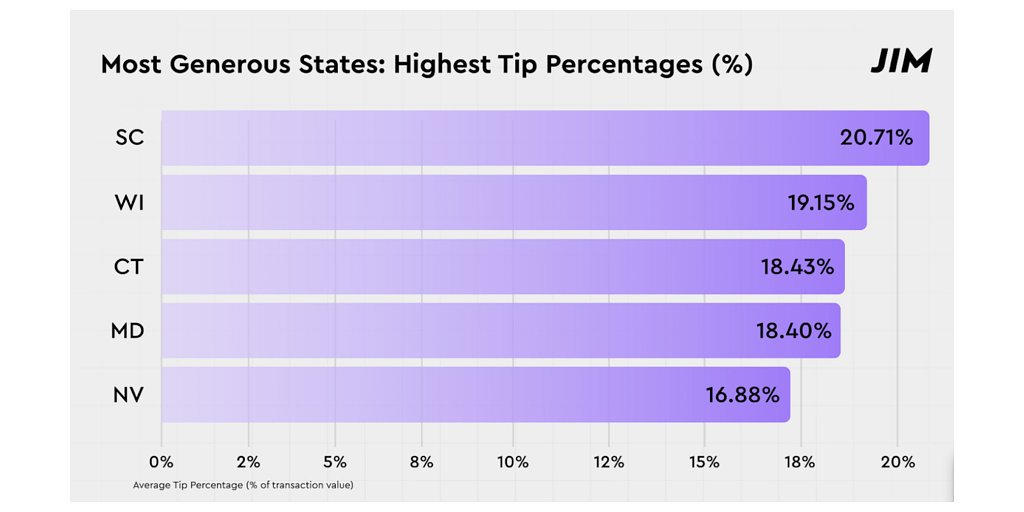
- Most generous state: South Carolina (20.71% average tip rate)
Experts agree that while tipping remains culturally ingrained, Americans are becoming more selective, driven by 'tip fatigue' and regional economic/cultural factors, with gratuities increasingly directed toward higher-value services.
Tipping Point: How 'Tip Fatigue' Is Reshaping American Generosity
SUNNYVALE, Calif. – January 22, 2026 – A growing sense of “tip fatigue” is causing Americans to become more selective with their gratuities, even as tipping expands into new sectors of the economy. A new report, the 2025 JIM Generosity Index, reveals a complex picture of modern gratitude: while consumers are annoyed by the ever-present digital tip jar, they are not abandoning the practice entirely. Instead, they are rethinking where, when, and how much they give.
The report, released by the payment app JIM.com, analyzed nearly 90,000 tipping transactions across all 50 states. It found that the national average tip percentage stands at 15.46%, a figure that aligns with the long-held cultural standard of 15% to 20%. However, this national average masks deep regional divides and a significant shift in the types of services benefiting from consumer generosity.
The Rise of 'Tip Fatigue' and Selective Generosity
The JIM.com report highlights that nearly 63% of Americans harbor at least one negative view toward tipping, a sentiment echoed by broader market research. A recent Bankrate survey found that 41% of Americans believe tipping culture is “out of control,” while a WalletHub report noted that nearly nine in ten feel it has gone too far. This frustration is largely fueled by “tip creep,” the phenomenon where digital payment screens increasingly prompt for tips in situations where gratuity was not previously expected, from auto repair shops to retail counters.
Pew Research Center data confirms this perception, with 72% of U.S. adults stating that tipping is expected in more places today than it was five years ago. The result is a more discerning consumer. While tipping frequency at traditional sit-down restaurants has stabilized, with about 70% of diners always tipping their server, consumers are pushing back elsewhere. Studies show that a majority of Americans do not tip at fast-casual restaurants or for automated services, viewing them as transactions where a gratuity is not warranted. Quality of service remains the paramount factor, with approximately 77% of adults citing it as the primary driver of their tipping decisions.
This environment of fatigue and selectivity means that the once-automatic 20% tip is no longer a given. Instead, consumers are making conscious choices, rewarding excellent, personalized service while bypassing prompts for minimal-effort transactions.
A Nation Divided: The Geography of Gratuity
Where you live significantly shapes how you tip. The Generosity Index exposes a stark geographical divide in tipping habits, with some states consistently showing higher rates of generosity than others. South Carolina emerged as the nation's leader, with an average tip rate of 20.71%, the only state to surpass the 20% threshold in the study. It was followed by Wisconsin (19.15%), Connecticut (18.43%), Maryland (18.40%), and the tourism-heavy state of Nevada (16.88%).
At the other end of the spectrum, five states fell well below the national average. Oregon ranked as the least generous with an average tip of 13.10%. It was joined at the bottom by Virginia (13.58%), New York (13.72%), Alaska (14.11%), and Illinois (14.37%).
While the specific rankings can vary between different data sets—a Toast report, for example, identified Delaware as the most generous state, while Square’s data pointed to Virginia—the consistent trend across all studies is a significant regional variation. Experts suggest this divergence is driven by a combination of economic and cultural factors. States with different minimum wage laws for tipped workers, varying costs of living, and unique cultural norms, such as the tradition of “Southern Hospitality,” all contribute to these distinct tipping patterns.
Beyond the Diner: Where Tips Are Flowing Now
Perhaps the most significant trend revealed by the data is the migration of tipping dollars away from exclusively traditional service environments. While restaurants and coffee shops remain core tipping categories, the largest tips and highest percentage rates are increasingly found elsewhere. The average tip value across all sectors was $12.44, but this figure was heavily influenced by high-dollar service interactions.
“Tipping behavior is evolving, but one thing is consistent that Americans still gravitate toward the 15% to 20% standard, regardless of industry,” said Ricardo Cici, Chief of Growth of CloudWalk, the fintech company behind JIM.com. “What is changing is where tipping shows up and what it means economically. We are seeing meaningful tip dollars flowing into higher-value services beyond restaurants, which has real implications for small operators who rely on fast, fair access to their earnings.”
The report found that relationship-driven services like barber and beauty shops command some of the highest tip percentages, averaging 17%. Meanwhile, higher-ticket categories like automotive services and specialized home repair are seeing the largest average tip amounts, often exceeding $20 per transaction. This indicates that while consumers may be fatigued by low-value tip prompts, they are willing to show significant financial appreciation for skilled labor and personalized services they value.
Empowering the Micro-Entrepreneur in a Shifting Economy
The evolving tipping landscape creates both challenges and opportunities for the smallest of businesses. For the food truck owner, mobile beautician, or solo tradesperson, unpredictable gratuity can make cash flow a constant struggle. This is where new financial technology is stepping in to level the playing field. JIM.com, the platform behind the index, is one of several players targeting what it calls “underserved micro-businesses.”
Unlike traditional point-of-sale systems that may require costly hardware, these modern solutions turn any smartphone into a payment terminal. This accessibility is crucial for entrepreneurs who operate on the go or with minimal overhead. In a competitive market that includes established giants like Square and PayPal Zettle, JIM.com aims to differentiate itself with a focus on an integrated AI business assistant and instant settlement of funds. For a micro-business, immediate access to earnings—including tips—is not a luxury but a necessity for paying suppliers, buying inventory, and covering daily expenses.
These platforms provide more than just payment processing; they offer data insights that help entrepreneurs understand sales trends, customer behavior, and tipping patterns. By simplifying operations and providing crucial financial tools, this technology empowers a new generation of small-scale entrepreneurs to navigate the complexities of a service economy where consumer habits are in constant flux.