
- 5,000 procedures: THINK Surgical's TMINI® Miniature Robotic System has been used in over 5,000 total knee arthroplasty (TKA) procedures, marking a fivefold increase in case volume in just twelve months.
- 70% market compatibility: The TMINI system is now compatible with implants that account for approximately 70% of the total U.S. knee replacement market by volume.
- 30% market share: Zimmer Biomet, a key partner, holds over 30% of the total knee replacement market in 2024.
Experts view THINK Surgical's TMINI system as a disruptive force in orthopedic robotics, driven by its open-platform flexibility, strategic partnerships, and rapid adoption, signaling a shift toward surgeon autonomy and broader market accessibility in robotic-assisted knee replacements.
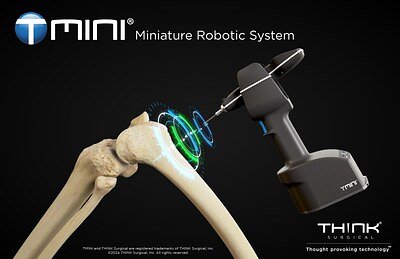
THINK Surgical's TMINI Robot Surpasses 5,000 Knee Replacements
FREMONT, CA – May 27, 2026 – In a milestone that underscores the accelerating adoption of new surgical technology, THINK Surgical, Inc. announced today that its TMINI® Miniature Robotic System has been used in over 5,000 total knee arthroplasty (TKA) procedures. The achievement marks a dramatic fivefold increase in case volume in just twelve months, positioning the company as a formidable force in the competitive orthopedic robotics market.
The 5,000th procedure was completed by Dr. John Tiberi of Cedars-Sinai Orthopedics in Los Angeles, a veteran surgeon in the field of robotic-assisted surgery. "TMINI is the most versatile knee replacement robotic system that I've seen since I started using robotics in 2013," stated Dr. Tiberi in the company's announcement. "The operating room form factor has been well received from my team and the open platform options have allowed me to seamlessly adopt modern implants for my patients' needs."
This rapid growth from 1,000 to 5,000 procedures in a single year is not accidental. It is the result of a deliberate and aggressive dual-channel commercial strategy that is beginning to pay significant dividends, challenging the established norms of the multi-billion dollar orthopedic device industry.
The Strategy Behind Explosive Growth
At the heart of THINK Surgical's recent success is a potent combination of strategic partnerships and expanded technological capabilities. Stuart Simpson, President and Chief Executive Officer of THINK Surgical, attributed the momentum to two key factors: "The addition of new implant modules on our open-platform TMINI and acceleration in the exclusive distribution partnership with Zimmer Biomet are both driving this growth."
The exclusive distribution partnership with Zimmer Biomet, a titan in the orthopedic space holding over 30% of the total knee replacement market in 2024, has been particularly impactful. This collaboration provides THINK Surgical, a privately held innovator, with access to Zimmer Biomet's vast and experienced sales force, extensive distribution network, and deep-rooted hospital relationships. For hospitals and surgeons, the partnership presents a compelling package: the combination of THINK's TMINI robot with Zimmer Biomet’s industry-leading Persona® Knee System.
This alliance allows Zimmer Biomet to offer an alternative, highly flexible robotic system alongside its own ROSA® Robotic Surgical Assistant, broadening its portfolio to appeal to a wider range of surgical preferences. It effectively gives the market leader a powerful tool to compete against other major players while giving THINK Surgical a critical channel for rapid market penetration and validation.
An Open Platform Revolution
Beyond its strategic partnerships, the TMINI system’s core design philosophy is its most significant differentiator: its open platform. Unlike many competing robotic systems that operate in a closed ecosystem, requiring surgeons to use the manufacturer's proprietary implants, TMINI is implant-agnostic. This 'open' architecture provides surgeons with the freedom to choose the best implant for their patient from a library of compatible options.
This approach directly addresses a long-standing point of friction for many surgeons and hospital administrators who have been hesitant to adopt robotics due to restrictive implant contracts. By decoupling the robot from the implant, THINK Surgical empowers surgeons with autonomy and allows hospitals to maintain flexibility in their supply chains and potentially leverage better pricing on high-volume implants.
This strategy was bolstered significantly in February 2026 with the announcement of compatibility with the Stryker® Triathlon® Knee System. Stryker and Zimmer Biomet are two of the largest players in the global knee implant market. With this addition, THINK Surgical claims its TMINI system is now compatible with implants that account for approximately 70% of the total U.S. knee replacement market by volume. This broad compatibility makes the TMINI a highly attractive and versatile investment for healthcare facilities looking to build a robotics program that serves a diverse group of surgeons with varying implant preferences.
Redefining the Robotic Operating Room
While the business strategy is compelling, the TMINI system’s physical design offers a different set of advantages inside the operating room. The 'miniature' in its name is a key feature. The system consists of a wireless, handheld robotic cutting tool that is significantly smaller and less obtrusive than the large, floor-standing robotic arms that characterize many first-generation systems.
This compact, minimalist design helps streamline operating room workflow, requiring less space and causing less disruption. The system utilizes a CT-based 3D surgical plan, which surgeons can use to meticulously map out the procedure beforehand. During surgery, the TMINI PRO™ Workflow provides real-time data and feedback, allowing for dynamic adjustments to optimize implant positioning and ensure stability. The robotic handpiece is designed to execute these plans with sub-millimeter and sub-degree accuracy, automatically compensating for hand movement to ensure the pre-operative plan is carried out with exceptional precision.
As the field of orthopedic robotics matures, THINK Surgical's rapid ascent with its TMINI system illustrates a clear market appetite for flexibility, efficiency, and surgeon choice. While established players like Stryker with its Mako system and Smith & Nephew with its CORI system continue to dominate, THINK's open-platform model presents a disruptive challenge. The system's recent FDA 510(k) clearance in May 2023 means that extensive, independent long-term clinical outcome data is still forthcoming, a crucial step for any new medical technology. However, its focus on delivering surgical precision, combined with a business model that empowers rather than restricts, has clearly struck a chord in the orthopedic community, suggesting this milestone is not just a number, but a sign of a larger shift in the future of robotic surgery.