
- 15 minutes: Time to deploy a robot for a new task using GRIIP, compared to months with traditional methods.
- 2 days: Time to set up a complete, production-ready robotic cell.
- 5 parts per minute: GRIIP-powered cell's sustained throughput with sub-millimeter accuracy.
Experts view GRIIP as a groundbreaking advancement in industrial automation, enabling rapid, flexible robotics deployment without extensive training or programming, potentially democratizing AI-driven manufacturing.
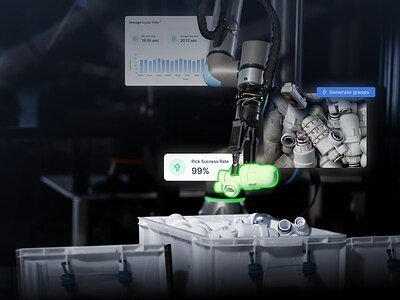
The Zero-Shot Factory: Vention's GRIIP Rewrites Automation Rules
MONTREAL, QC – February 10, 2026 – Industrial automation firm Vention today unveiled a technology that could fundamentally alter the economics and speed of deploying robotics in manufacturing. The company announced the launch of GRIIP (Generalized Robotic Industrial Intelligence Pipeline), an end-to-end physical AI system designed to allow robots to perform complex tasks in unstructured environments with virtually no setup or training.
This move signals a significant shift away from the traditional model of industrial robotics, which often requires weeks of task-specific programming and vast datasets to train a machine for a single function. Vention claims GRIIP enables 'Zero-Shot Automation,' a paradigm where a robot can be deployed for a new task, such as picking parts from a bin, in minutes instead of months.
A New Era of 'Physical AI'
At the heart of GRIIP is a unified pipeline that handles everything from perception to motion. It integrates Vention's proprietary models with powerful foundation models from industry leader NVIDIA, including NVIDIA Isaac FoundationStereo for depth perception and FoundationPose for estimating an object's precise position and orientation in 3D space. Running on Vention's MachineMotion AI controller, which is powered by an NVIDIA Jetson module, the system processes all the necessary data at the edge, right on the factory floor.
What makes this approach revolutionary is its claimed ability to generalize. The AI pipeline can reportedly handle a vast diversity of part shapes, surface textures, colors, and even challenging materials like transparent or reflective objects without prior exposure. It adapts in real-time to variations in lighting and other environmental conditions that would typically confound traditional machine vision systems.
According to Vention, this allows for an astonishingly fast deployment cycle: a user can go from a digital CAD file of a part to having a robot successfully pick that part in just 15 minutes. A complete, production-ready robotic cell can be deployed in under two days. This is achieved without creating any training data, a process that is historically one of the most time-consuming and expensive bottlenecks in AI-driven automation.
Redefining the Factory's Bottom Line
The business implications of such a platform are profound. For years, the high cost and complexity of automation have kept it out of reach for many small and medium-sized manufacturers, particularly those with high-mix, low-volume production runs where re-tooling a robot for each new product is economically unfeasible.
By eliminating task-specific programming, GRIIP promises to democratize advanced robotics. The same generalized platform can be scaled across numerous common manufacturing applications, including bin picking, machine tending, conveyor pick-and-place, and kitting, without extensive reconfiguration. This flexibility allows manufacturers to maximize the return on their automation investment by applying a single system to multiple problems.
Vention has backed these claims with impressive performance metrics from a three-month trial. The company reported that a GRIIP-powered cell sustained autonomous 24/7 'lights-out' production, maintaining a consistent throughput of up to five parts per minute and achieving sub-millimeter accuracy in pose estimation. This level of reliability is critical for manufacturers seeking to boost productivity and compete on a global scale.
The launch places Vention at the forefront of an emerging 'physical AI' race. While competitors like Covariant and RightHand Robotics have also developed sophisticated AI brains for logistics and piece-picking, Vention's focus on 'zero-shot' deployment in manufacturing and its deep integration with NVIDIA's foundational AI stack represent a distinct strategic approach. The goal is to create a system that is not just intelligent, but also immediately useful and scalable.
The Evolving Human Role in the Autonomous Factory
The advent of truly generalized AI like GRIIP inevitably raises questions about the future of manufacturing labor. The prospect of 'lights-out' factories operating around the clock with minimal human intervention suggests a significant shift in the nature of work.
While such technologies are poised to take over repetitive and physically demanding tasks, they also create a demand for new, higher-level skills. The focus of human labor is expected to pivot from manual operation to system oversight, process optimization, and maintenance of these sophisticated robotic systems. Instead of programming individual robot paths, workers will manage fleets of autonomous cells, diagnose issues, and orchestrate the overall production flow.
The platform's architecture, which allows for continuous improvement via over-the-air software updates, means that the robots will get smarter over time without hardware changes. This positions the technology not as a static piece of equipment, but as an evolving asset. For the workforce, this underscores a future of continuous learning, where adapting to new software capabilities and human-robot collaboration models becomes a core competency.
The Path to Widespread Adoption
Vention is not waiting to bring its vision to the market. The company is currently scaling a client demonstration program, working with enterprise clients who are evaluating GRIIP for planned deployments in 2026. This phased rollout will be crucial for proving the technology's value and reliability across a wide range of real-world industrial environments.
The ability to convert existing, traditionally programmed robotic cells into autonomous operations by integrating the GRIIP pipeline offers a clear upgrade path for manufacturers who have already invested in automation infrastructure. This approach lowers the barrier to entry for adopting next-generation AI, allowing companies to enhance their current capabilities rather than starting from scratch. As industries grapple with labor shortages and the need for more resilient supply chains, the promise of faster, more flexible, and more intelligent automation has never been more compelling.
Topics & Related
Machine Learning
Cryptocurrency & Digital Assets
Revenue
Related Company Pulse