
- 8,000 nits peak brightness on Hisense's flagship 116UX model, designed for high-dynamic-range visuals.
- Nearly 100% BT.2020 color space coverage, surpassing current broadcast standards.
- Omdia forecasts MiniLED displays will surpass OLED TV shipments by 2025, a shift Hisense aims to lead.
Experts would likely conclude that Hisense's World Cup campaign is a strategic move to position itself as a leader in next-generation display technology, though it faces stiff competition and must overcome early technical challenges to solidify its market dominance.
The World Cup's New Field: Hisense's High-Stakes Tech and Brand Play
NEW YORK, NY – June 12, 2026 – As the first whistles of the FIFA World Cup 2026™ echo across North America, another, quieter contest is unfolding on the sidelines and in living rooms worldwide. Chinese electronics giant Hisense, an Official Sponsor of the tournament, has unfurled a multi-pronged campaign that uses the globe’s most-watched sporting event as a launchpad for its technological ambitions. The initiative, centered on its proprietary RGB MiniLED display technology, is more than a simple marketing exercise; it represents a calculated maneuver in the high-stakes war for dominance in the global consumer electronics market, a space where technological prowess and brand perception are inextricably linked.
This isn't just about selling more televisions. It's about engineering a shift in the public consciousness, leveraging the emotional power of football to cement a corporate narrative of innovation and leadership. As fans tune in, they will be participants in a grand experiment, one that tests the structural integrity of brand loyalty and the power of a perfectly rendered image.
The Technological Gambit: A War of Light and Color
At the heart of Hisense's World Cup strategy is a piece of hardware: the RGB MiniLED television. The company boldly claims to be "The Origin of RGB MiniLED," a title that isn't pure marketing hyperbole but is rooted in a strategic push to define industry standards. The claim is bolstered by the Consumer Technology Association's recent recognition of "RGB LED" as a new display category, a standard Hisense was instrumental in establishing. This move positions the company not just as a manufacturer, but as a foundational architect of next-generation display technology.
Unlike conventional MiniLED screens, which use a backlight of blue LEDs filtered through a quantum dot layer to create colors, Hisense's approach employs discrete red, green, and blue LEDs as the direct light source. This method, powered by a proprietary system the company calls "Chromagic," promises purer colors and a wider gamut, aiming to cover nearly 100% of the BT.2020 color space—a benchmark that far exceeds current broadcast standards. With claims of up to 8,000 nits of peak brightness on flagship models like the 116UX, the technology is designed to deliver the kind of dazzling, high-dynamic-range visuals that make a stadium's green pitch pop and a player's vibrant jersey feel almost tangible.
However, Hisense is not fighting this battle in a vacuum. The premium television market is a fiercely contested battlefield. Samsung's Neo QLED and LG's QNED televisions have already popularized MiniLED technology, and Sony has pivoted its flagship Bravia line to MiniLED, all chasing superior brightness and contrast. This industry-wide shift is mounting a serious challenge to the dominance of OLED technology, which has long been the gold standard for picture quality but struggles with peak brightness and carries the risk of screen burn-in. Industry analysts at Omdia forecast that shipments of MiniLED displays will surpass OLED TV displays as early as 2025, a tectonic shift that Hisense is poised to exploit.
Yet, pioneering technology comes with its own set of challenges. Independent reviews of Hisense's early RGB MiniLED offerings have been promising but also highlight the teething problems of a new technology. Some critics have noted issues with backlight clouding and less-than-ideal viewing angles. They suggest that while the on-paper specifications are formidable, the real-world performance can sometimes fall short of the seamless perfection offered by top-tier competitors, indicating that the journey from "Origin" to undisputed champion is still underway.
The Global Stage as a Battlefield
Leveraging a mega-event like the FIFA World Cup is a classic play for a company seeking to transition its global brand perception. For Hisense, which has steadily grown from a value-focused manufacturer into the world's number one seller of 100-inch-plus televisions, this sponsorship is about "premiumizing" its image. This is the company's third collaboration with FIFA, a long-term investment aimed at associating its logo not with affordability, but with cutting-edge performance and global prestige.
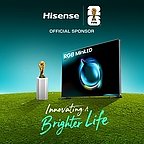
The pitch-side advertising is a masterclass in this strategic messaging. Slogans like "The Origin of RGB MiniLED TV" and "Innovating a Brighter Life" are beamed to billions of viewers, directly linking the emotional highs of the tournament to the company's core technological claims. It's a powerful form of narrative control, suggesting that to truly experience the game in all its color and glory, one needs Hisense technology. This transforms the television from a passive viewing device into an essential component of the fan experience.
"Football has a unique ability to bring people together across cultures and generations," noted Jason Ou, President of Hisense Middle East and Africa, in a statement. This sentiment, while a familiar corporate platitude, reveals the strategic calculus. The universal language of football provides a frictionless medium for a global brand to communicate its values and ambitions, bypassing cultural and linguistic barriers to forge a direct, emotional connection with consumers.
From Hudson Yards to Dubai: Engineering the Fan Experience
Hisense's strategy extends far beyond the stadium and the television screen. The company is meticulously constructing a series of "fan experiences" designed to make its technological claims tangible. In New York City, a week-long pop-up experience has taken over a prime spot at Hudson Yards. Here, the abstract concept of "RGB MiniLED" is translated into a physical, interactive playground.
The activation, themed around the RGB primary colors, is a sophisticated blend of branding and entertainment. Visitors can use a "Digital Mirror" to virtually try on Adidas team kits, with the company's "Chromagic" technology ensuring the jersey colors are rendered with photorealistic accuracy. Another interactive game allows fans to participate in a virtual penalty shootout, with successful shots progressively revealing a co-branded digital mural. These aren't just gimmicks; they are carefully designed feedback loops that allow consumers to "feel" the benefits of color accuracy, motion clarity, and large-screen immersion.
This localized approach is being replicated globally. From fan zones in Dubai and Abu Dhabi to activations in Qatar and Iraq, Hisense is creating a distributed network of brand touchpoints. These events, featuring watch parties, competitions, and product showcases, allow the company to tailor its global message to local audiences, creating a unified brand experience that feels both massive in scale and personal in its execution. By embedding itself within the fabric of the fan community, Hisense is attempting to do more than just sell a product; it is aiming to become an indispensable part of the World Cup ritual itself.