
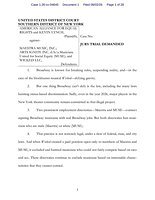
- 1 Plaintiff: Kevin Lynch, a white male composer and music director, alleges he was barred from applying to the Wicked apprenticeship program due to race and sex criteria.
- 2 Defendants: The lawsuit targets Wicked the musical, Maestra Music, and Musicians United for Social Equity (MUSE).
- 3 Legal Precedent: The case builds on the Students for Fair Admissions v. Harvard ruling, challenging race-conscious programs in the private sector.
Legal experts suggest this case could force a re-evaluation of DEI programs, pushing organizations toward broader, non-identity-based frameworks to avoid litigation while still addressing historical inequities.
The Wicked Lawsuit: Is Corporate DEI Facing Its Final Curtain Call?
NEW YORK, NY – June 02, 2026 – The bright lights of Broadway are now illuminating a courtroom drama with national implications. In a move that sends shockwaves far beyond the theater district, the long-running musical Wicked has been named in a federal civil rights lawsuit alleging that its diversity-focused apprenticeship program unlawfully discriminates based on race and sex. The suit, filed today by the American Alliance for Equal Rights (AAER), targets not only the production itself but also two nonprofit partners, Maestra Music and Musicians United for Social Equity (MUSE). This case represents more than a dispute over a single position; it marks a significant escalation in the legal assault on Diversity, Equity, and Inclusion (DEI) initiatives, placing the arts and, by extension, corporate America at a precarious crossroads.
At the heart of the legal challenge is the very mechanism designed to foster inclusion. The lawsuit, filed on behalf of New York composer and music director Kevin Lynch, argues that he was illegally barred from applying to the “Music Director Experience”—a paid, three-week apprenticeship with Wicked—solely because he is a white male. The case has become a flashpoint in the contentious debate over how organizations can remedy historical underrepresentation without falling foul of anti-discrimination laws.
The Allegations on Center Stage
The complaint, filed in the Southern District of New York, alleges that the program's eligibility criteria constitute blatant discrimination. To apply for the coveted apprenticeship, which offered one-on-one training with the show’s Music Director, candidates were required to be members of either Maestra Music or MUSE. Maestra's directory is open exclusively to female and nonbinary musicians, while MUSE’s directory is reserved for musicians of color. By design, a white male musician like Lynch, despite a resume that includes work at The Juilliard School and collaborations with Broadway stars, was ineligible to even be considered.
The lawsuit argues this structure violates federal law under 42 U.S.C. §1981, which prohibits racial discrimination in contracts, as well as New York State and City human rights laws. AAER President Edward Blum, the activist spearheading the case, highlighted the perceived contradiction in a pointed statement. "Wicked is a story about a green-skinned witch who is feared, marginalized, and harshly judged because she looks different from everyone else," Blum said. "Yet the organizations behind this apprenticeship program allegedly excluded applicants because of their race and sex... The only quality that Kevin Lynch lacked was being the right race and sex."
The Architect of the Challenge
This lawsuit is not an isolated event but a key part of a broader, meticulously executed legal strategy by Edward Blum and AAER. Fresh off his landmark victory in Students for Fair Admissions v. Harvard, which dismantled race-conscious college admissions, Blum is now systematically applying that precedent to the private sector. His organization has launched a series of legal challenges aimed at dismantling programs that offer exclusive opportunities based on race or sex.
This pattern includes a successful suit against the Fearless Fund, which offered grants exclusively to Black female entrepreneurs, and another pending case against Southwest Airlines for a travel award program for Hispanic students. Blum’s legal argument is consistent: that the Supreme Court's ruling against affirmative action in education applies to “every context,” including employment, apprenticeships, and grants. By targeting a high-profile cultural institution like Wicked, AAER is ensuring its crusade against what it terms “reverse discrimination” receives maximum public attention. For corporate leaders and boards of directors, this case serves as a stark warning that their own DEI programs, no matter how well-intentioned, are now in the legal crosshairs.
An Industry's Reckoning with Representation
The irony is that programs like the “Music Director Experience” were created to solve a well-documented problem. In the wake of the 2020 racial justice movements, Broadway and the wider arts community faced intense pressure to address systemic inequities. Organizations like Maestra and MUSE were born from this reckoning. Maestra was founded by composer Georgia Stitt to combat the stark gender imbalance in theater pits, citing industry data showing that women held only 22% of musician jobs in Broadway orchestras. Similarly, MUSE was established as a multi-racial collective to create pathways for musicians of color, who have been historically underrepresented in theatrical music departments.
These organizations and their partnerships with major productions like Wicked were hailed as progressive steps toward creating a more equitable industry. They were designed not to exclude, but to open doors that had long been closed. The lawsuit forces an uncomfortable question: can the tools used to correct past discrimination be legally distinguished from discrimination itself? The answer will have profound consequences for the entire cultural sector, which relies heavily on fellowships, grants, and apprenticeships to cultivate new talent and diversify its ranks.
Navigating the New Legal Landscape
As the case proceeds, arts administrators and corporate counsels across the country will be watching intently. The outcome could set a powerful precedent, forcing a complete re-evaluation of how diversity initiatives are structured. Legal experts suggest that organizations may need to shift from identity-based eligibility criteria to broader, more nuanced frameworks that focus on life experience, socioeconomic background, or overcoming specific adversities, rather than explicit race or gender categories. This creates a significant strategic and operational challenge for HR and legal departments.
The lawsuit against Wicked transforms the abstract legal theory of the Harvard decision into a tangible risk for any organization with a DEI program. It raises the stakes for boards and executives, who must now balance their commitment to diversity with the escalating threat of litigation. The central conflict—between addressing historical disparity and adhering to a legal framework that increasingly demands colorblind and gender-neutral policies—is now playing out on one of the world's biggest stages.