
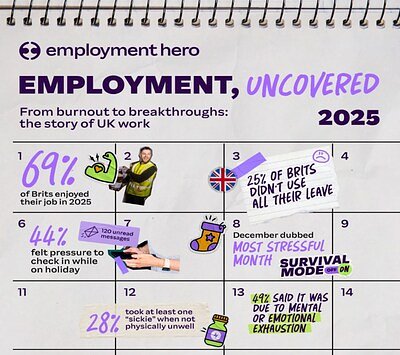
- 69% of UK workers report enjoying their jobs despite high burnout rates.
- 44% of workers felt pressured to work during time off.
- 28% of workers admitted to taking at least one 'fake' sick day for burnout or mental health reasons.
Experts agree that while UK workers exhibit resilience and job satisfaction, the unsustainable pressure and lack of genuine rest risk long-term productivity and well-being, requiring urgent workplace culture reforms.
The UK’s Burnout Paradox: Happy Workers, Unsustainable Pressure
LONDON, UK – December 04, 2025 – A striking paradox is defining the British workplace. New research reveals a workforce pushed to its limits by economic pressures and an ‘always-on’ culture, yet one that remains surprisingly resilient and even content. While nearly 70% of UK workers report enjoying their jobs, this positive sentiment masks a troubling reality of burnout, un-taken leave, and the rise of the ‘mental health sickie’ as a desperate tool for rest.
Data from Employment Hero's 2025 ‘Employment Uncovered’ report, a comprehensive analysis drawing from over 100,000 employee records and a national survey, paints a picture of a workforce navigating one of its toughest years. The findings present a critical challenge for business leaders: the resilience of their employees is a powerful asset, but it is being treated as an infinite resource. In an era defined by rapid technological change and market volatility, companies banking on this goodwill without addressing its underlying causes are risking the very engine of their progress.
The Façade of Rest: 'Survival Season' and the Tethered Holiday
The traditional notion of a year-end wind-down has been thoroughly upended. According to the data, December has been dubbed ‘Survival Season’ by employees, marking it as the most stressful period of the work year, followed closely by January. This peak in pressure coincides with a time historically associated with rest and festivities, highlighting a profound disconnect between workplace demands and human need.
This strain is compounded by the inability for employees to truly disconnect. While long weekends remain popular—with Fridays being 20% more likely to be taken off than other weekdays—the breaks themselves are often performative. A staggering 44% of workers felt pressured to keep working during their time off, and a quarter didn't even use their full holiday allocation in 2025. For businesses, this trend of ‘tethered leave’ is a silent productivity killer. An employee who is checking emails from a beach is not truly recharging. The cognitive and creative benefits of genuine rest are lost, leading to diminished strategic thinking, increased errors, and a faster path to burnout upon return.
The pressure is not distributed evenly. Younger workers (ages 18-34) are significantly more affected, with 52% feeling unable to switch off, compared to just 36% of their colleagues aged 45 and over. This suggests a brewing crisis in talent retention, as the next generation of leaders and innovators is burning out before it can truly begin to flourish.
Sick Days as a Distress Signal
When annual leave fails to provide a genuine escape, employees are forced to seek refuge elsewhere. The report uncovers a telling trend: the sick day is being repurposed as a burnout release valve. On average, employees took seven sick days between January and October, but the story lies in the motivation. Nearly a third of workers (28%) admitted to taking at least one sick day when they were not physically unwell.
Burnout was the primary driver, cited by 49% of those who took a ‘fake’ sick day. Another 39% said they felt overwhelmed and simply needed a break. This is not a story of employee dishonesty, but a clear signal of a systemic failure in workplace support. Full-time employees, who are often subject to the most intense pressure, were more than twice as likely as their part-time counterparts to take a sick day for mental recuperation.
For business leaders and HR professionals, this data should be a blaring alarm. It indicates that current well-being initiatives and HR policies are insufficient. When employees must feign illness to secure a day of mental peace, it points to a culture where vulnerability is penalised and proactive mental health support is lacking. The direct cost of the absence is minimal compared to the long-term damage caused by a culture that forces its people into such coping mechanisms, eroding trust and fostering an environment of ‘presenteeism’ where employees are at their desks but not fully productive.
A Generational Shift in Workplace Values
The research casts a particular spotlight on the generational dynamics at play. Younger workers are not only feeling the pressure more acutely but are also leading the charge in using sick days as a mental health tool. This is not a sign of a less resilient generation, but rather a more vocal one with different expectations of the employer-employee contract. They are inheriting a world of work defined by poly-employment, cost-of-living crises, and the looming impact of AI, and they are demanding a workplace that acknowledges and supports their well-being.
For companies focused on innovation and long-term growth, this trend is a critical piece of market intelligence. The battle for talent is increasingly fought on the terrain of culture and support. To attract and retain the brightest minds, businesses must evolve beyond traditional benefits and create an environment where rest is encouraged, mental health is destigmatized, and the definition of sick leave is expanded to include mental exhaustion. The companies that fail to adapt will find themselves struggling to recruit the very people needed to navigate the complexities of the modern economy.
The Enduring Power of Purpose
Despite the immense strain, the report’s most paradoxical finding is that 69% of workers still enjoyed their job in 2025. This resilience is rooted in a deep-seated desire for meaning and identity through work. Nearly half (48%) of respondents said work is a key part of their identity, and 40% would continue working even after a lottery win. The happiest cohort of all were the self-employed and freelancers (83% enjoyment), pointing to the powerful psychological benefits of autonomy and control.
As Kevin Fitzgerald, UK Managing Director at Employment Hero, noted in the report, "When nearly half the workforce feels the need to check emails on annual leave or use sick days as an excuse to actually switch off, it's clear something needs to change. But this research also reveals something... even in a difficult year, most people still enjoyed their jobs."
This is the central lesson for every business leader. The problem is not the work; it is the unsustainable framework within which it is performed. Employees are not asking to do less, but to be supported more. The enduring pride people find in their work is a powerful, renewable energy source for any organization. However, like any resource, it requires careful stewardship. The challenge for 2026 is for businesses to stop simply drawing from this well of resilience and start actively replenishing it, recognizing that a supported, rested, and mentally healthy workforce is the only true foundation for powering progress.