
- 400% increase: The percentage of new residential solar projects installed with batteries quadrupled between 2020 and 2024.
- $35 billion savings: Nationwide deployment of Advanced Transmission Technologies (ATTs) could save consumers $35 billion.
- 100 gigawatts unlocked: ATTs could unlock up to 100 gigawatts of new capacity in the existing grid.
Experts agree that modernizing the U.S. electric grid requires a two-pronged approach: empowering consumers with decentralized energy resources while upgrading the existing grid with advanced transmission technologies to enhance efficiency and reliability.
The Two-Front Fix for America's Overloaded Electric Grid
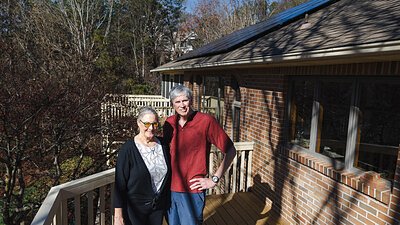
WASHINGTON – February 23, 2026 – For Jim King and Jayne Cleveland, the decision to install solar panels and a battery in their Weaverville, North Carolina, home was initially about innovation and saving money. But just six weeks after their system went live in August 2024, its true value became terrifyingly clear.
When Hurricane Helene devastated western North Carolina, knocking out power for most of the region, the couple woke up to a home that was running seamlessly on stored solar energy. "We were stuck," Cleveland recalls. "But we had power." For three weeks, as their neighbors waited for the main grid to be repaired, the King-Cleveland household remained an island of electricity, a stark testament to a brewing revolution in how America generates and consumes power.
Their story is a microcosm of a nation at an energy crossroads. The U.S. electric grid, an engineering marvel of the 20th century, is straining under the unprecedented demands of the 21st. A recent report from The Pew Charitable Trusts highlights a two-pronged strategy gaining traction across the country: empowering consumers with local energy systems while simultaneously making the existing grid smarter and more efficient.
A Looming Power Crisis
The demand for electricity is surging at a rate not seen in decades. The U.S. Energy Information Administration (EIA) projects that power consumption will hit record levels in 2026, marking a four-year growth streak unseen since 2000. The culprits are a perfect storm of modern technology and economic activity.
The voracious appetite of data centers, fueled by the explosive growth of artificial intelligence, is a primary driver. Analysts at Gartner project that global data center electricity consumption will double by 2030, with AI servers alone potentially accounting for nearly half of that load. In Texas, the grid operator ERCOT anticipates that over half of its staggering new power demand by 2031 will come from data centers. This demand is compounded by a resurgence in domestic manufacturing and the steady electrification of homes and vehicles.
"Even in our daily lives, we see energy demand increase," says Yaron Miller of Pew's energy modernization team. "So much to plug in! Chargers, battery packs, EVs. If we do nothing, that's a problem for powering businesses. That's a problem for keeping the AC on in the hot summer or the refrigerator running."
This demand crunch is colliding with an aging infrastructure and the increasing frequency of extreme weather events. Hurricanes like Helene, ice storms, and heat waves are no longer black swan events but regular stressors that expose the grid's vulnerabilities, leaving millions in the dark.
Power to the People: The Rise of the Decentralized Grid
The first front in this modernization effort is happening not in massive power plants, but in basements, on rooftops, and across college campuses. These technologies, known as Distributed Energy Resources (DERs), include solar panels, batteries, smart thermostats, and even electric vehicles.
Homeowners like King and Cleveland are at the vanguard. Their system, installed through a Duke Energy pilot called PowerPair, cost $40,000 upfront, but a $9,000 utility rebate and a 30% federal tax credit significantly softened the blow. Now, their electric bills sometimes show a negative balance. "Though it might take a decade to recoup all the cost, we've had electric bills with negative numbers, where Duke Energy owes me," says King. Their home is now part of a "virtual power plant" (VPP), where the utility can tap into their stored energy during peak times, benefiting both the customer and the grid.
This trend is rapidly accelerating. The percentage of new residential solar projects installed with batteries quadrupled between 2020 and 2024. This model isn't just for individual homes. In Washington, D.C., Gallaudet University hosts one of the city's first microgrids. This self-contained energy system, developed with partners like Scale Microgrids and Urban Ingenuity, can power the entire campus independently during an outage.
The microgrid is also a financial success. The university earns revenue by leasing its rooftops and providing stability services to the regional grid. "It's a very good investment," says Dave Good, Gallaudet's director of Energy, Utilities, and Sustainability. "We expect to save about 40% on our energy bills every year, which is millions of dollars." Furthermore, 400 local residences subscribe to the university's solar output, reducing their own energy costs.
"DERs benefit the customer, and they benefit the grid," says Maureen Quinlan of Pew's energy modernization team. "There's a great untapped potential here, and we're trying to create an ambitious vision for the nation."
Making the Grid Smarter, Not Just Bigger
While decentralization is critical, experts agree it's only half the battle. The second front involves upgrading the existing transmission network with Advanced Transmission Technologies (ATTs). Instead of spending a decade and billions of dollars on new power lines, ATTs can squeeze significantly more capacity out of the wires already in place.
These technologies range from advanced sensors that provide real-time data on line conditions—allowing operators to safely push more power through—to new, high-performance conductors that can carry double the electricity of their older counterparts. According to the Department of Energy, a nationwide deployment of ATTs could unlock up to 100 gigawatts of new capacity and save consumers $35 billion.
"ATTs make the grid more efficient and able to squeeze more power out of the existing infrastructure," says Pew's Miller. "That's a low-hanging fruit, and a really smart move."
This pragmatic approach has found rare bipartisan support in statehouses. In the last three years, at least 16 states have passed laws to encourage ATT deployment. In 2025, Utah Governor Spencer Cox signed a bill sponsored by Representative Christine Watkins that requires utilities to evaluate and deploy cost-effective ATTs. "Our grid is aging, and it hasn't been maintained," Watkins says. "It was a no-brainer."
Similarly, Indiana passed legislation sponsored by Senator Eric Koch to tackle a backlog of energy projects stalled by grid congestion. "Our grid was built 100 years ago and needs upgrading," Koch states. "Now is the opportune time to capture the latest technology."
A Unified Front for a Modern Grid
The path to a resilient energy future requires a coordinated effort from all stakeholders. Utilities like Duke Energy are testing solutions, from homeowner partnerships to town-sized microgrids. When Hurricane Helene washed away the substation in Hot Springs, North Carolina, a Duke microgrid powered the entire town for six days.
Meanwhile, influential figures like Pat Wood, former chair of the Federal Energy Regulatory Commission and now co-chair of Pew's DER Advisory Council, are working to shift the industry's mindset. "The problem is, a lot of the people in the utility industry, and in the government, don't understand what a transformative potential we have just sitting there ready for us," he says. "I'm trying to unlock innovation and risk-taking and an entrepreneurial mindset that is missing in energy."
Ultimately, modernizing the grid is about providing more options, greater reliability, and a cleaner energy supply. It's a complex, nationwide challenge being met with a powerful combination of local action and smart policy, empowering consumers to be part of the solution.
For Jayne Cleveland in Weaverville, the choice is clear. "I love knowing that I'm not pulling power from anywhere but from the sun," she says. "I'm sold."
Topics & Related
Artificial Intelligence
Generative AI
Automation
ESG
Decarbonization
Revenue
Net Income
Inflation
Fintech
Energy & Utilities
Cloud & Infrastructure
Expansion
Related Company Pulse