
- Didit's 'You Do' platform eliminates the need for recipients to create accounts or learn new software, reducing follow-up emails by streamlining task delegation.
- The platform aims to reduce the mental overhead of tracking tasks, with features like automatic reminders and AI-powered request creation.
- Founded in 2024 and self-funded, Didit operates from Reno, Nevada, contrasting with the venture capital-driven models of Silicon Valley.
Experts would likely conclude that Didit's 'You Do' platform offers a promising, low-friction solution to the widespread problem of task delegation inefficiencies, particularly for external collaborations, though its success will depend on user adoption and habit change.
The Startup Killing the Follow-Up Email With a Single Link
RENO, NV – December 09, 2025 – In the modern workplace, a single phrase has become both a constant burden and a symbol of inefficiency: “Just following up.” It lives in our inboxes, clogs our chat channels, and represents the countless hours wasted tracking requests that have fallen into a digital void. While billion-dollar project management suites promise to solve this, their complexity and high-friction adoption often create more problems than they solve, especially when dealing with external partners. Today, a self-funded startup from Reno, Nevada, is launching a deceptively simple, yet potentially revolutionary, attack on this problem.
Didit, Inc. has officially launched its "You Do" platform, a request management system built on a single, powerful premise: the person you delegate a task to shouldn't have to do anything except the task itself. No accounts, no sign-ups, no new software to learn. It’s a direct challenge to the established order of collaboration tools and a strategic bet that the path to productivity lies in removing barriers, not building more feature-rich walls.
The Tyranny of the Digital Paper Trail
The problem Didit addresses is universal. Business leaders coordinate with contractors, marketing managers chase deliverables from agencies, and freelancers juggle feedback from multiple clients. Even outside of work, parents organize family chores and volunteers coordinate community events. The common thread is the chaotic, fragmented nature of delegation. Important requests are made verbally, buried in long email threads, or lost in the rapid-fire stream of instant messages. The mental load of remembering who was asked to do what, by when, and whether it’s been done is a significant and often invisible drain on productivity.
This is the gap that traditional project management software like Asana, Trello, or Monday.com has tried to fill. These platforms are powerful for internal teams willing to commit to a single ecosystem. However, their effectiveness crumbles at the organizational boundary. Asking a client, a vendor, or a short-term contractor to create an account on your preferred system just to track a single task is often a non-starter. The friction is too high, adoption is low, and teams inevitably revert to the familiar chaos of email and chat.
"I used to spend half my day writing 'just following up' emails and trying to remember what I asked people to do," said Angela Franklin, an IT and Workplace Director who was an early user of the platform. "Didit eliminated all that mental overhead." This sentiment highlights the core pain point: the follow-up isn't just an email; it's a symptom of a broken process.
A 'You Do' Model Built on Zero Friction
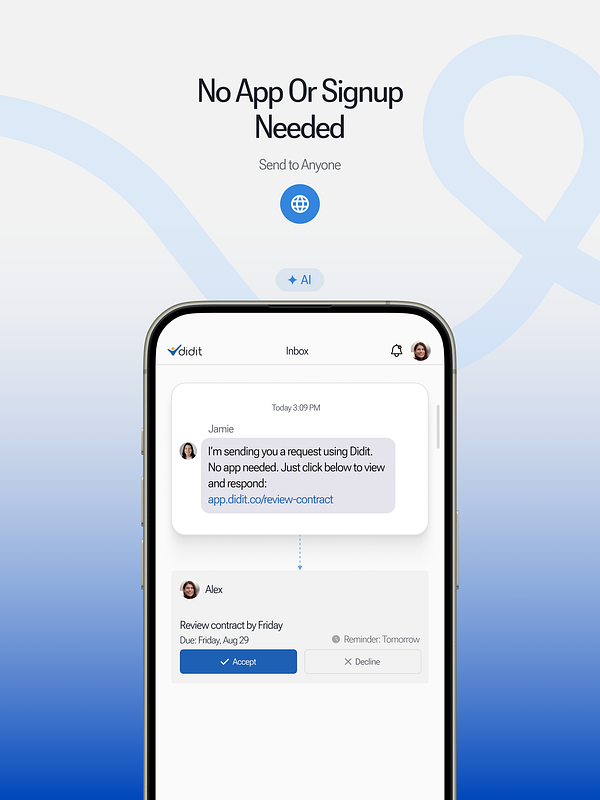
Didit’s strategic insight is to reframe the problem. Instead of being another "To Do" app for the user, it positions itself as a "You Do" platform for the delegator. The company’s key innovation, which it calls "Zero Recipient Friction," is the engine behind this shift. A user creates a request in the Didit app, then shares a simple, private link via email, text, Slack, or any other channel. The recipient clicks the link and is taken directly to a clean, single-purpose page detailing the request. There, they can ask questions, add comments, and, most importantly, mark the task as complete—all without ever creating an account.
"Instead of being another 'To Do' app, Didit is a 'You Do' app where you can ask anyone to do anything, even if they don't have the app," explained Darryl Rubarth, Founder and CEO of Didit. "It relieves you of the mental load of remembering who you asked to do what, by when, and all the related details."
This approach effectively turns the delegation process inside out. It places the system's power in the hands of the person making the request while making participation for the recipient as effortless as clicking a link. The platform further reduces the delegator's burden with features like automatic reminders, ensuring tasks don't get forgotten without forcing the user to manually send those dreaded follow-up messages. By adding an AI-powered creation tool that can interpret voice or text commands to generate clear, actionable requests, Didit is also streamlining the front end of the process, aiming to make task creation faster than typing an email.
Redefining Collaboration Beyond the Enterprise
The implications of this low-friction model extend far beyond personal productivity. It has the potential to reshape how businesses collaborate with their entire external ecosystem. For small businesses, it offers a lightweight but structured way to manage freelancers, suppliers, and clients without investing in complex, expensive software. For larger enterprises, it can solve the persistent challenge of "shadow IT," where teams resort to unsanctioned tools to work with outside partners because the official corporate software is too cumbersome.
Tom Reardon, a real estate adviser and early adopter, noted the platform’s versatility: "Between real estate clients and coaching youth hockey, I'm constantly juggling people and deadlines. Didit gives me one place to coordinate everything. Nothing falls through the cracks." This highlights the platform's ability to bridge the professional and personal divide, serving a market segment that heavyweight project management tools often ignore.
By focusing on the request rather than the project, Didit is carving out a new niche. It’s not trying to replace complex project management systems but rather to own the massive volume of informal tasks that currently fall through the cracks. These are the tasks "too simple for formal project management but too important to lose track of," as Rubarth puts it. In doing so, Didit is creating a new standard for ad-hoc collaboration.
A Bootstrap Bet from the 'Biggest Little City'
Perhaps as interesting as the product is the company's story. Founded in 2024, Didit is a self-funded startup operating not out of Silicon Valley, but from Reno, Nevada—a city actively cultivating its own tech ecosystem. This bootstrap approach is a stark contrast to the venture capital-fueled growth model that dominates the software industry. Being self-funded often forces a company to be relentlessly focused on solving a real problem and achieving product-market fit from day one, rather than chasing growth at all costs.
Didit's strategy appears to be a direct reflection of this ethos: solve a fundamental, universal problem with a simple, elegant solution. By avoiding the feature bloat common in VC-backed competitors, the company is betting that users will choose ease of use and effectiveness over a dizzying array of functions they rarely need. This lean, focused approach, born outside the traditional tech hubs, represents a different, perhaps more sustainable, model for innovation.
The challenge ahead for Didit will be changing entrenched user habits. Email is a formidable foe, not because it's a good tool for task management, but because it's ubiquitous and requires no new behavior. The success of the "You Do" platform will depend on whether the relief it provides from the follow-up cycle is compelling enough to inspire users to generate a link instead of typing another email. If it can, this small Reno startup might just make a significant dent in our collective digital workload.