
- Early Detection Window: Q-TRED provides a critical window of several minutes for intervention before thermal runaway occurs.
- Distributed Sensing: Unlike traditional Battery Management Systems (BMS) with limited sensors, Q-TRED places a sentinel on every individual battery cell.
- Global Consortium: Soteria's Battery Safety IP Exchange (IPX) includes over 70 members, including NASA, Mercedes, DuPont, and Bosch.
Experts would likely conclude that Q-TRED represents a significant advancement in battery safety by enabling proactive detection of thermal events through chemical precursors, potentially reducing the risk of catastrophic failures in lithium-ion batteries.
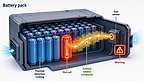
The Silent Sentinel: A Chemical Clue to Avert Battery Catastrophe
GREENVILLE, S.C. – June 05, 2026 – In a world increasingly powered by lithium-ion batteries, a persistent and fiery anxiety smolders just beneath the surface: the threat of thermal runaway. This is the catastrophic, self-sustaining chain reaction that can turn a battery pack into an inferno. Now, a new partnership is pioneering an innovative approach that aims not just to manage this risk, but to detect it at its most nascent stage, essentially giving batteries a sense of smell to warn of impending danger.
Soteria Battery Innovation Group, a company dedicated to advancing battery safety, has announced it will license Q-TRED, a novel thermal event detection technology developed by global defense and security firm QinetiQ. The technology will be integrated into Soteria's Battery Safety IP Exchange (IPX), a collaborative platform designed to accelerate the adoption of safety innovations. This move signals a potential paradigm shift, moving beyond simply monitoring temperature to proactively identifying the chemical precursors of a battery failure.
A Paradigm Shift in Detection
For years, the standard for battery safety has relied on a Battery Management System (BMS) that acts as a digital watchdog, monitoring voltage, current, and—most critically for thermal events—temperature. These systems typically use a limited number of thermal sensors placed at strategic, but discrete, points within a large battery pack. While essential, this method is fundamentally reactive. By the time a sensor registers a dangerous temperature spike, a thermal event may already be well underway and difficult to stop.
Q-TRED, born from the advanced research labs of a defense technology giant, flips the script. Instead of waiting for the heat, it looks for the chemical signature that precedes it. The technology involves applying a specialized coating to every individual battery cell. When a cell begins to dangerously overheat, this coating releases a specific, non-toxic volatile compound—a detectable vapor. Commercially available gas sensors within the battery pack can then “sniff” this vapor, triggering an alert long before the situation escalates to a full-blown thermal runaway event.
This distributed sensing strategy is the core of its innovation. Where a traditional BMS has a few guards watching a large fortress, Q-TRED places a silent sentinel on every single cell. Experts note that during the initial stages of failure, battery cells release specific volatile organic compounds (VOCs) as their electrolyte breaks down. Detecting these gases can provide a critical window of several minutes for intervention—enough time for a system to shut down, activate cooling measures, or alert an operator to a problem that would otherwise be invisible.
The High Stakes of Battery Safety
The urgency for such an innovation is underscored by a landscape rife with high-profile battery incidents. From electric vehicles that are notoriously difficult to extinguish once ablaze, to multi-million-dollar Battery Energy Storage System (BESS) installations that have burned for days, the consequences of thermal runaway are severe. A BESS fire in San Diego in 2024, for example, saw flare-ups for a week, while another in South Africa earlier this year highlighted the explosive risks.
These events release not only intense heat but also a cocktail of toxic and flammable gases, posing significant risks to first responders and the environment. The issue has captured the attention of regulators worldwide. The Federal Aviation Administration (FAA), still mindful of the Boeing 787 Dreamliner battery failures over a decade ago, maintains stringent rules for batteries in aviation, viewing thermal runaway as a potentially catastrophic event. In the automotive sector, the National Highway Traffic Safety Administration (NHTSA) is keenly focused on EV battery safety, while organizations like UL Solutions are constantly updating standards for everything from e-bikes to large-scale energy storage.
The growing regulatory pressure and immense economic cost of recalls and failures create a powerful market driver. The industry is no longer just seeking higher energy density; it's in a desperate race for certifiable safety. Solutions that can provide an earlier, more reliable warning are not just a value-add, but are becoming an essential component of risk mitigation.
Open Innovation as an Accelerator
Developing a groundbreaking technology is one thing; ensuring its widespread adoption is another. This is where Soteria's unique business model comes into play. The company operates a global consortium of over 70 members—including NASA, Mercedes, DuPont, and Bosch—and its Battery Safety IP Exchange (IPX) is designed to break down the barriers that often slow the implementation of new safety tech.
Rather than forcing companies to license dozens of individual patents from different entities to build a comprehensive safety system, the IPX offers a unified framework. It bundles complementary technologies spanning internal cell materials, propagation resistance, and now, advanced detection with Q-TRED. By making a portfolio of safety solutions accessible under one roof, Soteria aims to help manufacturers integrate multiple layers of protection more easily and cost-effectively.
"Early warning is one of the most important layers in battery safety, and it is underserved by limited, discreet measurement points," said Brian Morin, CEO of Soteria Battery Innovation Group, in the official announcement. "By combining Q-TRED with broader industry collaboration through the IPX, the industry can build battery systems that identify problems earlier, respond faster, and reduce the risk of damaging failures."
From Defense to Devices: The Path to Market
The transition of Q-TRED from a defense-focused company like QinetiQ—which was spun out of the UK's Ministry of Defence research agency—to the broad commercial market is a classic example of how mission-critical innovation can find new purpose. However, the path from a licensing deal to ubiquitous adoption is fraught with challenges.
The primary hurdles will be cost, scalability, and integration. Convincing cost-sensitive industries like automotive and consumer electronics to add a new material coating and an array of gas sensors to their products will require a clear demonstration of value and reliability. Manufacturers will need to re-tool production lines, and the entire supply chain, from chemical suppliers to system integrators, must be coordinated.
Furthermore, the technology must undergo rigorous validation and certification to meet the stringent standards of the automotive, aerospace, and energy storage sectors. This process can take years. The system must prove not only its ability to detect real events but also its resilience against false alarms, which could erode user trust and lead to unnecessary shutdowns. Soteria and its partners in the consortium will now begin the critical work of validating, integrating, and determining the best implementation strategies to transform this promising innovation into a practical, scalable solution for a battery-powered future.