
- Public support for animal research has dropped from 65% in 2001 to 47% in 2025 (Gallup polls).
- The FDA Modernization Act 3.0 now allows drug developers to use non-animal methods for safety and efficacy testing.
- The Animal Welfare Act excludes rats, mice, and birds, which make up the majority of lab animals.
Experts agree that scientific progress and ethical responsibility are not mutually exclusive, and the dialogue is shifting toward finding practical alternatives to animal testing.
The Shifting Ethics of Science: A New Dialogue on Animal Research
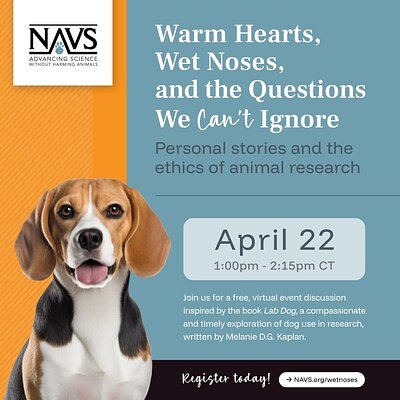
CHICAGO, IL – March 19, 2026 – As the scientific community grapples with evolving ethical standards and groundbreaking technological advancements, the long-standing practice of animal testing is facing unprecedented scrutiny. Against this backdrop, the National Anti-Vivisection Society (NAVS) is set to host a free webinar on April 22, aiming to foster a more nuanced conversation about one of science's most contentious topics.
The event, titled "Warm Hearts, Wet Noses, and the Questions We Can't Ignore," seeks to carve out a middle ground in a debate often dominated by extreme viewpoints. Hosted by NAVS director of advocacy and policy Meredith Blanchard, the panel will feature voices from journalism and advocacy, including Melanie D.G. Kaplan, author of the recent book "Lab Dog"; Madeline Krasno, executive director of Justify; and Lauren Stein, executive director of the International Foundation for Ethical Research (IFER).
"This conversation is meant to inform and inspire those who find themselves stuck in the middle, desiring to advance scientific research while also protecting dogs and other animal life," Blanchard stated in a press release. The webinar's goal is not to force attendees into polarized narratives but to equip them with an ethical framework and practical language for constructive dialogue.
A Search for Common Ground Amidst Shifting Tides
The initiative comes at a pivotal moment. Public support for animal research has been on a steady decline for two decades. Gallup polls reveal a significant drop in the percentage of Americans who find medical testing on animals "morally acceptable," falling from 65% in 2001 to just 47% by 2025. This shifting sentiment reflects a growing public awareness and a desire for more humane scientific methods.
NAVS, a nonprofit founded in 1929, is positioning this event as a way to address this cultural shift head-on. The organization's stated ambition is to create a forum that is "curious rather than confrontational." Blanchard emphasized this approach, stating, "Together, we'll process modern and ethical approaches to research in a way that's reflective, not just reactive."
The panel's composition is designed to facilitate this reflective process. Lauren Stein's work with IFER places her at the forefront of funding and promoting non-animal methods, offering a look at the viable alternatives. Meanwhile, Melanie D.G. Kaplan brings a deeply personal and investigative perspective, having explored the world of research beagles for her book, "Lab Dog." Her work exemplifies the power of personal stories to humanize complex ethical dilemmas and bridge the gap between scientific procedure and public empathy.
The Regulatory and Technological Revolution
The conversation is not happening in a vacuum. Federal regulations and technological innovation are rapidly reshaping the landscape of biomedical research. The FDA Modernization Act 3.0, for instance, represents a landmark shift in policy, allowing drug developers to use methods other than animal testing—such as cell-based assays and computer models—to establish a drug's safety and effectiveness. The FDA itself has acknowledged that animal testing has a "poor track record of predicting safety and efficacy in humans," a statement that has emboldened the push for alternatives.
Even with these advancements, the primary U.S. regulatory framework, the Animal Welfare Act (AWA), has long been a point of contention for advocacy groups. Enacted in 1966, the AWA sets minimum standards of care but controversially excludes rats, mice, and birds—the very animals that constitute the vast majority of subjects in laboratory research. This legislative gap has fueled criticism and intensified the search for oversight mechanisms and alternative methodologies that can provide more reliable, human-relevant data.
This is where the work of organizations like IFER and the development of Non-Animal Methodologies (NAMs) become critical. Technologies such as organ-on-a-chip systems—micro-engineered devices that simulate human organ functions—are moving from the theoretical to the practical. These systems, along with advanced computer simulations (in silico models) and 3D organoids, promise not only to reduce animal suffering but also to generate more accurate and predictive results for human health, potentially accelerating drug development and improving safety.
Personal Stories and the Path Forward
Beyond policy debates and technological specifications, the NAVS webinar aims to highlight the human and animal stories that are often lost in the discussion. Kaplan's journey, which began with the adoption of a former research beagle, provides a powerful narrative lens through which to view the industry. Her investigation involved interviews with a wide spectrum of stakeholders, from researchers and ethicists to activists and lawmakers, painting a nuanced picture of an industry at a crossroads.
These personal narratives are crucial for fostering the empathy that can lead to meaningful change. By sharing stories drawn from lived experience, the panelists hope to help attendees think more clearly about the ethical stakes without feeling pressured to choose a side in a long-running conflict.
The upcoming webinar serves as a microcosm of a much larger societal conversation. It reflects a growing recognition that scientific progress and ethical responsibility are not mutually exclusive. As technology provides new pathways for discovery and public opinion increasingly favors compassion, the dialogue is shifting from whether we should move away from animal testing to how we can best manage that transition for the benefit of both human and animal life.