
- Revenue Growth: Absen reported a 7.5% revenue increase to $124 million in Q1 2026.
- Net Profit Growth: Net profit rose 7.9% to nearly $5.5 million in Q1 2026.
- Gross Margin: Industry-leading gross margin of 32.21% in Q1 2026.
Experts would likely conclude that Absen's strategic shift toward value-driven growth and operational efficiency is outperforming traditional scale-based models in the saturated LED display market.
The Quiet Coup: Absen Rewrites the Rules in a Saturated Market
SHENZHEN, China – June 10, 2026 – In the global manufacturing arena, a familiar logic has long held sway: scale is king. Bigger factories, higher volumes, and aggressive market share capture were the accepted pathways to dominance. But in the fiercely competitive global LED display market, a so-called 'red ocean' battleground, that logic is fracturing. As macroeconomic headwinds and brutal price wars squeeze margins to their breaking point, a strategic divergence is cleaving the industry in two. On one side, companies tethered to the old logic of scale are seeing their profits erode. On the other, a new model is emerging.
Shenzhen-based Absen is proving to be the vanguard of this new approach. While some of its largest competitors reported revenue declines and even net losses, Absen announced counter-cyclical growth in the first quarter of 2026, with revenue climbing 7.5% to $124 million and net profit rising 7.9% to nearly $5.5 million. This isn't a statistical anomaly; it is the calculated result of a strategic pivot away from the siren song of sheer volume and toward the disciplined cultivation of value. The company is demonstrating that in a mature industry, the most potent strategic leverage comes not from being the biggest, but from being the most essential.
A Tale of Two Trajectories
The first quarter of 2026 served as a stark litmus test for the global LED sector. While the overall market is projected to grow, the benefits are not being distributed evenly. The financial disclosures of major players paint a picture of profound divergence. Absen’s positive growth and industry-leading gross margin of 32.21% stand in sharp relief against the performance of key rivals.
For instance, competitor Leyard reported a significant sequential revenue decrease and a drop in net income for Q1 2026. More dramatically, Unilumin, another industry heavyweight, posted a net loss of over $11 million (82.96 million CNY) for the quarter. These are not companies struggling in a vacuum; they are titans of the industry facing the same market pressures as Absen. The difference lies in their strategic posture. The traditional model, heavily reliant on asset scale and capturing every possible project, has become a liability, expanding risk exposure to currency fluctuations and upstream cost hikes.
Absen’s resilience, despite generating over 76% of its revenue overseas, points to a more sophisticated approach to risk and operations. Where others engaged in what the company calls "passive contraction"—cutting low-margin projects and suffering the inevitable revenue drop—Absen pursued "addition for quality." It didn't just shed unprofitable business; it actively grew its portfolio of high-value, flagship products. This strategic substitution allowed it to expand its gross margin without sacrificing top-line growth, a feat that breaks the conventional trade-off between profitability and market share.
Deconstructing the Premium: From Price Tags to Ownership Costs
The core of Absen's strategic rationale lies in its redefinition of value. In a market where price wars are the default weapon, the company has managed to secure pricing power by fundamentally shifting the customer conversation from initial acquisition cost to Total Cost of Ownership (TCO) and long-term operational reliability.
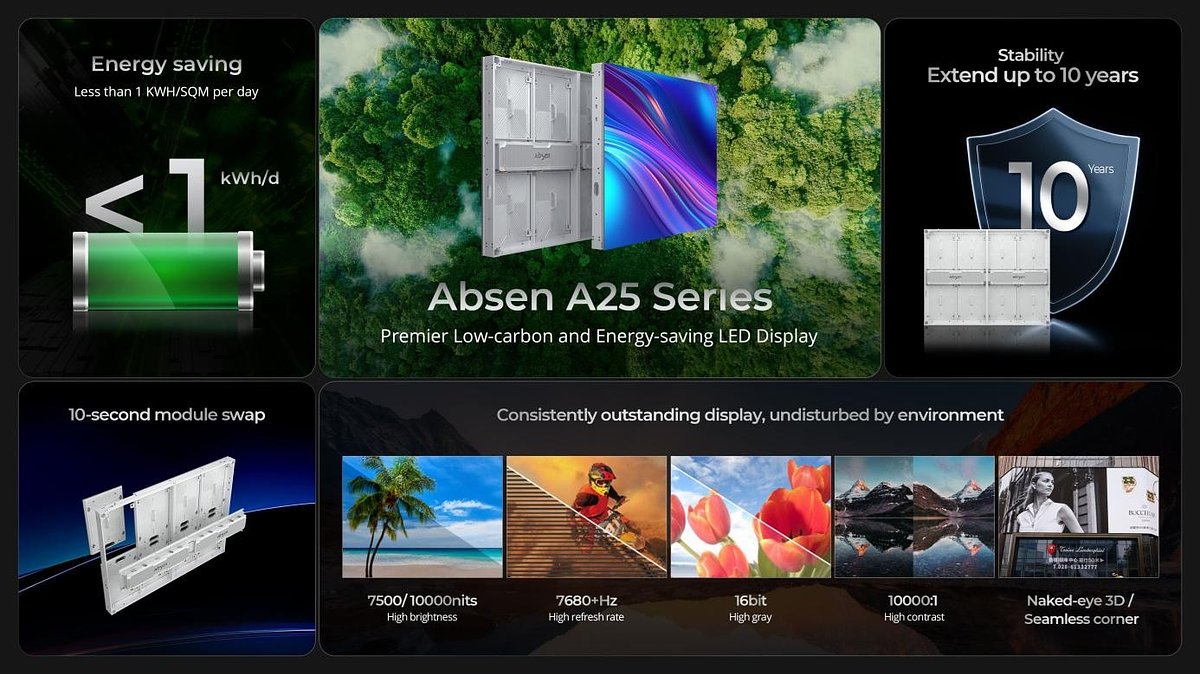
A telling case involves a U.S. highway operator who procured Absen products at what was reportedly twice the average market price. From a conventional procurement standpoint, this seems irrational. But the strategic calculation was clear: for critical infrastructure, the cost of failure is astronomical. The expense of road closures and emergency maintenance crews dwarfs any initial savings from a cheaper screen. Absen’s response was not a discount, but a promise: an unprecedented 10-year warranty. This move effectively transferred the long-term operational risk from the client to the manufacturer, turning a product sale into a decade-long partnership.
This is not a risky gamble but the outcome of absolute focus. Absen claims to voluntarily walk away from 90% of commoditized projects to concentrate 100% of its resources on core product lines where it can deliver overwhelming value. This radical focus yields compounded advantages. Its A25 Outdoor Advertising Series, for example, which secured over $139 million in orders in 2025, features technology that can cut power consumption by up to 50%. For a large-format screen, this translates into hundreds of thousands of dollars in operational savings over its lifespan, directly addressing clients’ sustainability goals and operating budgets. Similarly, its NT V2 rental series is engineered to be exceptionally lightweight, drastically reducing transport and labor costs for major events. These are not marginal improvements; they are solutions to high-stakes problems, and customers are willing to pay a premium for them.
The Efficiency Engine: Turning Operations into a Fortress
Superior products and premium pricing can only be sustained by a ruthlessly efficient operational backbone. This is Absen’s unseen moat. While competitors are burdened by extended payment terms and bloated inventories—the legacy of predatory growth strategies—Absen’s balance sheet tells a different story. In 2025, its cash conversion cycle was compressed to a remarkable 37 days, with accounts receivable turnover at just 65 days. In simple terms, the company converts its investments into cash faster than its rivals, providing the capital agility to reinvest in innovation and weather market shocks.
This financial discipline is the direct output of long-term infrastructural investment. The company has built a global network of over 5,400 certified service engineers blanketing 165 countries. This network is not a cost center but a critical component of its value proposition. It enables Absen to deliver on its promises of reliability, slashing repair cycles and ensuring the uptime that its high-value clients demand. This global service capability, combined with a tightly managed supply chain, creates an operational fortress that is exceedingly difficult and expensive for competitors to replicate.
As the LED industry continues its consolidation, the underlying mechanics of power are shifting. The linear formula of winning through price cuts and extended credit has run its course, trapping risk on the balance sheets of those who practice it. Absen is charting a different path, one where growth is cultivated through product excellence, customer-centric value, and operational discipline. It is a quieter, more deliberate strategy, but one that is proving far more resilient in a turbulent global economy.