
- 30% of cluster capacity typically stranded due to structural inefficiencies
- 15%–35% average Kubernetes cluster utilization for CPU and memory
- $90 million in venture funding raised by Komodor
Experts would likely conclude that Komodor's AI-driven proactive approach represents a significant advancement in cloud cost optimization, addressing structural inefficiencies that traditional reactive tools cannot.
Beyond Rightsizing: Komodor's AI Targets Structural Cloud Waste
TEL AVIV and SAN FRANCISCO – June 10, 2026 – In the relentless push for cloud efficiency, engineering teams have become adept at reactive cost-cutting. They rightsize workloads and deploy autoscalers, trimming the most obvious fat from their cloud bills. But a stubborn layer of waste persists, a structural inefficiency that locks away vast sums of money in underutilized infrastructure. Today, AI SRE platform Komodor unveiled a new strategy that aims to eliminate this waste not by reacting to it, but by preventing it from ever occurring.
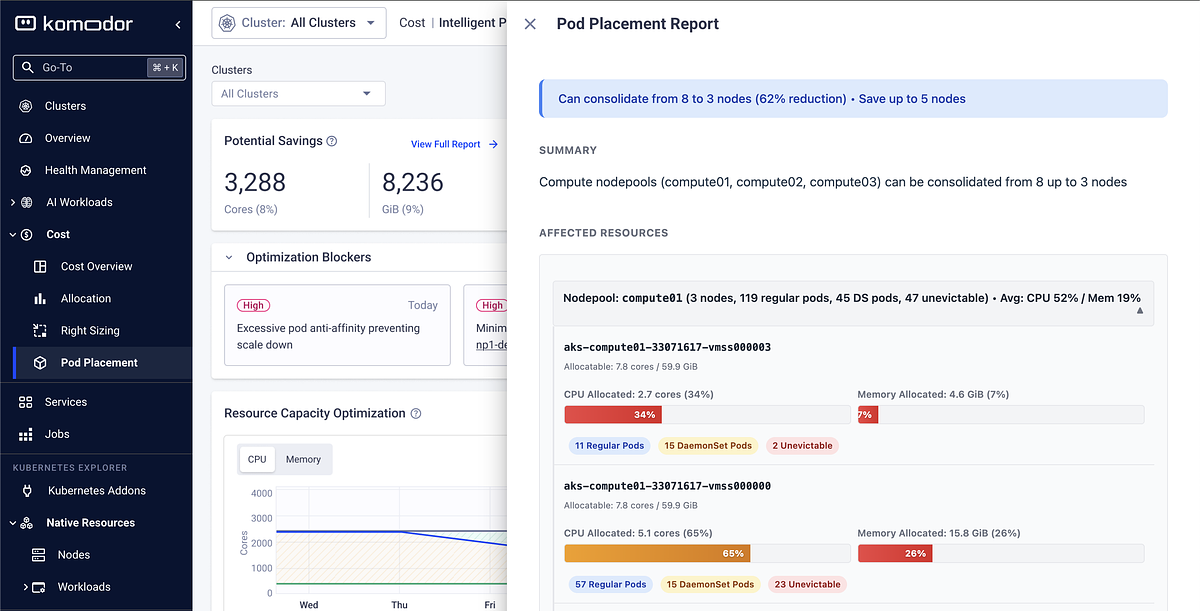
The company announced two new capabilities, Capacity Intelligence and Predictive Placement, designed to proactively optimize Kubernetes clusters. The goal is to reclaim what Komodor identifies as more than 30% of cluster capacity typically stranded by complex operational blockers that traditional tools can't see or solve. This figure is consistent with industry research, which shows average Kubernetes cluster utilization for CPU and memory often languishing between 15% and 35%, leaving a massive portion of paid-for resources idle.
Komodor’s move signals a critical evolution in cloud cost management, shifting the focus from trimming overprovisioned workloads to redesigning the very logic of how those workloads are placed and managed within a cluster.
The Limits of Reactive Optimization
For years, the standard playbook for cloud cost optimization has been twofold: workload rightsizing to adjust CPU and memory requests based on past usage, and node autoscalers like Karpenter to add or remove servers as needed. While effective, these methods have a ceiling. They are fundamentally reactive, addressing waste only after it has been generated.
“Traditional cloud infrastructure cost optimization is reactive, causing it to miss significant savings opportunities,” said Itiel Shwartz, Co-Founder and CTO of Komodor, in the announcement. This reactive posture leaves a significant amount of 'stranded capacity' untouched—resources that are paid for but unusable due to subtle, interlocking constraints within the Kubernetes environment.
These constraints include Pod Disruption Budgets (PDBs) that prevent node consolidation, anti-affinity rules that fragment capacity by design, and unevictable workloads that anchor underutilized nodes in place, forcing clusters to swell. Reactive tools, lacking deep operational context, can't safely navigate these complexities. Komodor's proactive methodology, however, analyzes workload behavior, scheduler decisions, and reliability rules in concert to dismantle these structural inefficiencies.
AI as the Proactive Architect
Komodor's solution is a continuous loop powered by its two new features, which are integrated into its Klaudia Agentic AI technology. The first, Capacity Intelligence, acts as a forensic accountant for the cluster. It continuously scans for the root causes of stranded capacity, diagnosing issues like conflicting disruption policies or inefficient pod placement rules. For each identified issue, it provides a root cause analysis and a quantified financial impact, along with one-click remediation options that include built-in reliability checks.
The second feature, Predictive Placement, is where the strategy shifts from forensics to architecture. Operating ahead of the default Kubernetes scheduler, it uses AI-driven simulations to model the future state of the cluster. It identifies nodes that are likely to be drained and steers new workloads away from them, preventing the 'node bloat' that forces autoscalers to provision unnecessary capacity. It also intelligently groups unevictable workloads onto designated nodes, freeing up the rest of the cluster for more efficient consolidation. This proactive guidance is a significant departure from simply reacting to pod requests.
“Because Komodor’s AI SRE has complete awareness of both workload behavior and cluster state, it can prevent structural inefficiencies before they occur and continuously optimize pod placement to maximize cluster utilization,” Shwartz explained. This context-aware approach is the key to unlocking savings without introducing instability, a common fear that keeps many organizations from pursuing more aggressive optimization.
A New Front in a Crowded Field
Komodor, which has raised $90 million in venture funding, is not alone in the quest to tame Kubernetes costs. The market is populated by established players like Kubecost, which excels at cost visibility, and automation platforms like Cast AI and Spot by NetApp, which focus on optimizing resource purchasing and autoscaling. However, Komodor is differentiating itself by embedding its cost optimization logic directly into a broader, AI-driven SRE platform.
Where many FinOps tools provide dashboards and recommendations for human operators, Komodor’s 'Agentic AI' is designed for autonomous action. The emphasis is on prevention and automatic remediation, governed by reliability guardrails. This positions the platform as less of a reporting tool and more of an active, intelligent agent managing the cluster's health and efficiency.
By tackling the nuanced, structural causes of waste—the very issues that often fall into the blind spot between SRE and FinOps teams—Komodor is addressing a critical, underserved segment of the market. The promise is not just to make clusters cheaper, but to make them fundamentally more efficient and resilient, reducing the operational toil on engineering teams who spend countless hours manually untangling these complex configuration puzzles.
For enterprises struggling with sprawling cloud-native environments, this shift from reactive clean-up to proactive architectural management could represent the next major leap in controlling cloud spend. By teaching the system to anticipate and prevent waste, Komodor is betting that the most significant savings are found not in trimming the edges, but in redesigning the core.