
- $100-inch-plus TV market dominance: Hisense ranks #1 globally in this segment, highlighting its technological prowess.
- 16 sensory-inclusive stadiums: Hisense partners with FIFA and KultureCity to create calming environments for neurodivergent fans.
- Multi-year FIFA partnership: Deepened since 2018, culminating in being the Official VAR Review TV Provider for World Cup 2026.
Experts would likely conclude that Hisense's World Cup activation masterfully blends experiential marketing with strategic market expansion, leveraging both cutting-edge technology and inclusive initiatives to strengthen its brand authority in the U.S. consumer electronics sector.
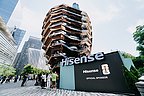
The Price of the Game: Inside Hisense's World Cup Spectacle
NEW YORK, NY – June 12, 2026 – The glow is hypnotic. Against the copper skeleton of The Vessel at Hudson Yards, massive LED screens pulse with the primary colors of digital life: red, green, blue. For five days, this patch of hyper-manicured corporate real estate has been transformed into a shrine for football fans, an outpost of the FIFA World Cup 2026™ hosted not by a city, but by a corporation. This is Hisense’s RGB-themed pop-up, and it is a masterclass in modern marketing, a place where the passion of the world’s most popular sport is filtered, enhanced, and sold back to you in stunning 4K.
On the surface, it’s a public celebration. Fans line up for interactive games, their faces illuminated by the brand’s flagship televisions. They are promised an immersive experience, a chance to touch the tournament atmosphere. But beneath the cheers and the flash of social media posts lies a different kind of game, one being played for market share, brand authority, and a direct line into the American consumer’s wallet. It’s a spectacle that forces us to ask a difficult question: When a global cultural event is this deeply intertwined with corporate strategy, who is the real winner?
Engineering the Fan Experience
Nothing here is left to chance. The entire activation is built around a clever marketing acronym. “RGB,” the foundational red, green, and blue pixels of a digital display, has been rebranded as “Real Game Begins with Hisense.” It’s a slogan that works on two levels: positioning the company’s technology as essential for an authentic viewing experience while framing this very event as the kickoff for fan engagement.
That engagement is meticulously engineered. In one corner, a “Digital Mirror” invites fans to virtually try on official adidas jerseys. Powered by what the company calls “RGB Chromagic technology,” a person’s reflection is instantly clad in the colors of their favorite national team. It’s a piece of technological wizardry that seamlessly blends a fan’s identity with two corporate partners, Hisense and adidas. In another area, a “Color Mural” shooting game allows participants to unlock a co-branded digital artwork, perfectly formatted for sharing on Instagram. Each interaction is designed to be fun, frictionless, and, most importantly, shareable, turning attendees into willing brand ambassadors.
This is the playbook of experiential marketing, where the goal is no longer just to be seen, but to be felt. By building a physical space that translates technical specifications—color accuracy, motion clarity, large-screen immersion—into tangible activities, the electronics giant forges an emotional connection. The memory of scoring a virtual goal becomes intertwined with the brand name, a far more powerful association than a 30-second television ad could ever achieve.
The American Offensive
This elaborate setup at one of New York’s most expensive pieces of real estate is no mere fan service. It is the beachhead in a strategic offensive to conquer the lucrative and fiercely competitive U.S. consumer electronics market. Hisense, a Chinese manufacturer with a dominant global position in certain sectors—ranking number one in the 100-inch-plus television segment, according to industry analysts—has long viewed North America as a key battleground for growth.
The FIFA World Cup 2026™, held across the U.S., Canada, and Mexico, presents a once-in-a-generation opportunity. By securing a high-profile sponsorship and placing its most ambitious activation in the heart of America’s commercial capital, the company is making a direct appeal to the American consumer. The choice of Hudson Yards is itself a statement, a signal that the brand is targeting an affluent, tech-savvy demographic, far from the grassroots fields where football is often played.
This event is just one piece of a much larger, multi-year strategy. The company’s partnership with FIFA is not new; it has steadily deepened since the 2018 World Cup. Its most significant coup is becoming the Official VAR Review TV Provider. This move brilliantly positions its screens as instruments of truth and precision, the final arbiters in moments of high-stakes controversy on the field. Every time a referee jogs to the pitch-side monitor, the association is reinforced: Hisense is synonymous with accuracy. It’s a level of brand authority that is nearly impossible to buy through traditional advertising alone.
From Fan to Sales Funnel
Perhaps the most telling component of the Hudson Yards activation is a program called “Our Host with Hisense.” It is here that the gap between fan celebration and corporate calculation becomes starkly clear. Presented as a fun, football-themed quiz, the program invites participants to answer questions to generate an “R/G/B color-profiled fan identity poster.”
But the real purpose is not self-discovery; it’s market research and lead generation. The fan’s identity, now neatly profiled, is used to generate a matched product recommendation. A QR code on the poster directs them to the Hisense U.S. website, landing them on a purchase page for the specific television deemed right for their “profile.” In a few simple steps, a fan’s passion has been quantified, categorized, and converted into a sales lead. The offline interaction—the fun of the quiz—becomes an entry point to an online discount coupon draw, creating a seamless data and traffic exchange.
This is the modern consumer journey in miniature. It begins with an emotion—love for a team, excitement for the World Cup—and ends at a checkout page. There is an unnerving efficiency to it, a system that transforms cultural identity into a demographic and fandom into a funnel. It lays bare the transactional nature of these large-scale sponsorships, where every piece of “free” fun is an investment aimed at an eventual return.
The Official Version of Reality
For all the calculated commercialism, it would be a mistake to dismiss the entire endeavor as purely cynical. In a move that demonstrates a more complex corporate consciousness, Hisense has also partnered with FIFA and the non-profit KultureCity to support the first-ever Sensory Inclusive tournament. This initiative will establish dedicated sensory rooms in all 16 host stadiums, equipped with the company's technology to provide a calming environment for fans with autism, PTSD, and other sensory sensitivities. It is a laudable use of corporate resources to make the “beautiful game” more accessible to all, a genuine effort to address a systemic inequity in public spaces.
This duality lies at the heart of the modern corporate sponsorship. The same company that profiles fans to sell them televisions also helps build spaces for neurodivergent children to experience the joy of the game. The same technology that provides referees with the clarity to make a game-changing call is used to create a virtual world where you can try on a jersey you are then prompted to buy. Technology, it seems, is a neutral and powerful tool, capable of both deepening a commercial transaction and widening human access.
As fans leave the glowing spectacle at Hudson Yards, their phones filled with photos and their heads with brand messaging, they carry with them this complicated reality. They have participated in an authentic moment of collective excitement, yet one that was wholly owned, curated, and monetized. It leaves one to wonder if the “real game” truly begins with a better screen, or if the real game is the relentless, ever-more-sophisticated effort to sell us that screen in the first place.