
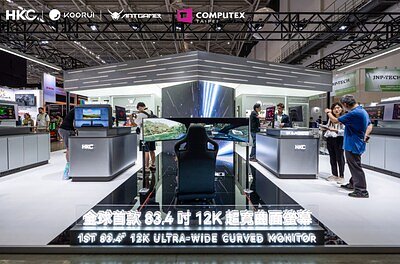
- 12K Ultra-Wide Monitor: HKC's Shield C83U60 boasts an 83.4-inch, 11520×2160 resolution, demanding DisplayPort 2.1/HDMI 2.1 and a 1.5-meter desk depth for optimal use.
- 1000Hz Gaming Display: ANTGAMER's ANT25ASF offers a native 1000Hz refresh rate, targeting esports professionals with minimal practical benefit for most users.
- RGB-MiniLED Technology: HKC's Apex series introduces RGB-MiniLED, promising wider color gamut and higher brightness than conventional MiniLED.
Experts would likely conclude that while COMPUTEX's 'world-first' monitors showcase impressive technological advancements, their practical value and long-term viability remain uncertain due to significant hardware, software, and ergonomic challenges.
The Pixel War: Are COMPUTEX's 'World-First' Monitors a Gamble?
TAIPEI, TAIWAN – June 03, 2026 – The showroom floors of COMPUTEX are once again a battleground for technological superlatives, and this year, the display sector is the primary theater of war. Under the banner "Win Beyond the Frame," a trio of interconnected brands—HKC, ANTGAMER, and KOORUI—unveiled a barrage of products heralded as "world-firsts." We saw the world’s first 12K ultra-wide monitor, the first native 1000Hz gaming display, and a new front opening in panel technology with RGB-MiniLED. The announcements generated significant buzz, but for professionals who value clarity over chaos, the critical question is whether these boundary-pushing innovations represent a true leap forward or a high-risk gamble with significant hidden costs.
The New Frontier of Immersion and Its Toll
At the forefront of the spectacle is HKC's Shield C83U60, a colossal 83.4-inch, 12K ultra-wide curved monitor. With a staggering 11520×2160 resolution, it promises to deliver the holy grail for financial traders, video editors, and simulation enthusiasts: a seamless panoramic workspace free from the distracting bezels of a multi-monitor array. The appeal is undeniable. Imagine a stock trading dashboard or a complex video timeline sprawling across a single, uninterrupted canvas. However, a forensic look beyond the press release reveals substantial practical hurdles.
While an incredible feat of raw panel manufacturing, the C83U60 presents what some industry engineers are calling "hidden bottlenecks." The immense pixel count demands massive GPU bandwidth, likely requiring the latest DisplayPort 2.1 or HDMI 2.1 connections running at full tilt, a capability still not universal on professional workstations. Furthermore, operating systems like Windows and macOS have a fraught history with high-DPI scaling on unconventional resolutions, raising the specter of blurry text and interface glitches that could cripple productivity. Perhaps the most overlooked cost is physical: the R1000 curvature on such a wide panel necessitates a desk depth of up to 1.5 meters to avoid severe neck strain and ensure the peripheral edges are even visible. For many, this isn't just a monitor upgrade; it's an office renovation.
On the other end of the spectrum, ANTGAMER made its own audacious play for the esports elite with the ANT25ASF, the world's first native 1000Hz gaming monitor. Paired with a 0.8ms response time on a FAST-TN panel, this display is engineered for a single purpose: to provide a competitive edge where fractions of a millisecond matter. While this achievement will undoubtedly capture the imagination of professional gamers, it also represents a point of diminishing returns for the vast majority of the market. The visual difference between 750Hz—a refresh rate ANTGAMER is already shipping globally—and 1000Hz is perceptible only to a tiny fraction of users. This level of specialization highlights a growing trend of hyper-niche products that, while technologically impressive, offer little practical value to the broader base of power users and hybrid professionals.
The Battle for Color, Contrast, and Longevity
Beneath the headline-grabbing resolution and refresh rates, a more significant war is being waged at the panel level. HKC's debut of the Apex series, the world's first 31.4-inch and 27-inch RGB-MiniLED monitors, signals a major strategic move in the ongoing battle between emissive and transmissive display technologies. Unlike conventional MiniLED backlights that use blue LEDs coated with a phosphor layer to create white light, RGB-MiniLED uses discrete red, green, and blue LEDs. This allows for direct light and color control without the need for a color filter, promising a wider color gamut, higher purity, and brightness that could rival OLED without the associated risk of permanent burn-in.
This development is a direct challenge to the market momentum of QD-OLED, a technology leveraged by sister brand KOORUI in its new 49-inch S4941XO ultra-wide. QD-OLED itself is a formidable technology, combining the perfect blacks and infinite contrast of OLED with the enhanced color volume of Quantum Dots. The result is a stunningly vibrant and immersive experience, particularly for media consumption and gaming. The emergence of a viable, high-performance RGB-MiniLED alternative introduces a critical decision point for high-end users. The choice is no longer simply between the imperfect blacks of LCD and the burn-in risk of OLED. Now, it's a three-way contest where professionals must weigh the absolute contrast of QD-OLED against the potential for higher peak brightness and long-term stability offered by RGB-MiniLED. This technological schism will define the premium display market for the next several years.
Finding Balance in a Market of Extremes
Perhaps the most actionable intelligence to emerge from the showcase comes not from the most extreme products, but from those designed to bridge the gap between specialization and versatility. KOORUI's S2741LM, a 4K Mini LED monitor, exemplifies this trend with its dual-mode functionality. It allows a user to seamlessly switch between a 4K resolution at a crisp 160Hz for creative work and a lower FHD resolution at a blistering 320Hz for competitive gaming. With 1,152 local dimming zones and VESA DisplayHDR 1400 certification, it makes few compromises in either mode.
This dual-mode philosophy acknowledges a crucial reality of the modern professional: the desk is no longer a single-purpose environment. The same user who needs pixel-perfect color accuracy for a design project in the afternoon may want fluid, low-latency performance for a gaming session in the evening. Monitors like the S2741LM and ANTGAMER's dual-mode ANT275PQ Ultra offer a pragmatic solution, providing two highly optimized experiences in a single hardware investment. This stands in stark contrast to the hyper-specialized 12K and 1000Hz models, suggesting that for many users, the most valuable innovation isn't pushing a single metric to its theoretical limit, but offering flexibility to excel across multiple disciplines.
The Competitive Calculus in a Crowded Field
The aggressive push by HKC and its sister brands is not happening in a vacuum. The display market is fiercely competitive, and established giants are not standing still. At this same event, MSI also laid claim to its own "world-firsts," including high-refresh-rate OLEDs that directly challenge ANTGAMER's speed-focused offerings. Samsung, a pioneer in QD-OLED, continues to push boundaries with ever-larger and faster panels. By planting so many "world-first" flags, HKC, ANTGAMER, and KOORUI are making a bold statement of intent, aiming to carve out leadership in key growth segments before competitors can consolidate their positions.
Their strategy appears to be a multi-pronged assault: capture the headlines and the ultra-high-end halo with extreme products like the 12K Shield and 1000Hz ANTGAMER, while driving volume and market share with versatile, high-value offerings from KOORUI. It’s an ambitious play that seeks to redefine their market position from that of a fast follower to a technology leader. However, success will depend not on the initial splash at a trade show, but on their ability to navigate the complex challenges of manufacturing at scale, software integration, and convincing discerning professionals that their boundary-pushing innovations are worth the inherent risks and hidden costs of being an early adopter.