
- $800 billion: Annual trade volume between China and Europe targeted by the partnership.
- $1.6 trillion: Global B2B cross-border payments market value.
- 15%: Share of China's SME exporters using XTransfer's platform.
Experts would likely conclude that this partnership represents a strategic shift in global trade infrastructure, combining fintech agility with traditional banking strength to reduce friction in cross-border payments.
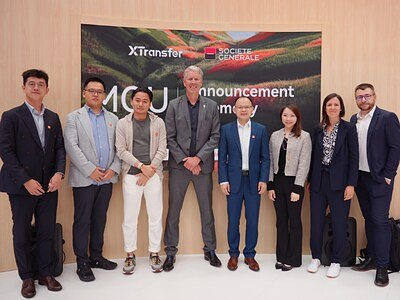
The New Plumbing: XTransfer and SocGen Rewire Global Trade Flows
AMSTERDAM, June 05, 2026 – On the surface, the announcement at Money20/20 Europe was standard corporate fare: a Memorandum of Understanding (MOU) signed between a financial technology firm and an established bank. XTransfer, a Shanghai-based B2B payments platform, and Societe Generale, a titan of European banking, shook hands on a partnership to streamline cross-border payments. But to dismiss this as just another press release is to miss the strategic undercurrents reshaping the very architecture of global trade.
This isn't merely about making payments faster. It's a calculated move to rewire the financial plumbing that connects the world's manufacturing powerhouse, China, with European markets. The partnership aims to build a more efficient, transparent, and resilient pipeline for the nearly $800 billion in annual trade flowing between the two blocs. By combining the digital agility and AI-powered risk management of a fintech with the regulatory heft and infrastructure of a legacy institution, this alliance offers a blueprint for how the friction-laden world of B2B payments will evolve.
The Anatomy of Friction
For years, the narrative of global trade has been one of increasing volume and velocity. Yet the financial infrastructure supporting it has remained stubbornly archaic, particularly for the small and medium-sized enterprises (SMEs) that form the backbone of global supply chains. The MOU explicitly targets the “persistent frictions” that plague international commerce: fragmented collection systems, opaque fees, prolonged settlement times, and a labyrinth of compliance requirements.
These are not minor inconveniences. The global B2B cross-border payments market, valued at over $1.6 trillion, is rife with inefficiency. Recent industry data shows that 63% of businesses demand faster settlements, while nearly half report severe reconciliation challenges. For an SME in Germany trying to pay a supplier in Shenzhen, this friction translates into higher costs, trapped working capital, and significant operational risk. Transactions can get lost in a correspondent banking system built for a different era, exchange rates can erode margins, and the fear of a frozen account due to a compliance misstep is ever-present.
This is the strategic rationale behind the XTransfer-Societe Generale pact. It seeks to replace the patchwork of legacy systems with a streamlined, digitally native solution. The goal is to create an experience where cross-border payments are as predictable and automated as domestic ones, a baseline expectation that, as Societe Generale's Andreea Parneci noted, is now standard for internationally active clients.
A Hybrid Model for a Hybrid World
The most compelling aspect of this deal is the fusion of two seemingly disparate worlds. On one side is Societe Generale, a bastion of the traditional financial system, bringing its global infrastructure, bank-grade resilience, and deep regulatory expertise. On the other is XTransfer, a fintech that has rapidly become a dominant force in its niche, claiming to handle payments for nearly 15% of China's SME exporters and processing over $12 billion in monthly transactions.
XTransfer’s core asset is its technology. Its “X-Net” platform is a globally unified settlement network, but its true power lies in its AI-driven risk management engine. The system performs real-time fraud detection and anti-money laundering checks by cross-referencing trade data like invoices and shipping documents, boasting a seamless risk-control approval rate of 99% and a fraud ratio it claims is the industry’s lowest. This allows it to navigate complex compliance landscapes at a fraction of the cost of a traditional bank.
For Societe Generale, partnering with XTransfer provides an immediate injection of this digital capability and access to a vast network of over 700,000 SMEs. It’s a strategic shortcut to innovation. As Andreea Parneci, Deputy Head of Global Transaction and Payment Services at Societe Generale, stated, "By combining our global infrastructure with an innovative digital platform such as XTransfer, we continue to enhance the efficiency and reliability of international payments."
For XTransfer, the alliance offers legitimacy, scale, and deeper banking connectivity within Europe. It’s a symbiotic relationship designed to build what XTransfer’s Founder and CEO, Bill Deng, calls “a globally unified B2B cross-border settlement network.”
Deconstructing the 'Pay to China' Pipeline
The centerpiece of the collaboration is the development of integrated financial solutions, including a “Pay to China” service with USD and CNY settlement. This directly addresses one of the biggest pain points for businesses trading with China. Settling payments into Mainland China, particularly in the local currency, has long been a complex process governed by strict capital controls overseen by the People's Bank of China and the State Administration of Foreign Exchange.
By leveraging XTransfer’s compliance technology—which authenticates the legitimacy of each trade—and Societe Generale’s banking rails, the partnership aims to create a trusted and efficient channel for these payments. This allows a European importer to pay its Chinese supplier directly in CNY, mitigating currency risk for the supplier and simplifying the process for the buyer. The use of Hong Kong as a settlement hub adds a layer of flexibility, taking advantage of its position as a major offshore RMB center.
This isn't just about convenience; it's about strategic advantage. Providing reliable, multi-currency settlement options strengthens the entire supply chain, making it more resilient and cost-effective. The exploration of advanced FX solutions to convert local currencies into USD and EUR further reinforces this, giving traders greater certainty in a volatile world.
The New Competitive Battleground
This partnership does not exist in a vacuum. It is the latest move in an intensifying competition to dominate the lucrative B2B cross-border payments market. Standalone fintechs like Wise Business and Airwallex have already made significant inroads by offering speed and transparency. Meanwhile, banking giants are racing to modernize their own offerings.
What makes the XTransfer-Societe Generale model significant is its hybrid nature. It suggests a future where the dichotomy between “fintech” and “bank” dissolves. This is not XTransfer’s first such move; it signed a similar MOU with BNP Paribas in 2025, indicating a deliberate strategy to embed its technology within Europe's core financial institutions. It is a quiet, methodical campaign to become the indispensable plumbing for Asia-Europe trade.
By creating these alliances, XTransfer and its banking partners are building a powerful competitive moat. They are combining the network effects of a massive SME user base with the deep-rooted trust and regulatory access of incumbent banks, creating an integrated ecosystem that is difficult for either a standalone fintech or a slow-moving traditional bank to replicate. This is how the quiet moves of today will define the next decade of the global economy.