
- 3.5 billion user-driven kilometers logged by QCraft's QPilot system, with over 100 million automated parking assists.
- Less than once per 500,000 kilometers Automatic Emergency Braking (AEB) false-trigger rate.
- Global production target of 2026 for mass-market urban autonomous navigation.
Experts would likely conclude that QCraft and Qualcomm's collaboration represents a significant leap forward in urban autonomy, with production-ready technology poised to disrupt the automotive industry by 2026.
The New Kings of the Road: How a Chip Giant and an AI Upstart Are Conquering Urban Autonomy
WUXI, China – June 11, 2026 – In the intricate dance of modern mobility, the most crucial steps are no longer happening on the factory floor, but on silicon wafers. This was made vividly clear last week in Wuxi, where attendees of the Qualcomm Automotive Technology and Cooperation Summit were chauffeured through complex city streets not by humans, but by an advanced assisted driving system. The demonstration, a collaboration between AI firm QCraft and chip titan Qualcomm, wasn't just a technical showcase; it was a declaration that the era of mass-market urban autonomous navigation is arriving, with a target date of 2026 for global production.
For years, the promise of self-driving cars has been bifurcated. Highway autopilot systems have become relatively common, but the chaotic, unpredictable environment of the city has remained the final, formidable frontier. QCraft’s demonstration of its urban Navigate-on-Autopilot (NOA) solution, running smoothly on production vehicles equipped with Qualcomm’s SA8650P system-on-a-chip (SoC), signals a critical breach of that frontier. This isn't a moonshot research project; it's a production-ready solution on a fast track to global deployment.
The Chipset is the Chessboard
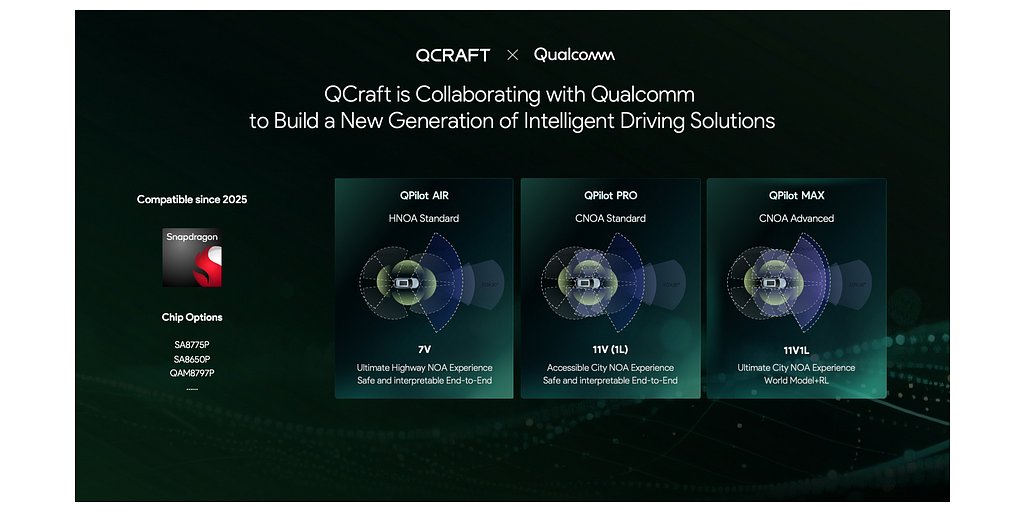
The story of QCraft’s rapid ascent is inextricably linked to its strategic calculus on partnerships. The alliance with Qualcomm, formally announced less than a year ago at IAA MOBILITY 2025 in Munich, has proven to be a powerful accelerant. While many tech firms spend years adapting software to hardware, QCraft completed the development and on-road validation of both highway and urban NOA on Qualcomm’s SA8775P and SA8650P platforms in under twelve months. This blistering pace is a testament to a new reality in the automotive world: software and hardware co-development is no longer an advantage, but a prerequisite for survival.
Qualcomm, a dominant force in mobile communications, has strategically positioned its Snapdragon Ride platform as the central nervous system for the next generation of vehicles. These SoCs provide the immense computational power necessary to process torrents of sensor data and execute complex AI decisions in real-time. By leveraging this off-the-shelf power, QCraft circumvents the prohibitively expensive and time-consuming process of developing bespoke hardware. The partnership is already looking ahead, with joint development underway for an even more powerful solution based on Qualcomm’s QAM8797P platform, ensuring a roadmap that keeps pace with the exponential growth in AI complexity.
However, QCraft is not betting on a single horse. The company’s architecture is designed for flexibility, with support for chipsets from other major players like Horizon Robotics and NVIDIA. This platform-agnostic approach is a shrewd strategic move, offering automakers choice and mitigating supply chain risks. It transforms QCraft from a simple supplier into a versatile integration partner, capable of adapting its 'brain' to the 'nervous system' of any major vehicle architecture. This flexibility is critical for its stated goal of global delivery to markets in Europe, the U.S., Japan, and South Korea, where automaker preferences vary widely.
From Highway Cruising to Urban Complexity
The true significance of the Wuxi demonstration lies in the word 'urban'. While highway assistance systems operate in a relatively structured environment with clear lanes and predictable traffic flow, cities are a maelstrom of variables. The test vehicles, equipped with QCraft's system, navigated a gauntlet of urban driving’s most notorious challenges: unprotected left turns across oncoming traffic, chaotic intersections with mixed pedestrian and vehicle flow, and seamless maneuvering in congested tunnels. Observers noted the system’s smooth, “human-like” control, a quality that has eluded many of its predecessors and is essential for passenger acceptance.
Achieving this level of performance moves the industry beyond the current state of advanced driver-assistance systems (ADAS). It requires a system that doesn't just react to its immediate surroundings but anticipates the intent of other road users. This is the core challenge that has kept more advanced autonomy confined to limited geofenced areas or pilot programs. By proving its capability in real-world production vehicles, QCraft is putting immense pressure on competitors and signaling to global automakers that a scalable, cost-effective solution for Level 2++ and higher urban autonomy is no longer a distant dream.
This progress is built on a foundation of staggering real-world data. The company’s existing QPilot assisted-driving solution is already installed on nearly 30 production models from various manufacturers, with over 50 more models expected this year. This fleet has logged over 3.5 billion user-driven kilometers and more than 100 million automated parking assists. This vast dataset is the lifeblood of its AI development, providing a continuous feedback loop for refining algorithms. Furthermore, the system’s impressive safety metric—an Automatic Emergency Braking (AEB) false-trigger rate of less than once per 500,000 kilometers—is the kind of hard data that convinces risk-averse automotive executives and safety regulators.
The Dawn of the 'Physical AI' Driver
Perhaps the most profound insight from the announcement came from QCraft’s CTO, Dr. Dong Li, who framed the current moment as an inflection point toward “general-purpose physical AI.” This concept moves beyond the narrow, programmed logic of traditional ADAS. The goal is not just to build a car that follows rules, but to cultivate an AI with genuine driving instincts. The essential tools for this evolution, according to Dr. Li, are 'world models' and 'reinforcement learning'.
A world model is the AI's internal, predictive simulation of the physical world. It allows the system to play out countless 'what-if' scenarios in a fraction of a second—what if that pedestrian steps off the curb? What if the car in front brakes suddenly? Reinforcement learning is the process through which the AI teaches itself within this simulated world, running billions of cycles of trial and error to discover the optimal and safest driving strategies without ever endangering a real vehicle.
QCraft’s cloud-based world model is a formidable asset. It includes a “zero-shot engine” that can use natural language prompts to synthesize long-tail corner cases and adverse weather scenarios on command—situations that would be too rare or dangerous to test exhaustively in the real world. This low-cost, closed-loop simulation allows the AI to develop what Dr. Li calls “defensive driving instincts” for proactive safety. “Safety will always be our highest priority,” he affirmed. This AI-centric approach, focused on building an artificial intuition for the road, represents a fundamental paradigm shift. It’s a strategy for scaling intelligence, turning the immense challenge of autonomous driving from a hardware problem into a data and simulation problem, which is exactly where today’s AI giants excel.