
- 100% plant-based: BioFleax® is composed entirely of renewable plant resources, offering a sustainable alternative to fossil-fuel-based textiles like PET.
- 60% faster drying: BioFleax boasts superior moisture management, drying 60% faster than conventional PET fabrics.
- ISCC PLUS certification: Leaf Bio’s process has earned the world's first ISCC PLUS certification, verifying the sustainability and traceability of its bio-based materials.
Experts view BioFleax as a significant advancement in sustainable fashion, combining high performance with eco-friendly credentials, and its debut in the Stella McCartney x H&M collaboration signals a critical shift toward mainstream adoption of next-generation materials.
The New Fabric of Fashion: BioFleax Debuts in McCartney x H&M Collab
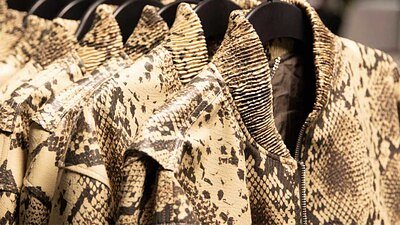
LONDON, UK – May 22, 2026 – In the world of high-street fashion, a snakeskin-print bomber jacket is often just a fleeting trend. But in the new Stella McCartney H&M Spring 2026 collection, it represents a potential sea change. The jacket’s standout feature isn’t its design, but its composition: BioFleax®, a 100% plant-based performance material making its global retail debut.
More than two decades after their first groundbreaking collaboration, the reunion of Stella McCartney and H&M arrives at a critical juncture for the fashion industry. As brands and consumers grapple with the environmental cost of apparel, the demand for genuine innovation in materials, supply chain transparency, and circular systems has never been more urgent. The introduction of a novel material like BioFleax into a mainstream collection moves the conversation from abstract sustainability reports to a tangible product consumers can see, touch, and wear. It signals a critical transition for next-generation materials, moving them from the lab to the retail floor.
Beyond the Hype: The Science of a Plant-Based Textile
BioFleax is not simply another plant-derived fabric; it represents a significant step in material science. Developed by the technology platform Leaf Bio, it is an innovative PEF (polyethylene furanoate) textile. Unlike its fossil-fuel-based counterpart, PET (polyethylene terephthalate)—the ubiquitous polyester found in countless garments—PEF is derived entirely from renewable plant resources. Leaf Bio’s process utilizes renewable biomass, including upcycled agricultural byproducts like straw, to create the foundational chemical building blocks of the fiber.
This innovation has earned Leaf Bio the world's first ISCC PLUS certification for its core components, a globally recognized standard that verifies the sustainability and traceability of bio-based materials throughout the entire supply chain. For the fashion industry, this level of third-party validation is crucial in combating claims of greenwashing.
More importantly, BioFleax is engineered for performance, aiming to eliminate the perceived trade-off between sustainability and functionality. According to Leaf Bio, the material is designed to combine the comfort of natural fibers with the durability and versatility of synthetics. Its performance metrics are impressive: it boasts a moisture regain rate three to five times higher than PET and dries 60% faster, offering superior moisture management. Furthermore, it possesses natural antibacterial properties and intrinsic UV protection without the need for chemical additives or metal ion treatments, which are common in conventional performance wear. This combination of eco-credentials and high performance makes it a compelling alternative for an industry heavily reliant on petroleum.
A Partnership with Purpose
The choice of collaborators for BioFleax’s debut is as significant as the material itself. Both Stella McCartney and H&M have built their brands, in different market segments, around ambitious sustainability platforms. For Stella McCartney, a lifelong vegetarian, the commitment is foundational. Her brand has been a pioneer in luxury fashion, shunning leather, fur, and feathers since its inception and consistently championing material innovation, from recycled cashmere to mycelium-based leather alternatives.
Similarly, H&M Group has set aggressive public targets, aiming for 100% of its materials to be either recycled or sustainably sourced by 2030. Having already reached 91% of this goal in 2025—with nearly a third of materials coming from recycled sources—the fast-fashion giant is investing heavily in decarbonization and new material technologies. The group’s public reporting, aligned with stringent EU standards, and its global garment collecting initiative underscore a corporate-wide push towards a circular business model.
This renewed partnership is more than a one-off collection. The collaborators have also established an "Insights Board," a forum intended to bring together experts from technology, media, and advocacy to drive dialogue and action on circularity and innovation across the industry. This move suggests a deeper commitment to fostering systemic change beyond the lifespan of a single product line.
From Pilot to Production: The Challenge of Scale
For any new material, the journey from a laboratory concept to a commercially available product is fraught with challenges. The fashion industry's complex, high-volume supply chains are notoriously difficult for newcomers to penetrate. BioFleax's inclusion in the Stella McCartney H&M collection is therefore a significant milestone, demonstrating its readiness for real-world application.
It proves that the material can not only meet design specifications—in this case, for a trendy snakeskin-print bomber—but also withstand the rigors of industrial manufacturing, dyeing, and finishing processes. As the press release notes, this moves BioFleax beyond “concept-stage experimentation and into global fashion products.”
One of the most critical aspects for long-term viability is circularity. While many bio-based materials present end-of-life challenges, Leaf Bio states that BioFleax is designed with future circularity in mind. Crucially, its chemical structure makes it compatible with existing PET recycling streams, a key advantage that could facilitate its integration into a truly circular economy without requiring a complete overhaul of current recycling infrastructure. This compatibility addresses a major bottleneck for scaling sustainable materials, making it a more practical and less disruptive solution for brands to adopt.
By appearing in a highly visible, accessible collection, BioFleax is undergoing a public trial, testing not only its performance but also its consumer appeal. This collaboration provides a blueprint for how material innovators and global brands can work together to de-risk and accelerate the adoption of sustainable technologies, proving both market demand and industrial feasibility at the same time.