
- 242 U.S. cities now have starter homes priced at $1 million or more, nearly triple the pre-pandemic count of 80.
- The national median home price stands at over $429,000, with monthly mortgage payments remaining historically high.
- A 20% down payment on a million-dollar home requires $200,000, a barrier for most first-time buyers.
Experts agree that the surge in million-dollar starter homes reflects a structural shift in housing affordability, driven by supply constraints and pandemic-era market dynamics, with regional disparities highlighting the need for policy intervention to address the crisis.
The Million-Dollar Starter Home: Is the American Dream a Luxury Good?
SEATTLE, WA – June 15, 2026
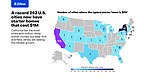
The quintessential American starter home—a modest, affordable first step on the ladder of property ownership—is becoming an artifact of a bygone era. In its place, a new, far more intimidating barrier to entry has emerged: the million-dollar price tag. A stunning new analysis from real estate technology giant Zillow reveals that a record 242 U.S. cities now feature "starter homes" with a typical value of $1 million or more. This figure has nearly tripled from just 80 cities before the pandemic, a stark indicator of a market fundamentally reshaped.
For generations of Americans, the starter home symbolized financial ascent and stability. Today, for many in these 242 cities, that first rung of the ladder is now forged from platinum. While the typical starter home nationwide—defined as a property in the lowest third of local home values—sits at a more terrestrial $198,649, the explosive growth of seven-figure entry points signals a deep, structural shift in housing affordability. This isn't a story about luxury real estate; it's about the escalating cost of simply getting in the game.
The Pandemic's Long Shadow: A Permanent Market Reset?
The roots of this affordability crisis run deep, but the pandemic acted as a powerful accelerant. A decade-long housing shortage collided with a perfect storm of intense buyer demand, fueled by historically low mortgage rates and a societal shift toward remote work. The result was a frantic, record-setting pace of price appreciation whose effects are proving stubbornly durable.
"The pandemic reset the cost of buying a home, spreading million-dollar starter homes from a handful of coastal states to more than two dozen states across the country," said Kara Ng, a senior economist at Zillow, in the report.
This "reset" has pushed the dream of ownership further out of reach for countless first-time buyers. While some market analysts point to a "Great Housing Reset" in 2026, where wage growth may finally begin to outpace the rate of home price increases, the ground-level reality remains daunting. National median home prices for all housing types continue to hover at record highs, reaching over $429,000 according to the National Association of Realtors, and monthly mortgage payments remain historically elevated despite a slight easing of interest rates from their recent peaks.
Even with some positive signs, like the time it takes for a home purchase to break even against renting decreasing from eight years to six, the psychological and financial weight of the initial purchase price is immense. The market may be stabilizing, but it's stabilizing at a new, much higher altitude.
A Tale of Two Coasts: Regional Gaps and Policy Failures
The phenomenon of the million-dollar starter home is not evenly distributed. It paints a detailed map of regional supply constraints and policy choices. California, long the epicenter of high-cost real estate, still leads the nation with 105 cities on the list. However, the most dramatic growth is now concentrated in the Northeast.
New York and New Jersey have added a combined 15 cities to the list in the past year alone. New York's total has surged to 41, up from just 12 before the pandemic, while New Jersey has ballooned from a single city in 2020 to 26 today. The New York City metropolitan area, which encompasses parts of New Jersey and Pennsylvania, is the undisputed leader, boasting 63 cities where the entry-level home costs a million dollars or more.
According to Zillow's analysis, this regional divergence is a direct consequence of housing supply. "Million-dollar starter homes are popping up in more Northeast cities because the housing shortage there hasn't been solved," Ng explained. "Sun Belt markets have responded with new supply and seen price growth moderate as a result. The Northeast hasn't had that relief."
This points to a critical crossroads for business and government. The problem is spreading inland, too. Before 2020, only Colorado had an interior city on the list. Today, 26 states—including Texas, Wyoming, and Illinois—have at least one. Experts argue that without significant intervention, this trend will continue. The most direct path to improvement, they contend, lies in tackling the barriers to building, particularly restrictive local zoning laws that stifle the creation of new, more diverse housing stock.
The Human Cost of a Million-Dollar Entry Fee
Beyond the data and market trends lies the profound human impact. For aspiring first-time buyers, the current market feels less like an opportunity and more like a locked gate. The financial hurdles are staggering. A 20% down payment on a million-dollar home is $200,000—a sum that is unattainable for the vast majority of young individuals and families, even those with solid incomes.
This affordability crisis is forcing a generation to make difficult life choices. Housing advocates note a significant rise in multigenerational living, not as a cultural preference, but as a financial necessity. Millions of millennials and Gen Zers are delaying major life milestones like marriage and starting families, or moving back in with their parents to save for a down payment that seems to grow faster than their savings accounts.
The delay in homeownership has long-term consequences for wealth creation. According to one housing economist, delaying a first home purchase from age 30 to 40 can result in a potential loss of over $150,000 in equity on a typical starter home. This widens the generational wealth gap and frays the social contract that promises upward mobility. In response, buyers are adapting. The very concept of a "starter home" is being redefined. Instead of a small, temporary dwelling, first-time buyers are now looking for properties they can live in for a decade or more, prioritizing space, modern amenities, and functionality, which further inflates the price they are willing—or forced—to pay.
Navigating the New Normal
While the landscape is challenging, it is not entirely devoid of change. Technology is playing a crucial role in helping buyers navigate this complex market. Companies like Zillow are developing tools like their BuyAbility℠ feature, which provides personalized estimates of affordable price points and monthly payments, and integrating modules that connect buyers with local down payment assistance programs. These innovations aim to empower buyers with information and resources in a market where every advantage counts.
There are also faint glimmers of hope on the macroeconomic front. For the first time since 2022, the typical mortgage payment has dipped below the standard 30% affordability threshold for the median household income, a small but significant step. Yet, this relief is overshadowed by a growing market bifurcation. While sales of homes priced over $1 million are surging, transactions for homes under $250,000 have fallen sharply, suggesting a market increasingly tilted towards the wealthy.
The rise of the million-dollar starter home is more than a statistic; it is a defining challenge of our time. It sits at the intersection of economic forces, policy decisions, and the deeply personal aspirations of millions. As businesses innovate and policymakers debate, the question remains whether the path to homeownership can be cleared for the next generation, or if the American Dream is becoming just another luxury good.