
- £2.4 million project funded by Scottish Enterprise
- PicoTesla-level sensitivity achieved with Tunnel Magnetoresistance (TMR) sensors
- CES 2026 debut for the MiMiG Wristband prototype
Experts view Neuranics' magnetomyography (MMG) technology as a groundbreaking advancement in human-machine interaction, offering a comfortable, non-invasive alternative to existing gesture control methods with significant potential in XR, digital health, and accessibility.
The Magnetic Revolution: Neuranics' Silent Gesture Control Tech
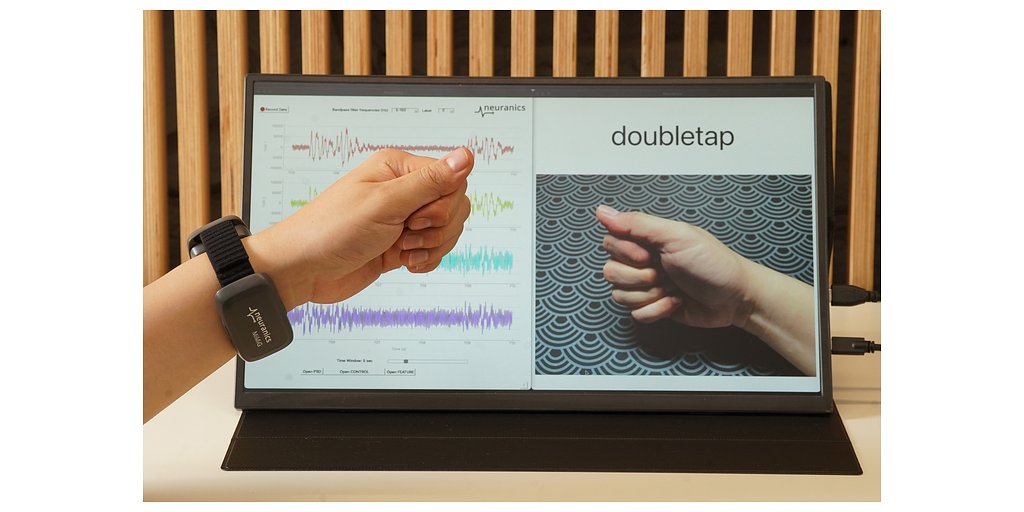
GLASGOW, Scotland – November 25, 2025 – The long-sought future of human-machine interaction (HMI) has often been depicted as a world of seamless, intuitive control, where our technology responds to our intent with minimal physical effort. While touchscreens and voice commands have brought us closer to this vision, they remain discrete, often public, actions. A new frontier is emerging, one that operates silently by listening to the body itself. At the vanguard of this shift is Neuranics, a Scottish technology firm poised to demonstrate a potentially transformative approach at CES 2026. The company will debut its MiMiG Wristband, a prototype that reads the subtle magnetic fields generated by muscle movement to enable complex gesture control.
This isn't merely another wearable gadget; it's a strategic move built on pioneering science that could fundamentally alter the architecture of interaction across extended reality (XR), digital health, and industrial automation. By moving beyond the limitations of current technologies, Neuranics is betting that the future of control is not just smart, but silent.
The Science of Silent Signals
At the heart of the MiMiG wristband is magnetomyography (MMG), the magnetic counterpart to the more familiar electromyography (EMG). While EMG detects the electrical potential generated by muscle cells and has been a staple in medical diagnostics and prosthetics, it comes with practical drawbacks. Effective EMG often requires conductive gels, adhesive electrodes, and tight skin contact, creating issues with comfort, signal degradation from sweat, and long-term wearability.
MMG, in contrast, measures the minute magnetic fields that are an inherent byproduct of those same electrical currents in our muscles. The core advantage is profound: magnetic fields can be detected without direct skin contact. Neuranics’ prototype promises a comfortable, low-profile wristband that works without gels or tight straps, potentially even through a thin layer of clothing. This circumvents the primary user-experience hurdles that have kept complex gesture control from achieving mainstream adoption in consumer wearables.
The historical challenge for MMG has been the sheer weakness of these biological signals, which are measured in picoTeslas—a fraction of the Earth's magnetic field. Detecting them required bulky, expensive laboratory equipment like SQUIDs (Superconducting Quantum Interference Devices), rendering the technology impractical for consumer applications. Neuranics’ breakthrough lies in its integration of ultra-sensitive Tunnel Magnetoresistance (TMR) sensors. TMR sensors, which leverage quantum mechanics to detect minute changes in magnetic fields, are exceptionally small, require very little power, and offer the picoTesla-level sensitivity needed to make MMG viable in a wearable form factor. This fusion of advanced sensor technology with the principles of MMG is the technological leap that underpins the company's entire value proposition.
Navigating a Competitive Landscape
Neuranics is entering a dynamic but crowded HMI market. Gesture control is currently dominated by optical systems, like those from Ultraleap, which offer impressive fidelity but require a clear line of sight, and by other wearables that rely on a fusion of EMG and Inertial Measurement Units (IMUs). While effective, these solutions have their own constraints, from environmental limitations to the aforementioned comfort and skin-contact issues of EMG.
Neuranics' strategy appears to be one of technological differentiation and strategic partnership rather than direct consumer competition. The MiMiG wristband being shown at CES is explicitly a developmental prototype available for evaluation by partners under NDA. This positions Neuranics not as a product company, but as a core technology provider aiming to embed its solution into the ecosystems of established players. By offering a complete signal chain—from the TMR sensors to a custom mixed-signal ASIC and AI-powered processing electronics—the company presents a turnkey solution for manufacturers in XR, digital health, and robotics.
This B2B focus is a shrewd move. It allows the company to focus on perfecting its deep-tech advantage while enabling other companies to innovate on top of its platform. Financial backing, including an £800,000 grant from Scottish Enterprise for a larger £2.4 million project, validates this approach and provides the capital to scale its research and development. The goal is to become an indispensable component for the next generation of devices, much like ARM did for mobile processors or Dolby for audio.
Redefining Wearables for Wellness and Accessibility
While the most immediate applications for high-fidelity gesture control are in XR and gaming, the broader implications of Neuranics' technology extend into more impactful domains. The non-invasive, comfortable nature of an MMG-based wearable opens significant opportunities in digital health and accessibility.
For remote patient monitoring and rehabilitation, a device that can continuously and comfortably track muscle activity, fatigue, and recovery without cumbersome electrodes could provide invaluable data to clinicians. Physical therapy adherence could be monitored remotely, and the onset of neuromuscular conditions could potentially be detected earlier through subtle changes in muscle signals over time. Unlike activity trackers that measure motion, MMG measures intent and effort, offering a much richer dataset for health analysis.
Furthermore, the technology holds immense promise for accessibility. Individuals with motor impairments could use subtle, almost invisible finger or hand gestures to control smart home devices, powered wheelchairs, or communication aids. This provides a level of discretion and ease that is simply not possible with more overt interfaces. In industrial settings, the ability to control machinery or robotics through gloves or protective clothing presents a clear advantage for safety and efficiency.
The upcoming CES 2026 demonstration will be a critical inflection point. Neuranics must prove that its prototype can deliver reliable, low-latency performance outside the lab. The participation of its CSO, Dr. Kia Nazarpour, on a CES panel about AI-powered wearables suggests the company is ready to articulate its vision for a future where devices move from being passive data collectors to proactive partners. If the MiMiG wristband lives up to its promise, it may well convince industry leaders that the next great leap in human-machine interaction will be read not from a screen, but directly from the silent, magnetic signals of the human body.