
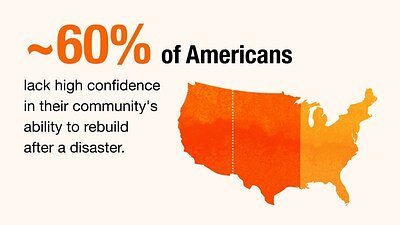
- 60% of Americans lack high confidence in their community's ability to rebuild quickly after a disaster.
- 78% of residents in disaster-prone regions report significant challenges with long-term recovery.
- 94% of construction firms struggle to fill craft worker positions, with disaster recovery projects facing a 60% shortage of qualified labor.
Experts agree that the severe shortage of skilled labor is a critical bottleneck in post-disaster recovery, requiring urgent investment in vocational training and workforce development to ensure community resilience.
The Invisible Crisis: Labor Shortage Halts Post-Disaster Rebuilding
ATLANTA, GA – January 20, 2026 – One year after devastating wildfires scorched Southern California, a new and formidable challenge is hindering recovery efforts not just in Los Angeles, but across disaster-stricken America: a severe shortage of skilled labor. New research reveals that even when financial aid is secured, the hands needed to rebuild—carpenters, electricians, and plumbers—are often nowhere to be found, turning natural disasters into prolonged economic and social crises.
A nationwide survey released today by The Home Depot Foundation and Morning Consult paints a stark picture of dwindling public confidence and delayed reconstruction. According to the findings, nearly 60% of Americans lack high confidence in their community's ability to rebuild quickly following a disaster. For those who have lived through it, the reality is even grimmer. More than half (52%) of residents rebuilding after a disaster reported that the process took significantly longer than they expected.
The problem is particularly acute in regions recently battered by nature's fury. In areas like Los Angeles, Texas, North Carolina, and parts of Florida, Ohio, and Kentucky, a staggering 78% of residents noted significant challenges with long-term recovery efforts. The professional contractors on the front lines confirm the bottleneck. While hiring skilled labor is a challenge industry-wide, the number of contractors citing a lack of qualified help as their greatest need jumps to 60% for those specifically working on disaster recovery projects.
"We are seeing a clear trend where disaster-impacted communities are experiencing delays in long-term recovery and the rebuilding process, with the lack of available labor being one of the primary issues," said Erin Izen, executive director of The Home Depot Foundation.
The Human Cost of a Widening Gap
The skilled trades gap is not a new phenomenon, but its collision with the increasing frequency of climate-related disasters has created a perfect storm of stalled progress. The core of the issue is a demographic cliff. Independent industry data from sources like the National Center for Construction Education & Research (NCCER) supports the alarming projection that approximately 40% of the current construction workforce is set to retire by 2031.
This looming mass retirement is already being felt. The Associated General Contractors of America (AGC) reported in its 2024 workforce survey that 94% of construction firms had openings for craft workers, and the vast majority found those positions incredibly difficult to fill. When a hurricane, flood, or wildfire strikes, this pre-existing national shortage becomes a localized catastrophe. The sudden, massive demand for skilled builders overwhelms the available supply, leaving homeowners and businesses in a frustrating limbo.
This delay is more than an inconvenience; it's a barrier to human and economic recovery. Families remain displaced, living in temporary housing for months or years. Businesses stay shuttered, draining local economies of jobs and tax revenue. The extended timeline also exacerbates other systemic issues, as communities of color and low-income households, who often face greater hurdles in accessing aid, are disproportionately affected by the slow pace of reconstruction.
Building a New Generation of Tradespeople
In response to this growing crisis, The Home Depot Foundation is significantly expanding its Path to Pro program, a national initiative launched in 2018 with a $50 million commitment to train the next generation of tradespeople. The program, which has already introduced over 245,000 people to the skilled trades and trained more than 43,000 participants, is now scaling up its efforts with a direct focus on building resilience in disaster-prone areas.
Beginning in 2026, the Path to Pro Education Grants program will expand to all 50 states. This will allow K-12 schools, community colleges, and nonprofit trade schools nationwide to apply for funding to purchase modern equipment and tools or remodel their training facilities, directly addressing the need for accessible, high-quality vocational education.
In Southern California, the Foundation is continuing its targeted recovery efforts. In partnership with the SkillPointe Foundation, it offers $2,500 scholarships to students within 60 miles of Los Angeles pursuing post-secondary education in construction roles. To date, over 70 such scholarships have been awarded in the region, supplementing a broader national scholarship program.
A particularly innovative effort is a $1 million partnership with Team Rubicon, a veteran-led disaster response organization. The pilot program, known as the "TRades Academy," trains military veterans and civilian volunteers with industry-recognized credentials from the Home Builders Institute (HBI). This creates a mobile corps of skilled volunteers capable of stabilizing housing and beginning critical repairs in the immediate aftermath of a disaster.
"As an organization focused on community resilience, before, during and after disasters, Team Rubicon feels the impact of the increasing gap in skilled trades workers," explained Danica Deming, vice president of Workforce Development for Team Rubicon. "Investing in skilled trades training alongside partners like The Home Depot Foundation is essential for building both strong communities and storm-resistant housing."
An Industry-Wide Call to Arms
The effort to close the trades gap extends far beyond a single foundation. Major industry associations are mobilizing to address the workforce pipeline as a matter of national priority. The Associated General Contractors of America (AGC), the National Association of Home Builders (NAHB), and Associated Builders and Contractors (ABC) are all running extensive initiatives.
These organizations are championing government-registered apprenticeship programs, developing standardized, competency-based training curricula with partners like NCCER, and advocating for federal and state investment in career and technical education. Their work focuses on introducing careers in construction at the high school level, recruiting from diverse populations including separating military members, and creating clear pathways to well-paying, stable careers.
This multi-pronged approach underscores a fundamental shift in understanding community resilience. It’s no longer just about having emergency funds or response plans in place. True resilience requires a long-term investment in the human infrastructure necessary to rebuild. By training a new, diverse generation of skilled tradespeople, these programs aim to ensure that when the next disaster strikes, communities will have the essential workforce they need to rise from the rubble and build a stronger future.