
- 90% of new data centers by 2030 will incorporate liquid cooling, up from less than 25% today (Gartner).
- 100kW per rack capacity in MSI's 21" 44OU ORv3 Liquid-Cooled Rack Architecture, a critical threshold for high-density AI deployments.
- 30-50% reduction in data center energy consumption with liquid cooling, addressing sustainability and efficiency challenges.
Experts agree that liquid cooling is becoming essential for AI infrastructure due to thermal and energy constraints, with MSI's modular, open-standard solutions positioning it as a leader in this critical transition.
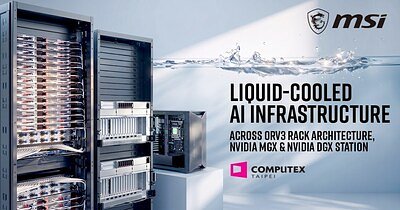
The Inevitable Chill: MSI's Bet on the Physical Future of AI
TAIPEI, Taiwan – June 2, 2026 – As the digital dust settles at COMPUTEX 2026, one of the industry's most significant truths is being written not in code, but in coolant. Micro-Star International (MSI), a company long known for its high-performance consumer hardware, has unveiled a comprehensive enterprise portfolio that signals a fundamental shift in how we build the engines of artificial intelligence. The message is clear: the exponential growth of AI is running headfirst into the physical limits of power and heat, and the future belongs to those who can manage the thermodynamics.
MSI's showcase is a masterclass in addressing this challenge, centered on a technology that is rapidly moving from niche to necessity: liquid cooling. "Scaling AI infrastructure now requires a balance between compute performance, thermal efficiency, and deployment flexibility," stated Danny Hsu, General Manager of MSI's Enterprise Platform Solutions. This simple statement belies the complex industrial transformation underway. The company's new lineup, spanning from rack-scale architectures to desktop supercomputers, isn't just an upgrade cycle; it's a bet on the physical infrastructure that will underpin the next decade of digital progress.
A Data Center Tipping Point
The AI industry has a voracious appetite for power, and with that power comes an immense amount of heat. Traditional air-cooling, the workhorse of data centers for decades, is simply no longer sufficient. The latest generation of AI accelerators, like NVIDIA's Blackwell GPUs, can each draw 1,000 watts or more. A single rack packed with this technology can generate heat loads that were unimaginable just a few years ago. This thermal barrier is the single greatest bottleneck to achieving the compute density required for tomorrow's AI models.
Industry projections paint a stark picture of this transition. Market analysts at Gartner predict that by 2030, a staggering 90% of new data centers will incorporate liquid cooling, a massive leap from less than a quarter today. This isn't just about performance; it's about economics and sustainability. Liquid cooling is vastly more efficient, capable of reducing a data center's overall energy consumption by 30-50%. In a world grappling with energy constraints and climate imperatives, this efficiency is non-negotiable.
MSI is positioning itself at the vanguard of this shift. The centerpiece of its announcement is the 21" 44OU ORv3 Liquid-Cooled Rack Architecture. This isn't a minor tweak; it's a purpose-built system designed for the new reality. Capable of supporting deployments up to 100kW per rack—a figure that would overwhelm most air-cooled facilities—it utilizes an integrated Liquid-to-Liquid Coolant Distribution Unit (L2L CDU). This design, built on the Open Compute Project (OCP) standard, is precisely what hyperscalers and large enterprises are demanding: a dense, efficient, and standardized way to deploy massive AI clusters.
Democratizing Supercomputing, from Desk to Data Center
While the hyperscale solutions capture headlines, MSI's strategy reveals a deeper understanding of the market's structure. The AI revolution is not monolithic; it's happening at every scale. The company's new portfolio ingeniously bridges the gap between individual developers and globe-spanning cloud providers.
At one end of the spectrum is the XpertStation WS300. Built on NVIDIA's DGX Station architecture, this is not a typical workstation. It's a liquid-cooled, deskside AI supercomputer powered by the formidable NVIDIA GB300 Grace Blackwell Ultra Desktop Superchip. With access to 748GB of coherent memory and blistering 7.1TB/s bandwidth, it gives individual researchers and small teams the power to develop, fine-tune, and run complex AI models locally. By bringing data-center-class computing to the desktop, MSI is equipping the architects of the next AI breakthrough with the tools they need, without requiring access to a full-scale data center.
At the other end is the vast array of NVIDIA MGX servers and modular platforms. These systems, like the liquid-cooled 6U CG681-S6093 platform supporting eight NVIDIA RTX PRO 6000 Blackwell GPUs, are the building blocks of large-scale AI factories. The MGX architecture, a modular reference design from NVIDIA, allows companies like MSI to rapidly develop a diverse range of servers optimized for specific AI workloads, from training to inference. This modularity is a recurring theme.
A Strategic Play on Modularity and Open Standards
Digging deeper into MSI's announcements reveals a savvy strategic play that goes beyond the hardware specifications. The embrace of standards like OCP's ORv3 and the new DC-MHS (Data Center - Modular Hardware System) is a direct appeal to the most sophisticated customers in the market. Hyperscalers and large enterprises are increasingly wary of vendor lock-in and demand the flexibility, scalability, and interoperability that open and modular systems provide.
The DC-MHS platforms allow for compute, storage, and networking nodes to be mixed, matched, and upgraded independently within a shared chassis. This disaggregated approach maximizes resource utilization, simplifies maintenance, and allows data centers to evolve gracefully, adopting new technologies without a complete "rip-and-replace" overhaul. By offering a comprehensive portfolio of DC-MHS components—including Host Processor Modules (HPMs) and servers supporting the latest AMD EPYC 9005 and Intel Xeon 6 processors—MSI is providing the LEGO bricks for building the next generation of efficient, adaptable cloud infrastructure.
This strategic blend of deep partnership with the dominant AI ecosystem player, NVIDIA, and a firm commitment to open, modular standards gives MSI a powerful position. It can offer the cutting-edge performance of Blackwell and MGX while simultaneously providing the flexibility and long-term cost benefits that large-scale operators require. It's a two-pronged approach that acknowledges that while NVIDIA may be designing the AI brains, companies like MSI are building the complex industrial bodies required to house them, a critical and often overlooked component of the ongoing technological transformation.