
- SafeNew AI's Humanizer Engine introduces 'linguistic reconstruction' to transform robotic AI text into human-like writing.
- The tool features 'multi-layer semantic preservation' and 'human cadence modeling' to enhance natural flow.
- SafeNew AI emphasizes privacy with encrypted processing and no storage of user content.
Experts would likely conclude that SafeNew AI's Humanizer Engine represents a significant shift in AI content tools, focusing on enhancing human-AI collaboration rather than evasion, with strong potential to redefine authentic communication in the digital age.
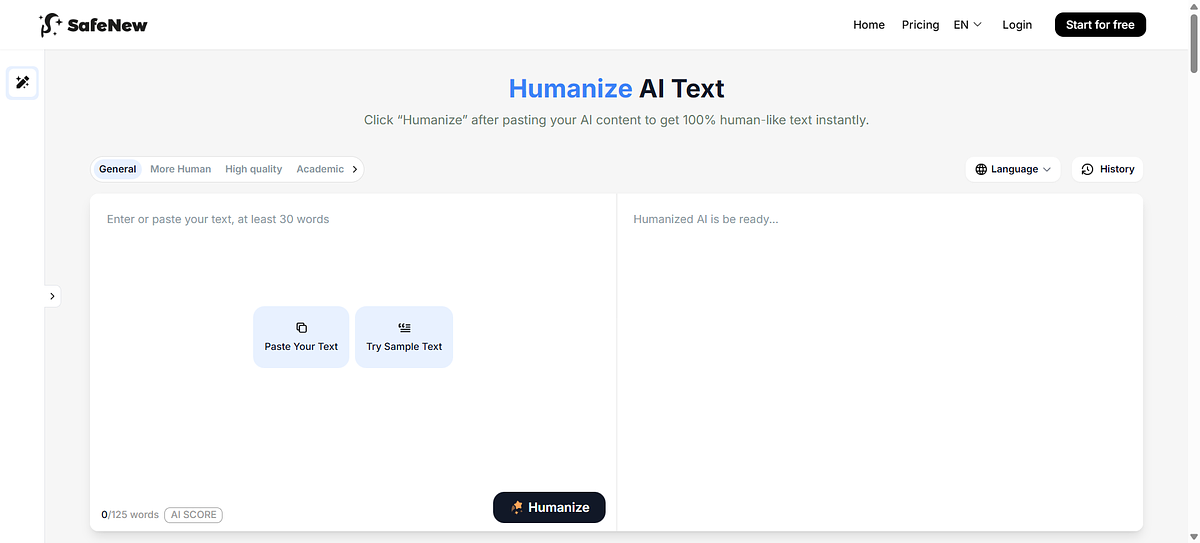
The Human Touch: SafeNew AI Aims to Fix Robotic Writing
SAN FRANCISCO, CA – November 27, 2025 – In an era where artificial intelligence can draft an email, write a marketing plan, or compose an essay in seconds, a new and subtle challenge has emerged: the loss of the human voice. AI-generated text, for all its efficiency, often carries a tell-tale signature—a robotic cadence, repetitive phrasing, and a distinct lack of personality. Addressing this growing disconnect, San Francisco-based SafeNew AI today launched its Humanizer Engine, a tool designed not to detect AI, but to imbue its output with the natural nuance of human expression.
The launch marks a significant pivot in the industry's conversation around AI content. While many developers have focused on an arms race of detection versus evasion, SafeNew AI proposes a different path: augmentation. The company’s core premise is that if we are to collaborate with AI, we need tools that help us refine its output, restoring the authenticity that resonates with readers and defines effective communication.
Beyond Simple Paraphrasing
At the heart of SafeNew AI's new offering is what the company calls "linguistic reconstruction." This is not the simple synonym-swapping or sentence-shuffling seen in common paraphrasing tools, which often still produce formulaic text. Instead, the Humanizer Engine purports to deconstruct the input text and rebuild it from the ground up, focusing on the subtle characteristics of human writing.
The engine's key features offer a glimpse into this deeper process. "Multi-layer semantic preservation" aims to ensure the core message and logical flow remain intact, preventing the meaning-drift that can plague less sophisticated rewriters. More innovatively, "human cadence modeling" analyzes and introduces varied rhythms and sentence structures, breaking up the monotonous patterns typical of machine-generated prose. This allows the final text to flow more naturally, with the starts and stops that characterize human thought and speech.
Furthermore, the system includes tone and style adaptation, allowing users to tailor the output for academic, professional, or creative contexts. By specifically targeting and eliminating "machine-pattern" cues—the predictable linguistic tics that AI detectors are trained to spot—the engine transforms the text into something that feels less manufactured and more authored. This one-click transformation promises to save users—from students polishing essays to marketers crafting brand messages—the considerable time once spent manually rewriting AI drafts to make them sound less like, well, an AI.
A New Philosophy in a Crowded Market
SafeNew AI enters a bustling and competitive market. Dozens of tools, such as Undetectable AI, StealthGPT, and WriteHuman, already promise to "humanize" text, with a primary selling point being their ability to bypass popular AI detectors like Turnitin and GPTZero. For many users, particularly in academia and SEO marketing, this detection-evasion capability is the main driver of adoption, born from a need to avoid penalties or ensure content ranks on search engines.
However, SafeNew AI is attempting to frame its mission differently. “Helping people express themselves naturally and confidently is at the heart of what we do,” said David M., CEO of SafeNew AI, in the company's announcement. “While many platforms focus on detecting AI-generated content, our mission is different. We focus on elevating the user’s voice, not judging it.”
This positioning suggests a strategic move away from the cat-and-mouse game of detection and toward a more constructive role as a writing partner. The target audience is broad and shares a common pain point: the uncanny valley of AI text. Content creators struggle to maintain a unique brand voice, professionals worry that reports sound impersonal, and non-native speakers seek to ensure their writing is not just grammatically correct but also culturally fluent. By focusing on empowerment rather than evasion, the company may carve out a niche with users who see AI as a collaborator, not a shortcut to be concealed.
The Trust Equation: Privacy as a Cornerstone
In an industry grappling with data privacy, SafeNew AI is making its security posture a central part of its value proposition. The company explicitly states that it uses encrypted processing protocols and, crucially, does not store or reuse user content. All text submitted to the Humanizer Engine is reportedly processed securely and discarded immediately after the humanized version is generated.
This privacy-first stance directly addresses one of the most significant anxieties surrounding AI tools. Users are increasingly aware that the text they input into free or poorly secured platforms can be used to train future models, stored indefinitely, or exposed in a data breach. For businesses handling proprietary information, law firms drafting sensitive documents, or individuals concerned about their digital footprint, this is a non-starter.
By building its service on a foundation of data ephemerality, SafeNew AI is not just offering a feature; it's building a platform for trust. This approach aligns with a broader push for responsible AI, as seen in regulatory frameworks like the EU AI Act, which place a heavy emphasis on data governance and user protection. In a market where functionality is often similar, a verifiable commitment to privacy could become the key differentiator that drives adoption among discerning professionals and organizations.
Redefining Human-AI Collaboration
Ultimately, the launch of tools like the Humanizer Engine prompts a larger question about the future of writing. It signals a move beyond the binary debate of human versus machine and toward a more integrated model of human-AI collaboration. The goal is no longer simply to generate text quickly, but to leverage AI for the heavy lifting of drafting and ideation, while using sophisticated tools to refine and infuse that output with human creativity, strategy, and emotion.
This evolving partnership allows writers to act more like editors and strategists, focusing their energy on the high-level aspects of communication—tone, narrative, and persuasive impact—rather than the mechanics of sentence construction. As David M. noted, "The next stage will involve more personalized and human-centered tools." The Humanizer Engine is an early example of this next wave, where technology serves not to replace human skill, but to amplify it.
The challenge, of course, will be in execution. The true measure of the Humanizer Engine will be its ability to consistently produce text that is not just undetectable, but genuinely well-written and authentic. If it succeeds, it could help set a new standard for how we interact with our increasingly capable digital assistants, ensuring that as our tools become more intelligent, our communication remains fundamentally human.