
- $1 billion federal investment to boost Canadian manufacturing and secure jobs at Alstom's Thunder Bay plant.
- 70 new subway cars for the Toronto Transit Commission (TTC), with 55% Canadian content.
- 240 direct jobs at the Thunder Bay facility, with up to 945 direct and 1,700 indirect jobs across Canada.
Experts view this investment as a strategic model for leveraging public procurement to support domestic manufacturing, job creation, and economic resilience, particularly in response to global trade volatility.
Canada's Billion-Dollar Bet on Domestic Manufacturing
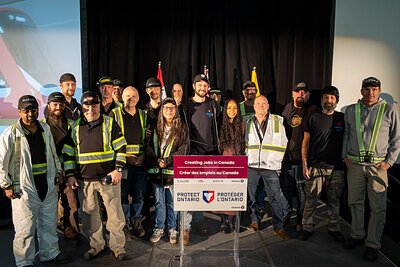
THUNDER BAY, ON – January 15, 2026 – A nearly $1 billion federal investment is set to inject new life into Canadian manufacturing, securing hundreds of jobs at Alstom's Thunder Bay plant for the construction of new subway cars for the Toronto Transit Commission (TTC). The deal, celebrated today by the union Unifor, is a flagship achievement of the federal government's recently implemented 'Buy Canadian' policy, a strategic pivot designed to bolster the national economy and insulate it from global trade volatility.
This landmark contract represents more than just new rolling stock for Toronto; it signifies a deliberate government strategy to leverage public procurement as a tool for industrial development and job creation. The move is being hailed by labor leaders as a model for the future.
"We have been saying this since the beginning of the U.S. trade war-- that all levels of government need to use their procurement dollars to maintain jobs in Canada," said Unifor National President Lana Payne in a statement. "This contract with Alstom is the way forward to supporting workers and building a resilient Canadian economy. This Made-in-Canada solution is a model for all sectors."
A Strategic Shift in Procurement
The Alstom contract is one of the first major tests of the federal government's 'Buy Canadian' policy, which officially began its phased rollout in December 2025. The policy prioritizes Canadian suppliers and domestic content in federal procurement, marking a significant departure from previous, more open-ended bidding processes. Initially applied to strategic procurements valued at $25 million or more, the policy is set to expand its scope to contracts over $5 million by spring 2026.
At its core, the policy requires suppliers on major projects to certify the use of Canadian-produced materials like steel and aluminum. For the Alstom deal, this translated into a crucial negotiation point. The federal and provincial governments each increased their funding to nearly $1 billion specifically to raise the Canadian content of the new subway cars to 55 percent—a long-sought goal for domestic manufacturing advocates.
This approach is reinforced by an 'Interim Policy on Reciprocal Procurement,' which aims to ensure fair market access by favoring suppliers from Canada and countries with reciprocal trade agreements. It's a clear signal that Ottawa intends to use its considerable purchasing power, estimated at up to $70 billion in additional public investment, to ensure Canadian companies and workers are the primary beneficiaries of taxpayer-funded projects.
Revitalizing Thunder Bay's Manufacturing Hub
For the city of Thunder Bay, the news is a jolt of economic optimism. The Alstom plant, a historic cornerstone of the region's industrial base, will be responsible for the final assembly of 70 new six-car Metropolis trains. The contract is projected to directly support 240 jobs at the Thunder Bay facility, with an additional 45 positions at Alstom's operations in Kingston and Toronto. The ripple effects are expected to generate up to 945 direct jobs across Canada and another 1,700 indirect positions throughout the supply chain.
This provides a critical lifeline to workers who have faced uncertainty and layoffs in recent years. "Our members are ready to get to work, we've been waiting for this moment," said Justin Roberts, President of Unifor Local 1075. "We take extensive pride in building reliable, sturdy and long-lasting subway cars and this pride radiates into our community, which will, no doubt, thrive from this contract."
The work is not just a temporary fix. While Alstom officially projects a three to four-year timeline for the initial order, union leaders anticipate the project could provide stable employment for seven to ten years, especially with options for up to 150 additional trainsets built into the contract. This follows a 2025 Ontario commitment of nearly $500 million to refurbish GO Transit coaches, further solidifying the plant's role as a key player in provincial transit infrastructure.
"We are absolutely thrilled for this contract and thrilled for our members," stated Unifor Ontario Regional Director Samia Hashi. "Ontario is built by workers and workers will be the ones who build our future."
The Billion-Dollar Deal and Its Details
The total value of the contract signed between Alstom and the TTC stands at CAD 2.3 billion. The 70 new trains are urgently needed to modernize Toronto's transit system. Fifty-five of the trains will replace the aging fleet on the TTC's Line 2 (Bloor-Danforth), which has been in service for decades. The remaining 15 are earmarked for the planned Yonge North and Scarborough Extensions, crucial projects for the expanding metropolis.
The path to this agreement was unconventional. In August 2025, the federal, provincial, and municipal governments jointly approved a single-source deal with Alstom, cancelling a previously planned competitive bidding process. This decision was explicitly framed as a strategic response to economic conditions and a desire to secure the work within Canada.
Manufacturing is scheduled to commence in 2028, with Alstom leveraging its national supplier network to meet the 55% Canadian content requirement. The focus on using Canadian carbon steel and aluminum is a direct application of the new procurement rules, intended to strengthen the entire domestic supply chain, from raw materials to final assembly.
A Bulwark Against Global Uncertainty
The 'Buy Canadian' policy and the resulting Alstom contract did not emerge in a vacuum. They are a direct response to an increasingly fraught global trade environment, particularly ongoing trade tensions with the United States. Canadian officials have openly positioned the policy as a defensive measure against U.S. tariffs and a way to mitigate the risks of relying on volatile international supply chains.
This represents a significant philosophical shift towards economic nationalism, where the government acts as its "own best customer" to foster domestic industrial capacity and resilience. By localizing procurement, Canada aims to protect key sectors and workers from external economic shocks, a lesson learned during recent global disruptions.
However, this inward-looking strategy may face challenges. The United States is expected to scrutinize what it may deem "restrictive procurement policies" during the scheduled review of the USMCA trade agreement in 2026. Despite potential friction, the Canadian government appears committed to this path, viewing it as essential for long-term economic security and national sovereignty in a world where reliable trading partnerships are no longer guaranteed.