
- 55 million calls/month: Handled by Retell AI's platform
- 2.5x faster development: Conductor reduces agent build time by up to 60%
- 70% of tests automated: System generates most simulation tests internally
Experts would likely conclude that Retell AI’s Conductor represents a significant advancement in enterprise voice AI management, addressing critical operational challenges with human oversight and data-driven improvements.
The Human Touch: Retell AI's Conductor Aims to Master Enterprise Voice AI
REDWOOD CITY, Calif. – June 29, 2026 – In the frantic race to deploy artificial intelligence, a critical question has emerged from the back offices of enterprise contact centers: Who is watching the AI? Voice agents, once simple scripted bots, have become complex, interconnected systems where a single misplaced edit can cascade into thousands of failed customer calls. Addressing this operational chaos, AI voice platform Retell AI today launched Conductor, a new system designed to bring order, safety, and human oversight to the management of production-scale voice agents.
The announcement marks a significant philosophical shift in the AI-as-a-Service market. While many platforms focus on the initial creation of an agent, Conductor is built for the messy reality of day-to-day operations. It functions as an AI copilot with a crucial difference: it understands the agent’s entire workflow and insists on human approval before any change goes live. This deliberate friction is designed to solve a growing crisis of confidence for enterprises that have moved beyond AI experimentation and are now grappling with the high-stakes reality of managing live, customer-facing systems that handle over 55 million calls a month on Retell's platform alone.
Beyond Generic Copilots
The core problem, as Retell AI sees it, is that the tools used to build AI agents are often not suited to operate them. Generic AI copilots, which excel at generating code or text from a prompt, lack the contextual understanding of a live operational environment. They might suggest an edit in a JSON file or a block of text, but they leave it to human teams to decipher the potential downstream impacts on routing logic, compliance rules, and customer experience.
"Generic copilots weren’t enough," said Bing Wu, co-founder and CEO of Retell AI, in a statement. "Building production-ready voice agents is far more complex than generating prompts or making isolated edits. Every change can impact customer experiences in unexpected ways. We built Conductor to think like an expert operator, not a generic assistant."
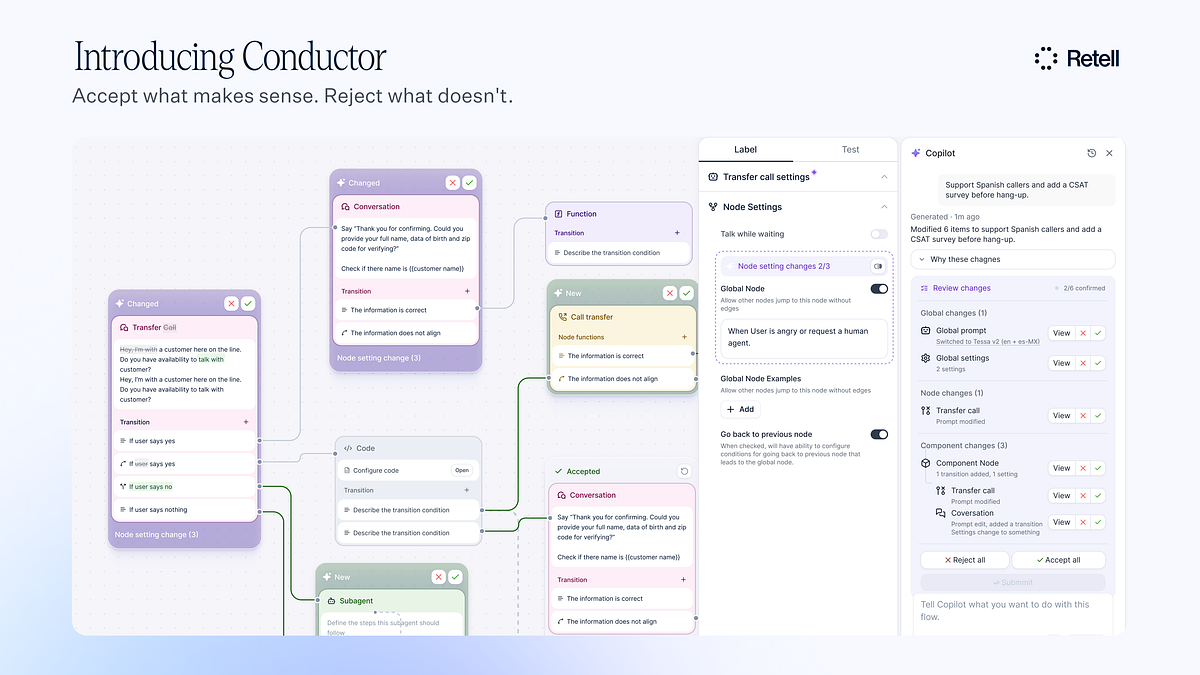
Conductor’s architecture is built on two key innovations. The first is its 'graph-native review interface.' Instead of presenting a wall of code, Conductor visualizes proposed changes directly on the agent's workflow map. An operator sees a clear before-and-after on the specific step being altered, can approve or reject individual changes, and can undo any decision with a click. This graph-based structure, which represents the agent as a network of interconnected nodes, is inherently more testable and transparent than a single, monolithic prompt.
The second innovation is 'operational intelligence.' The system actively monitors agent performance, identifies failed calls, and then automatically generates simulation tests to reproduce the error. From there, it proposes a specific, reviewable fix. This creates a continuous improvement loop driven by real-world data, moving agent management from a reactive, fire-fighting exercise to a proactive, data-driven process. The platform can be pointed to a specific failed call or workflow step to generate targeted recommendations, providing a level of context that generic tools simply cannot match.
Democratizing AI with Guardrails
Perhaps the most impactful feature of Conductor is its potential to broaden the pool of people who can safely manage an AI agent. By allowing teams to request changes in plain English—such as “Review recent calls and update the agent”—the platform abstracts away the underlying code. This empowers non-technical users in product, operations, and support teams to shape agent behavior without having to file a ticket with a backlogged engineering department.
This democratization is not a free-for-all. The platform’s insistence on a human-in-the-loop for approval is a critical guardrail. Nothing goes to production without a person signing off. This hybrid approach aims to combine the speed of AI-driven suggestions with the judgment and accountability of human oversight. The company reports that the system already generates 70 percent of its own internal simulation tests and executes half of all agent edits, proving its effectiveness in accelerating development while maintaining control.
By packaging the learnings from thousands of real-world enterprise deployments into Conductor, the Redwood City-based firm is effectively embedding expert knowledge into the tool itself. This allows organizations to build and iterate on voice agents using proven best practices, rather than relying on trial and error. For enterprises struggling to hire scarce and expensive voice AI engineers, this embedded expertise represents a significant competitive advantage.
The Business Case for Reliable AI
In the world of customer experience, reliability trumps raw sophistication. A single bad AI interaction can sour a customer relationship, while consistent, dependable automation builds trust and loyalty. Conductor is positioned to address this fundamental business need. By providing a framework for safe, continuous improvement, it helps ensure that the AI agent a customer speaks to today is better than the one they spoke to last week.
The return on investment extends beyond risk mitigation. Retell AI claims that Conductor can lead to a 2.5x faster journey from an idea to a production-ready agent, with up to 60% less build time. These efficiency gains are critical in a market where speed and agility are paramount. By freeing up engineers and empowering business users, companies can deploy and refine automation for their contact centers—which for clients like the San Antonio Spurs, Motorola, and Lenovo, handle millions of interactions—at a much faster cadence.
As enterprises scale their AI initiatives, the initial 'wow' factor of conversational AI is being replaced by the hard-nosed operational realities of maintenance, compliance, and performance management. The tools that succeed will be those that help businesses not just build an agent, but operate it effectively for the long haul. As Bing Wu noted, “Most AI tools help you build something once. Conductor helps you operate, improve and scale voice agents every day after launch. That's where the real challenge begins.”