
- $800M Investment: TARS has raised over $800M, including a record $455M Pre-A round, signaling strong investor confidence.
- 21-Degree-of-Freedom (DoF) Design: DexHand replicates the human hand's complexity, enabling unprecedented dexterity.
- Sub-Millimeter Precision: Demonstrated by performing tasks like wire harness insertion, setting a Guinness World Record.
Experts would likely conclude that TARS's DexHand represents a significant leap in robotic dexterity, combining advanced biomimicry and AI to bridge the gap between human and machine capabilities, with potential to disrupt industrial automation.
The Human Touch: How TARS's $800M Bet Redefines Robotic Dexterity
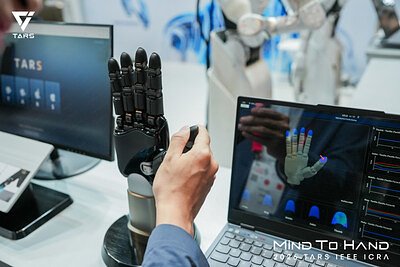
VIENNA, Austria – June 08, 2026 – Amid the academic fervor of the IEEE's premier robotics conference, ICRA 2026, one demonstration consistently drew a crowd of stunned industrialists and researchers. A sleek, human-sized robotic hand moved with an eerie fluidity, flawlessly executing the 26 gestures of English sign language before seamlessly transitioning to a task of sub-millimeter precision. This was the international debut of DexHand, the flagship product of TARS, a company that has emerged from relative obscurity to become one of the most formidable players in embodied artificial intelligence.
In a little over a year, the China-based startup has amassed a war chest of over $800 million, including a record-breaking $455 million Pre-A round, signaling immense investor confidence in its vision. But TARS isn't just building a better robotic gripper. It's tackling one of the most profound challenges in technology: creating a physical AI that can understand and interact with the world as deftly as a human. The Vienna debut wasn't just a product launch; it was a statement of intent to fundamentally reshape the landscape of manufacturing, logistics, and the very nature of physical work.
A Hand Built Like a Human's
For decades, industrial robots have been powerful but clumsy, their grippers designed for repetitive, brute-force tasks. The DexHand platform represents a radical departure from this paradigm. Its design philosophy is pure biomimicry. With a 21-degree-of-freedom (DoF) architecture, it is modeled 1:1 on the complex topology of the human hand, from the metacarpals to the phalanges.
This isn't merely an aesthetic choice. Conventional robotic hands often suffer from kinematic distortion and “motion blind spots” due to simplified joint designs. TARS engineers focused on replicating the spatial convergence of the human thumb's crucial CMC and MCP joints, a feat of engineering that grants DexHand a range of motion and dexterity previously confined to CGI. The result, as demonstrated at ICRA, is silky-smooth micro-manipulation, enabled by self-developed joints with high-precision reducers that virtually eliminate mechanical backlash.
But the mimicry doesn't stop at the skeleton. DexHand’s fingertips are packed with an astonishing sensor array. Ultra-high-resolution miniature cameras, capturing images at over 240Hz, can perceive microscopic textures as fine as 0.05mm. These work in concert with elastomer tactile sensors, giving the hand a sense of touch that rivals our own. This combination of sight and touch allows the system to gather an incredibly rich stream of data about the objects it interacts with.
This advanced dexterity was on full display in Vienna. Beyond the impressive sign language demonstration, the hand performed complex industrial tasks like sub-millimeter wire harness insertion, a task so demanding that TARS already holds a Guinness World Record for it. In a live demonstration, the system even detected and corrected its own errors in real time, showcasing a level of autonomy that moves far beyond pre-programmed routines.
The Brain Behind the Brawn
Hardware this sophisticated is only half the story. The true magic of the DexHand is unlocked by TARS’s proprietary AWE 3.0, a general embodied foundation model that acts as the system's brain. This AI is what translates the torrent of sensory data from the fingertips into genuine understanding.
For years, a persistent “sim-to-real gap” has plagued robotics. Robots trained in perfectly predictable digital simulations often fail spectacularly when faced with the chaotic and unpredictable physics of the real world. TARS attacks this problem head-on by having its AI learn directly from high-fidelity, real-world data captured by the DexHand itself. The company’s SenseHub technology provides a framework for this data capture, effectively turning every interaction into a learning opportunity.
The AWE 3.0 model doesn't just see a surface; it interprets it. By analyzing the micro-textures and tactile feedback, it can predict physical properties like hardness, roughness, and, most critically, slip risk. This allows the robot to be predictive rather than merely reactive. It can anticipate a slip and adjust its grip before it happens, a crucial capability for handling delicate or valuable objects in a fast-paced industrial environment. As TARS’s chief scientist and co-founder Dr. Ding stated during his keynote address at the conference, “TARS' DexHand is the optimized interface between human intelligence and robotic action.”
From Lab to Factory Floor: A Market Disruption Strategy
The technological prowess is backed by a formidable business strategy. TARS's meteoric fundraising, drawing capital from a powerful syndicate of financial VCs like Hillhouse Ventures and HongShan, strategic investors like Meituan, and even state-backed funds, underscores the perceived scale of the opportunity. This isn't just venture capital; it's a coordinated push to build a national and global champion in a critical future industry.
The company is explicitly targeting “real industrial environments,” and its technology is purpose-built for this goal. The demonstrations of packing and wire harness assembly are not theoretical exercises; they are direct solutions for pain points in the electronics and automotive industries, where the demand for automation is insatiable but has been limited by the dexterity of existing robots. The AI-powered industrial robot market is projected to skyrocket, and TARS is positioning itself to capture a significant share by offering a solution that is not just powerful, but adaptable.
Furthermore, the company has designed DexHand for scalability. By using a rigid, quasi-direct-drive design with only three types of motors and reducers, TARS has engineered a complex device that is simple to manufacture, a critical factor for driving down costs and enabling mass adoption on automated assembly lines. This full-stack approach—integrating its own data, models, and hardware, all optimized for real-world tasks and mass production—is a classic disruption playbook aimed squarely at the established industrial automation market.
The Crossroads of Innovation and Impact
The emergence of systems like DexHand, powered by general-purpose AI, places us at a critical crossroads. The potential to augment human capability and automate tasks once thought too complex for machines is immense. In manufacturing, this could mean higher quality, increased productivity, and the onshore relocation of industries that had moved in search of cheaper labor. For workers, it could mean a shift away from dangerous and repetitive manual tasks toward safer, more collaborative roles managing fleets of intelligent robots.
However, this transition is not without its challenges. The societal impact on labor markets will be profound, necessitating massive investment in reskilling and education to prepare the workforce for a future of human-robot collaboration. As these machines become more autonomous and physically capable, questions of safety, accountability, and ethical oversight become paramount.
TARS represents more than just a company with a clever piece of technology. It is a powerful illustration of how breakthroughs in hardware, fueled by advances in AI and backed by massive strategic investment, are poised to move out of the lab and physically reshape our world. The journey from a conference demonstration to widespread industrial adoption is still long, but the gauntlet has been thrown down. The era of dumb, caged robots is ending, and the age of physical AI is just beginning to take hold.