
- 91% of shoppers consider the quality of a store’s fresh departments highly influential in trusting the grocer.
- 78% of consumers have switched grocery stores due to better fresh departments.
- 46% of shoppers prioritize freshness over lower prices when choosing between stores.
Experts agree that the freshness of produce and prepared foods has become the defining factor in grocery shopper loyalty, outweighing even price in many cases, and retailers must invest in operational excellence to meet rising consumer expectations.
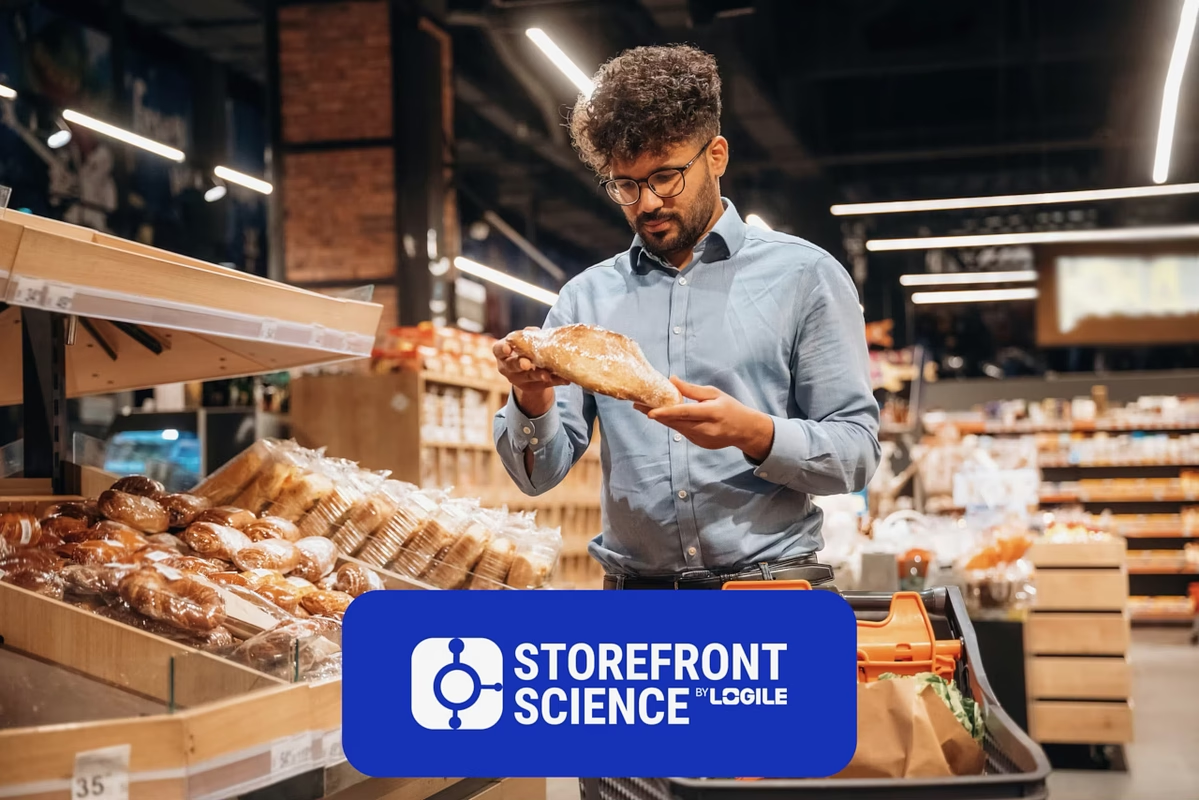
The Hidden Cost of Wilted Lettuce: Why Fresh Now Defines Grocery Loyalty
DALLAS, TX – June 16, 2026 – In the digital chaos of the 21st-century economy, where algorithms dictate prices and delivery drones are no longer science fiction, the battle for the American grocery shopper is increasingly being won or lost on surprisingly traditional ground: the produce aisle. For retailers navigating razor-thin margins and the existential threat of e-commerce, the humble apple and the crispness of lettuce have become the most potent weapons in their arsenal. A new report provides the clearest data yet that freshness is no longer just a department—it is the new currency of trust.
New research from Logile, a retail technology firm, finds that the sensory, high-stakes world of fresh departments is the primary driver of shopper loyalty. The firm’s 2026 State of Fresh Grocery Shopping Report, a survey of 1,000 U.S. consumers, reveals that a staggering 91% of shoppers consider the quality of a store’s fresh departments—produce, deli, bakery, and meat—to be highly influential in whether they trust the grocer. This finding positions the fresh perimeter not as one of many factors, but as the central litmus test for a store's overall quality and reliability.
The Fresh Factor: A New Litmus Test for Trust
The report's findings paint a vivid picture of a consumer who makes snap judgments with long-term consequences for retailers. A poorly maintained fresh section does more than just spoil a few sales; it poisons the perception of the entire brand. According to the survey, 84% of shoppers said that a messy or poorly stocked produce section negatively affects their perception of the entire store. This halo effect means the investment in spotless floors and organized aisles elsewhere can be instantly undone by a single display of wilted kale.
More critically, these perceptions are directly translating into lost revenue. The data shows that 78% of consumers have actively shopped at a different grocery store specifically because its fresh departments looked better. For a quarter of these shoppers, this is a frequent behavior. In a market defined by intense competition, this willingness to switch based on the visual appeal of a tomato is a powerful indicator of where retailers should be focusing their attention.
Perhaps the most disruptive finding, however, challenges a foundational tenet of modern retail: that price always wins. When presented with a choice between two equally convenient stores, 46% of consumers chose the one with better fresh departments, while only 40% opted for the one with lower prices. This pivot suggests a significant segment of the market now values the assurance of quality and freshness over a marginal discount, representing a profound shift in the value equation. Shoppers are signaling that they are willing to pay a premium—not just in dollars, but in loyalty—for the confidence that comes from a vibrant, well-managed fresh food section.
The Retailer's Mandate: Execution in an Era of High Expectations
While consumers have made their preference clear, delivering on the promise of freshness is one of the most operationally complex challenges in retail. Fresh departments are notoriously difficult, demanding a delicate balance of art and science. They are labor-intensive, subject to volatile supply chains, and defined by the unforgiving clock of perishability, which leads to high rates of shrink, the industry term for waste.
“Freshness is still the reason people walk into stores,” said Purna Mishra, Founder and CEO of Logile, in the report's release. “But shoppers’ expectations are rising faster than many retailers can keep up.”
This gap between expectation and execution is where customer frustration festers. The survey highlights sold-out fresh items as a recurring pain point that can send shoppers directly to a competitor. As industry analysts note, the current grocery landscape has entered a “discipline era,” where flawless operational execution is no longer a goal but a baseline requirement for survival. A strategy to prioritize fresh is meaningless without the on-the-ground capability to keep shelves stocked with high-quality products from open to close.
“The grocers who can execute fresh consistently, matching demand with production, labor, and inventory in real time, will keep winning trips and loyalty,” Mishra added. This underscores the core mandate for retailers: the days of static production plans and guesswork are over. The modern fresh department must be a dynamic, data-driven organism, responsive to the minute-by-minute fluctuations of customer demand.
AI in the Aisle: The Technology Behind Consistent Freshness
Meeting this mandate is pushing retailers to embrace sophisticated technological solutions. The hidden costs of inconsistent fresh execution—lost sales, high waste, and eroded customer trust—are driving significant investment in AI-powered platforms designed to tame the chaos of the fresh aisle. Companies like Logile, along with competitors such as UKG and Blue Yonder, are at the forefront of this shift, offering unified systems that bring precision to the traditionally intuitive art of managing fresh food.
These platforms leverage AI-driven forecasting models that can predict demand for specific items with remarkable accuracy—in some cases, within ±3%—by analyzing sales history, seasonality, promotions, and even local weather patterns. This allows a store to move from a “make and pray” model to a demand-driven one, where production plans are generated dynamically to ensure the right amount of product is available at the right time. For retailers using these systems, the results have been dramatic, with some reporting shrink reductions between 20% and 40%.
This technology extends to the store floor through mobile-first workflows. Associates are equipped with tablets that provide guided production plans, step-by-step recipe instructions, and prompts for critical tasks like temperature checks and inventory adjustments. This ensures consistency and food safety compliance across an entire chain, transforming a high-variability department into a model of operational discipline. By unifying forecasting, labor scheduling, inventory, and production planning onto a single platform, retailers can finally achieve a “one store, one forecast” approach, aligning every aspect of the operation toward the common goal of delivering a perfect fresh experience.
The Physical Store's Last Stand?
As online grocery shopping solidifies its place in the market, the strategic importance of the fresh department has become existential for brick-and-mortar retailers. According to Logile’s data, 74% of consumers agree that fresh food is a primary reason they continue to shop for groceries in person rather than online. You simply cannot, as Mishra noted, “replicate the look and smell of food that was just prepared through a screen.”
This makes the fresh department the most powerful anchor for the physical store, the key differentiator that online-only players cannot easily replicate. It is the sensory heart of the grocery experience, and retailers are learning that nurturing it is the best defense against digital irrelevance. The opportunity extends beyond raw produce, with 68% of shoppers saying that hot prepared meals would encourage them to buy from a store’s deli or prepared foods section. This points to a path for growth where the fresh department evolves into a full-service food destination, blending the lines between grocery and restaurant.
In the end, the data confirms what the most successful grocers have always understood intuitively: a store is judged by its commitment to quality, and nowhere is that commitment more visible than in its fresh food. For retailers in 2026, the choice is becoming stark. Investing in the complex systems and disciplined labor required to achieve excellence in fresh is no longer a competitive advantage; it is the price of admission to the future of grocery.