
- 1 in 4 on-site employees would prefer doing their taxes over spending a day in a poorly designed office
- 76% of employees would rather endure unpleasant experiences than tolerate a subpar office environment
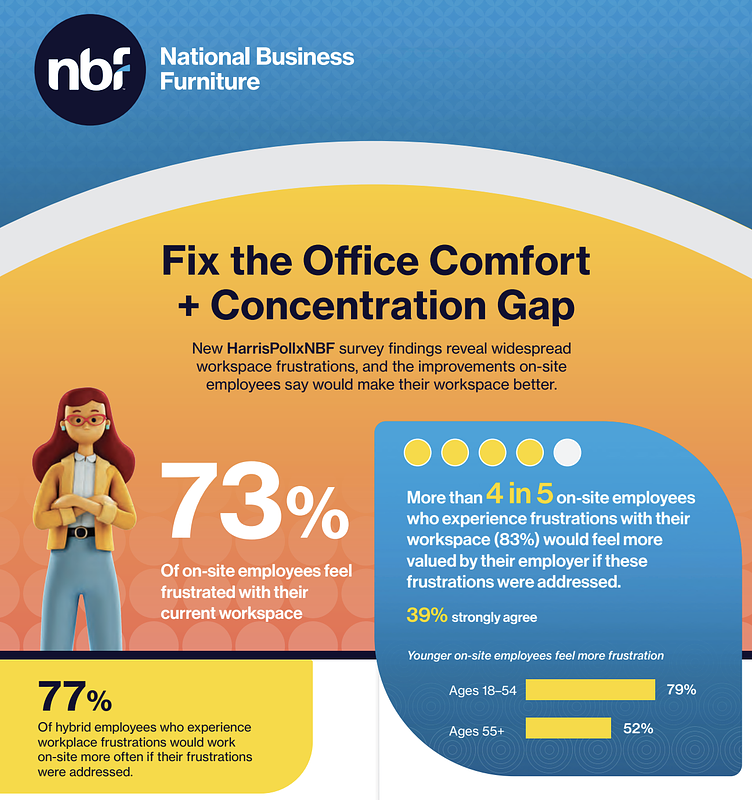
- 83% of employees with workspace frustrations believe addressing these issues would make them feel more valued
Experts agree that poor office design significantly impacts employee well-being, productivity, and retention, making it a critical factor for companies to address in today's competitive talent market.
The Hidden Cost of a Bad Desk: Why Employees Dread the Office
WEST ALLIS, Wis. – April 15, 2026 – For a significant portion of the American workforce, the daily commute leads to a place they would rather avoid, and it has nothing to do with their job description. A new study reveals a stark reality: one in four on-site employees would prefer the annual misery of doing their taxes over spending a day in a poorly designed office.
This striking finding is part of a broader survey conducted by The Harris Poll on behalf of National Business Furniture (NBF), which paints a grim picture of the modern American workspace. The research indicates that 76% of employees who work on-site would rather endure a variety of unpleasant experiences than tolerate a subpar office environment. These alternatives include being on hold with customer service for an hour (28%) or being wedged into the middle seat on a six-hour flight (25%).
The data suggests a deep-seated frustration that goes far beyond minor inconveniences, pointing to a systemic issue impacting employee well-being, productivity, and a company's bottom line.
A Crisis of Concentration and Morale
According to the survey, nearly three-quarters (73%) of all on-site employees report feeling frustrated with their current workspace. This sentiment is particularly acute among younger generations, with nearly 80% of workers aged 18-54 expressing frustration, compared to just over half of those aged 55 and older. The consequences are tangible and immediate.
More than half (57%) of on-site employees say they struggle to concentrate or focus on their tasks at least sometimes, directly attributing it to their physical surroundings. Another 52% experience frustration with inadequate meeting spaces. These daily struggles are taking a measurable toll on employee experience.
"Employees are telling us loud and clear: the quality of their office matters," said Yonca Heyse, President of NBF, in the press release announcing the findings. "When people can't focus, feel physically uncomfortable, or lack space that supports the way they work, it affects everything, from their productivity to whether they feel valued."
This feeling of being undervalued is a critical thread running through the research. An overwhelming 83% of employees who experience workspace frustrations believe they would feel more valued by their employer if those issues were addressed. For nearly two in five, this sentiment is strongly felt, highlighting a direct link between physical space and emotional connection to a company.
The Tangible Cost of a Bad Workspace
The frustrations voiced by employees translate into significant economic consequences. This widespread dissatisfaction contributes to a global crisis of employee disengagement, which research firm Gallup estimated cost the world economy $8.9 trillion in its 2023 report. When employees are disengaged, productivity plummets, and innovation stagnates.
Poor office design is a direct contributor to this productivity drain. Other industry studies have shown that thoughtfully designed layouts can increase productivity by as much as 20%. Conversely, environments that lack natural light, proper ergonomics, and acoustic control can lead to stress and fatigue. Research from the American Psychological Association has shown that elements like natural light and ergonomic furniture can make employees feel more focused and less stressed, while poor air quality alone can hinder cognitive function.
Beyond productivity, there are direct health and attendance costs. Poorly designed offices with inadequate ergonomic support are a leading cause of musculoskeletal issues, a major driver of absenteeism. Investing in an ergonomically optimized environment has been shown to reduce such disorders by up to 25%, boosting morale and keeping employees present and engaged.
The Office as a Competitive Advantage
In an era of hybrid work and a competitive talent market, the role of the physical office has fundamentally changed. The NBF survey reveals a powerful incentive for companies to invest in their workspaces: attracting and retaining their workforce. A remarkable 77% of hybrid employees who are currently frustrated with their office said they would choose to work on-site more often if their workspace were improved.
This finding is critical for leaders attempting to balance remote flexibility with the collaborative benefits of in-person work. Rather than mandating a return to the office, creating a space that employees want to be in emerges as a far more effective strategy. The office is no longer a default location but a destination that must offer value that a home office cannot—be it superior technology, seamless collaboration zones, or a stronger sense of community and culture.
Investing in the office is, therefore, an investment in human capital. By addressing the frustrations highlighted in the survey, companies can directly impact employee retention, improve morale, and strengthen their employer brand. In the competition for top talent, an office that demonstrates a clear commitment to employee well-being can become a powerful differentiator.
Redesigning the Future of Work
The data points to a clear path forward, aligning with broader trends in progressive workplace strategy. The future of office design is human-centric, flexible, and purpose-driven. Leading companies are moving away from one-size-fits-all layouts and toward dynamic ecosystems that offer employees choice and control.
This includes the implementation of biophilic design, which incorporates natural elements like plants, water features, and abundant natural light—elements shown to increase well-being by 15% and creativity by a similar margin. It also means creating a variety of zones tailored to different activities: quiet pods for focused work, open lounges for informal brainstorming, and technologically advanced conference rooms for hybrid meetings.
As work continues to evolve, the most successful organizations will be those that listen to their employees' needs and respond with intentional design. The physical environment is no longer a static backdrop to the workday; it is an active participant in shaping company culture, fostering innovation, and driving performance. For companies navigating this new landscape, the message is clear: the blueprint for future success may very well be drawn on an architect's floor plan.