
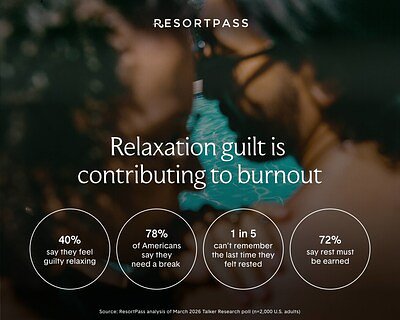
- 78% of U.S. adults say they desperately need a break, but 40% feel guilty for relaxing.
- 76% of parents find the idea of a single resort day highly attractive.
- 82% of Americans say being near water improves their mood.
Experts agree that chronic burnout in America is driven by a cultural belief that rest must be earned, leading to widespread guilt over taking vacations and a shift toward shorter, more accessible leisure options like daycations.
The Guilt Trip: Why Americans Are Too Burned Out to Take a Vacation
NEW YORK, NY – May 12, 2026 – By Sharon Henderson
For a nation that prizes productivity, America is paradoxically exhausted. A staggering 78% of U.S. adults say they desperately need a break, yet a pervasive sense of guilt is preventing them from taking one. According to a new report from the wellness platform ResortPass, 40% of Americans feel guilty for relaxing, creating a culture where rest is seen not as a right, but as a reward that many feel they haven't earned.
The findings, based on a national survey of 2,000 adults, paint a stark picture of a society grappling with chronic burnout. Three-quarters of Americans report feeling mentally or physically drained at least once a week, and for one in five, the memory of feeling fully rested is a distant one. This exhaustion is compounded by a belief system that ties worth to work; 72% of respondents agreed that relaxation is something people have to earn.
“As a culture, we need to start giving ourselves permission to slow down and take breaks without feeling like we've done something wrong,” said Michael Wolf, CEO at ResortPass, in the report. This sentiment taps into a deeper national conversation about work-life balance, where the lines between professional and personal time have become increasingly blurred.
The Problem with the Modern Vacation
Even when Americans do manage to get away, the traditional vacation is often failing to deliver on its promise of rest. The report highlights a phenomenon many travelers know all too well: seven in ten say they need a vacation to recover from their vacation. The stress begins long before departure, with one person in 70% of households shouldering the entire burden of planning flights, accommodations, and activities.
For parents, the challenge is even more pronounced. The survey found that 43% of parents return from family trips feeling more tired than when they left, with 40% stating that true downtime on these vacations is rare or nonexistent. The logistical hurdles of packing, navigating airports, and managing children's schedules can transform a break into another demanding project.
This exhaustion is happening even as paid time off goes unused. Eight in ten professionals expect to end the year with leftover PTO, citing fears of work piling up and a constant pressure to remain available. This aligns with broader labor trends, where studies from organizations like the Pew Research Center have consistently shown a significant portion of the workforce does not use all their allotted vacation time, contributing to a cycle of overwork and fatigue.
The Rise of the 'Daycation' Economy
The mounting frustrations with traditional travel and the pervasive feeling of burnout have fueled a significant shift in consumer behavior. Rather than waiting for a single, often stressful, annual trip, Americans are increasingly seeking out shorter, more accessible forms of escape. The ResortPass report found that 61% of adults would prefer a smaller, vacation-like experience this week—even for just a few hours—rather than waiting for a longer vacation down the road.
This demand has given rise to a booming “daycation” economy, a market pioneered by platforms like ResortPass that provide day-pass access to luxury hotel pools, spas, and amenities without the cost or commitment of an overnight stay. This business model has proven to be a win-win. Consumers gain access to affordable, low-stress leisure, while hotels unlock a new revenue stream by monetizing underutilized facilities. With partners including major brands like Hilton, Marriott, and Hyatt, the day-pass concept has moved from a niche offering to a mainstream hospitality strategy.
“As a parent of two toddlers, I know how exhausting it can be to plan a full family trip,” noted Nicole Maddern, VP of Marketing at ResortPass. “Sometimes what families really want is a simple day where the kids can swim, parents can relax, and no one has to worry about packing lists or airport delays.” The appeal is undeniable, with 76% of parents in the survey finding the idea of a single resort day highly attractive.
Redefining Rest in the Age of Burnout
The growing appeal of the daycation speaks to a deeper need to redefine what rest looks like in modern life. It suggests a move away from the grand, week-long escape toward the integration of smaller, more frequent restorative moments. The report’s findings show that the most effective breaks are often the simplest. An overwhelming 82% of Americans say being near water improves their mood, and 81% report feeling noticeably calmer after just a few hours by a pool or at a spa.
This aligns with psychological research on the power of “micro-breaks” to combat mental fatigue and improve well-being. By offering an accessible outlet for quick rejuvenation, daycations provide a practical antidote to the pressure of an “always-on” culture. It allows individuals to reclaim moments of peace without the guilt associated with taking extended time off work or the stress of complex travel logistics.
Ultimately, the report suggests a return to the simple pleasures that many recall from childhood. When asked about their fondest summer memories, respondents prioritized being outside (51%) and having free time (43%) far above big trips (16%). In an era where burnout has become a common affliction, the most profound form of rest may not be about getting away at all, but rather about finding meaningful ways to pause, recharge, and reconnect within the rhythm of our daily lives.