
- Median growth rate for surveyed firms: 9.9% (down 30% from 2024 peak of 14%)
- High Growth firms' median growth rate: 36.6% (4x faster than average)
- High Growth firms' median profitability: 39.5% (nearly double no-growth firms)
Experts agree that elite firms are thriving by strategically investing in marketing, leveraging AI, and promoting thought leadership, while the broader market struggles with slower growth and profitability.
The Growth Divide: Why Top Firms Thrive as the Market Cools
ARLINGTON, VA – January 13, 2026 – The era of easy, post-pandemic growth for professional services firms has officially ended. A major industry study released today reveals a market grappling with its slowest growth rate since 2018, as economic pressures and technological disruption create a challenging new landscape. However, the report also illuminates a stark divide, where a small cohort of elite, high-growth firms are not just surviving but thriving, achieving growth and profitability that dramatically outpace their competitors.
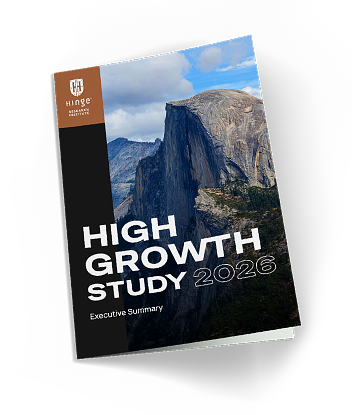
The 2026 High Growth Study, published by research and marketing firm Hinge Marketing, paints a picture of a market normalizing after a period of supercharged expansion. The median growth rate for the 770 firms surveyed has fallen to 9.9%, a sharp 30% decline from the peak of 14% recorded just two years ago. This cooldown signals increased competition and market saturation, forcing firms to fight harder for every dollar of new business.
Yet, within this challenging environment, a clear formula for success is emerging. "High Growth" firms—defined as those with at least 20% compound annual growth over three years—are accelerating away from the pack. These top performers posted a median growth rate of 36.6%, more than four times faster than the average firm. Their financial efficiency is even more striking, with median profitability hitting 39.5%, nearly double the margins of their no-growth counterparts.
The 'Pay-to-Play' Advantage in a Tougher Market
A central finding of the study is the widening investment gap between the leaders and the laggards. High Growth firms are now dedicating a formidable 12% of their total revenue to marketing efforts. This figure is more than double the 5% spent by "No Growth" firms and sits significantly above the broader industry average, which typically hovers between 7% and 10%.
This isn't just indiscriminate spending; it's a strategic "pay-to-play" approach in a market where visibility is paramount. "This year's study reveals that the recent era of 'easy growth' has ended," said Karl Feldman, Managing Partner at Hinge, in the report's release. "While the broader market is cooling, High Growth firms are buying their advantage by doubling down on marketing."
This investment reflects a crucial pivot in strategy. For 2026, the top marketing priority has shifted from simply creating content to aggressively promoting it. The focus is now on amplifying the firm's expertise through social media and, most importantly, developing the firm's subject matter experts into visible thought leaders. In a saturated digital world, having a unique perspective is no longer enough; ensuring that perspective reaches the right audience is the new battleground.
Despite the aggressive adoption of technology, the study underscores the enduring power of human connection. A hybrid marketing model prevails, where leads generated from personal referrals and direct human outreach still account for nearly two-thirds of all new business, proving that trust-based relationships remain the engine of growth in professional services.
Navigating the AI Paradox: Threat, Tool, or Strategic Weapon?
For the second consecutive year, artificial intelligence and automation have been named the number one challenge facing professional services firms. The anxiety is palpable, with nearly one-third of all firms now viewing AI not just as a productivity tool but as an active threat to their established business models. This perception is fueled by concerns over data security, the high cost of implementation, significant skill gaps, and the potential for AI to automate tasks traditionally performed by junior professionals, disrupting long-standing career paths.
However, the Hinge study reveals that High Growth firms are confronting this paradox head-on, transforming a potential threat into a powerful strategic weapon. While average firms may still be experimenting with AI for basic drafting, the leaders are integrating it as a core strategic asset. This distinction is critical to their outsized success.
Industry examples validate this trend. Consulting giant McKinsey & Company, for instance, now employs thousands of internal AI agents to assist its human consultants, reporting significant reductions in research time and faster development of client insights. Similarly, newly formed global law firm A&O Shearman has branded itself as "AI-led," embedding generative AI tools across all service lines to enhance efficiency while maintaining crucial human oversight. The emergence of "AI-native" consulting firms, which build their entire operating model around a hybrid of human expertise and proprietary AI platforms, further signals this strategic shift.
These leading firms understand that AI's true value lies not in replacing human experts, but in augmenting them. By automating repetitive tasks, AI frees up professionals to focus on higher-value activities like strategy, complex problem-solving, and client relationship management. This "Human + AI" model is becoming the hallmark of the most forward-thinking and fastest-growing organizations.
A Blueprint for Resilience in a Cooling Economy
The slowdown identified in the Hinge study is corroborated by wider market analysis. Reports from firms like Deltek have noted recent declines in revenue growth and profitability for the overall professional services sector, confirming that the market is recalibrating. Against this backdrop, the performance of High Growth firms is even more remarkable. Their median profitability of 39.5% stands in stark contrast to broader market trends that show EBITDA margins for average firms falling into the single digits.
This superior performance is not accidental; it is the result of a deliberate and disciplined strategy. These firms are not just growing faster; they are growing more efficiently by leveraging technology and investing in high-ROI marketing activities. They recognize that in a saturated market, brand visibility and recognized expertise are no longer optional—they are essential drivers of profitability.
The playbook used by these elite firms offers a clear blueprint for any professional services company aiming to achieve resilient growth. It involves a commitment to substantial marketing investment, a strategic pivot from mere content creation to the active promotion of thought leaders, and the sophisticated integration of AI to augment, not replace, human talent. As the market continues to tighten, the gap between the firms that adopt this playbook and those that do not is only expected to widen.