
- 20 active degrees of freedom (DOFs) in the flagship B20 Dexterous Hand, closely mimicking human hand articulation.
- $699 price tag for the entry-level B06 model, making advanced dexterity accessible to a broader audience.
- 600 grams weight of the B20 hand, designed for seamless integration into humanoid and service robots.
Experts view ZWHAND's tiered robotic hand lineup as a strategic breakthrough in democratizing advanced dexterity, bridging the gap between high-cost research and scalable commercial deployment in the embodied AI ecosystem.
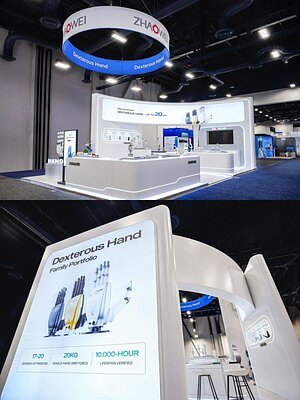
ZWHAND's New Robotic Hands Aim to Democratize Advanced AI Dexterity
LAS VEGAS, NV – January 12, 2026 – As the halls of CES 2026 buzz with the promise of embodied AI, one company is making a bold statement not with a full-fledged humanoid robot, but with the very components that could define its future: the hands. ZWHAND, a new player backed by a veteran manufacturing powerhouse, made its global debut with a lineup of robotic hands designed to bring human-like dexterity to the masses, a critical step in the wake of 2025's mass production of humanoid robots.
The company's showcase centered on a powerful proposition: "high-precision, mass-producible" robotic hands. This wasn't just about creating a single, hyper-advanced manipulator for a research lab. Instead, ZWHAND unveiled a tiered product family, signaling a strategic push to equip everything from cutting-edge humanoids to educational kits, potentially accelerating the entire field of human-robot interaction.
A Full-Spectrum Strategy for a New Era
Under the banner of "Full Spectrum, New Era," ZWHAND revealed a comprehensive strategy aimed at capturing the entire robotics market, from high-end research to cost-sensitive commercial applications. This approach acknowledges that the path to ubiquitous embodied AI isn't a one-size-fits-all solution.
At the pinnacle of this lineup is the flagship B20 Dexterous Hand. Branded with the promise "Evolved. Unrestricted.", the B20 boasts an impressive 20 active degrees of freedom (DOFs), closely mimicking the complex articulation of a human hand. Weighing just 600 grams and matching the dimensions of an adult male's palm, it is engineered for seamless integration into service and humanoid robots without compromising their mobility or balance. This high-fidelity hand is targeted at advanced humanoid platforms, specialized industrial arms, and research institutions pushing the boundaries of what machines can do.
Moving down the line, the A17 model features 17 active DOFs, striking a crucial balance between advanced dexterity and cost-efficiency. It's designed for the workhorse applications that will form the backbone of the commercial robotics industry, such as industrial sorting, logistics picking, and interactive service roles where nuanced grasping is required but budgets are a primary concern.
While the B20 and A17 represent significant technical achievements, the true market disruptor may be the entry-level B06. Its impact lies not in its complexity, but in its accessibility.
The $699 Hand: A Catalyst for Mass Adoption
The most significant announcement from ZWHAND might be the price tag on its B06 model: just $699 in mass production. With 6 DOFs, this hand is designed to deliver reliable basic grasping, but its low cost is poised to shatter long-standing barriers to entry in advanced robotics. For years, dexterous manipulators have been the domain of well-funded corporate R&D labs and universities, with price tags often running into the tens of thousands of dollars.
By offering a functional dexterous hand for under $1,000, ZWHAND is effectively creating an "innovation launchpad" for a much broader audience. STEM education programs in schools and universities, which previously relied on simple, claw-like grippers, can now provide students with hands-on experience in complex robotic manipulation. The vibrant maker and developer communities gain access to a powerful new tool for building sophisticated DIY projects, potentially fostering a wave of grassroots innovation.
This democratization of technology is critical for the long-term health and growth of the embodied AI ecosystem. As one industry analyst noted, "Widespread adoption doesn't happen until developers, students, and small businesses can afford to experiment. A sub-$700 dexterous hand could be the component that unlocks thousands of new applications we haven't even conceived of yet." This move positions the B06 not just as a product, but as a catalyst intended to cultivate a new generation of robotics engineers and entrepreneurs.
Engineering Human-Like Performance
The technical prowess behind ZWHAND's lineup was on full display at its CES booth, which featured immersive demos designed to prove these hands are mature technology, not just lab concepts. The "Gesture Dance Live Demo" was particularly telling, showcasing the B20's ability to perform complex, coordinated joint movements that translate directly to real-world tasks like delicate industrial assembly or natural, non-verbal communication in service roles.
This performance is rooted in deep engineering expertise. ZWHAND is a subsidiary of Shenzhen ZHAOWEI Machinery & Electronics, a publicly traded company with over two decades of experience in creating micro-drive systems. This heritage provides a crucial foundation for mass-producing the highly complex and compact components required for a dexterous robotic hand. The company has pioneered a "motor + ball screw" coupling structure and has managed to integrate motors, gearboxes, control boards, and even electronic skin into a single, cohesive system built into the knuckle. This integrated design is key to achieving the B20's low weight and compact form factor.
Further demonstrations of Bluetooth and VR teleoperation highlighted future applications in remote work. Operators could intuitively control the hands to perform complex tasks from a safe distance, signaling major potential for industries like telesurgery, deep-sea exploration, and hazardous material handling. The emphasis on plug-and-play compatibility with existing robot platforms further underscores the company's focus on practical, immediate implementation.
Carving a Niche in a Competitive Landscape
ZWHAND enters a market with established players, including the UK's Shadow Robot Company, known for its highly complex research-grade hands, and Open Bionics, which focuses on affordable prosthetic hands. However, ZWHAND's strategy appears uniquely positioned to bridge the gap between niche, high-cost research and scalable commercial deployment.
Where competitors often focus on one end of the spectrum, ZWHAND's tiered approach, from the B20 to the B06, allows it to address the diverse needs of a rapidly expanding market. Its key differentiator lies in the explicit goal of combining high precision with mass producibility, a claim substantiated by the manufacturing power of its parent company, ZHAOWEI. This ability to reliably produce sophisticated hardware at scale and at varying price points could give it a significant edge as the demand for humanoid and service robots explodes.
As robots continue their march from factory floors into our daily lives, their ability to interact with a world designed for human hands becomes paramount. The developments showcased by ZWHAND at CES 2026 suggest that the era of clumsy, single-function grippers is ending. In its place, a new generation of dexterous, smart, and increasingly accessible robotic hands is emerging, ready to unlock the true potential of embodied AI.