
The Great AI Disconnect: Executives Are Ready, But Is the Workforce?
- 92% of executives feel prepared to leverage AI, but only 51% of employees share that confidence, creating a 41-point 'readiness gap'.
- Only 8% of employees report that their company has communicated a clear vision for AI.
- 90% of HR leaders agree AI has redefined 'high performance,' yet only 42% of organizations have updated performance goals accordingly.
Experts emphasize that successful AI adoption hinges on bridging the gap between executive ambition and workforce readiness through clear communication, performance enablement, and HR-led strategic alignment.
The Great AI Disconnect: Executives Are Ready, But Is the Workforce?
MENLO PARK, Calif. – March 03, 2026 – A chasm is widening in the modern workplace, not between departments, but between ambition and reality. While corporate leaders are betting billions on artificial intelligence, a groundbreaking new report reveals that the employees expected to use this technology are being left behind, putting the entire AI revolution—and its promised return on investment—at significant risk.
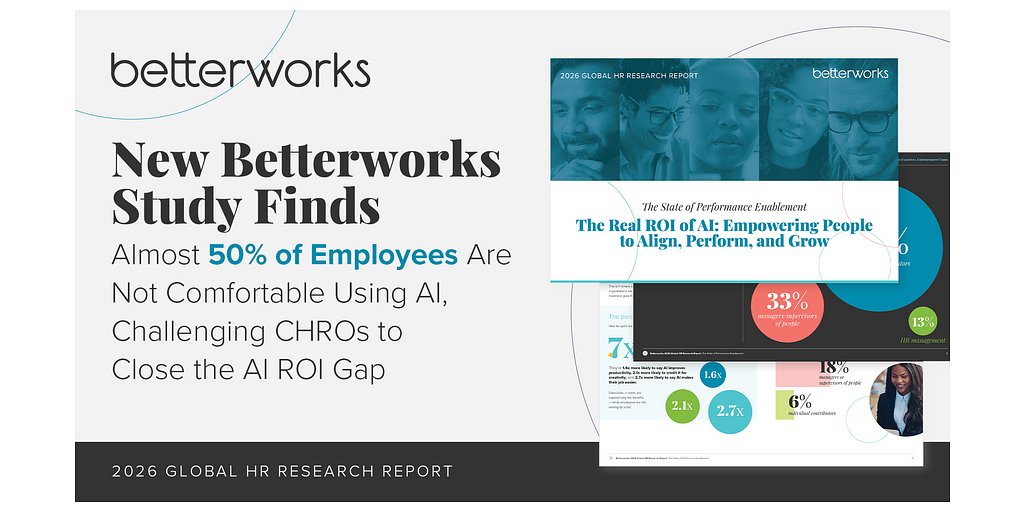
The "2026 State of Performance Enablement" report, released by performance management software firm Betterworks, paints a stark picture of this disconnect. The study, titled "The Real ROI of AI," found that while a staggering 92% of executives feel prepared to leverage AI, only 51% of their employees share that confidence. This 41-point "readiness gap" highlights a critical oversight in corporate AI strategy: investment in technology has far outpaced investment in people.
The findings suggest that the primary obstacle to successful AI adoption is not technological, but human. It's a challenge of performance, clarity, and culture that lands squarely at the feet of Chief Human Resources Officers (CHROs) and business leaders.
A Crisis of Clarity and Connection
The root of the workforce's hesitation appears to be a profound lack of communication and alignment. According to the Betterworks research, a mere 8% of employees state that their company has communicated a clear vision for AI. Without understanding the "why" behind the new tools, employees are struggling to see the "how" for themselves.
This ambiguity creates a perception divide. While nearly half (49%) of HR leaders now rank AI proficiency as a top influencer on employee performance, just 9% of employees believe AI skills have become more important to their personal success. This disparity indicates that while leadership sees AI as a strategic imperative, the message is failing to resonate on the ground where the work actually happens.
When a company’s AI strategy isn’t clearly connected to an employee's daily tasks through goals, coaching, and development, adoption inevitably stalls. The executive ambition to transform the business with AI fails to translate into tangible action, leaving expensive software licenses to gather digital dust and jeopardizing the anticipated ROI. The transition to an AI-augmented workforce is proving to be far more uneven and messy than many leaders anticipated, with success hinging on clear guidance that most employees say they are not receiving.
Redefining Performance in the AI Era
The integration of AI is fundamentally changing the nature of work and, consequently, what it means to be a high-performing employee. The report reveals that 90% of HR leaders agree that AI has redefined "high performance." Yet, in a striking disconnect, only 42% of their organizations have actually updated performance goals to reflect these new expectations.
This failure to adapt performance management frameworks is a critical misstep. If employees are not measured, recognized, or rewarded for developing and applying AI skills, there is little incentive to move beyond established workflows. This aligns with broader industry observations showing that while daily AI users report significant productivity gains—90% feel more productive according to the report—their usage is often confined to routine tasks like drafting emails or summarizing data, rather than higher-value strategic or creative work.
“AI is transforming how we work and the very nature of work itself,” said Doug Dennerline, CEO of Betterworks, in the company's press release. “But no amount of AI investment will pay off unless we empower the people closest to the work. Performance enablement gives employees clarity, coaching, and connection so that strategy becomes action, and ambition becomes real impact.”
The report's findings also signal a major shift in HR priorities. For the first time in six years, performance management has overtaken employee engagement as the top concern for HR leaders. This indicates a growing recognition that to unlock the value of AI, organizations must first build a structured system that makes AI relevant to how people perform, grow, and succeed.
The Pivotal Role of Human Resources
While executive teams may set the AI strategy, the research positions HR leaders as the indispensable architects of its successful implementation. The report argues that HR is at a pivotal moment to earn credibility in the AI revolution by bridging the gap between top-down strategy and bottom-up execution.
Nearly two-thirds of HR leaders surveyed believe that performance management is the most essential tool for preparing the workforce for AI. This is where "performance enablement" becomes the key. By embedding AI expectations directly into goals, providing continuous feedback and coaching on AI usage, and creating clear development paths for AI-related skills, HR can transform abstract corporate ambitions into meaningful, everyday work.
This people-first approach is what separates successful AI integration from a failed technology experiment. It requires HR to move beyond a traditional support role and become a strategic driver of business outcomes. The challenge is not just to roll out new tools, but to cultivate a culture of learning and adaptation, championed by managers who are themselves trained as effective AI coaches. This is the new frontier for HR, where its value is measured by its ability to shape a workforce that is not just compliant with change, but empowered to lead it.
Beyond Fear: The Untapped Potential of the Workforce
Despite the significant challenges highlighted, the outlook is not entirely bleak. The report offers a silver lining: employee fear surrounding AI is on the decline. The narrative is shifting away from anxiety over job displacement and toward a growing willingness to engage with and learn new technologies. The motivation is there, but the structure is missing.
This presents a golden opportunity for proactive organizations. Employees are not resisting AI; they are waiting for guidance. They are looking for systems that make AI relevant to their roles and provide a clear roadmap for how to use it to succeed. The data shows that when employees do become daily AI users, the benefits are clear, with 86% attributing their productivity boosts directly to AI.
The challenge, therefore, is to scale these individual pockets of success across the entire organization. It requires a deliberate, people-centric strategy that prioritizes clarity, provides robust support systems, and fundamentally rewrites the definition of performance for an AI-augmented world. The companies that successfully navigate this transition will be the ones that understand that the real return on AI is unlocked not in the algorithm, but in the empowerment of their people.