
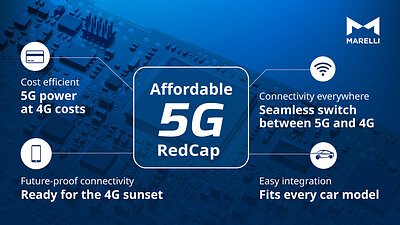
- 50% higher data rate and 2.5 times less latency than 4G with 5G RedCap
- 100 Mbps+ data rates for high-quality media streaming and real-time navigation
- 70% more power-efficient than full 5G, crucial for electric vehicles
Experts view Marelli's 5G RedCap as a balanced, cost-effective solution that bridges the gap between 4G obsolescence and full 5G overkill, making advanced connectivity accessible for mainstream and electric vehicles.
The 'Goldilocks' 5G: Reshaping Connected Car Affordability
SAITAMA, Japan – December 09, 2025 – The modern vehicle is at a digital crossroads. On one side lies the aging infrastructure of 4G networks, a technology facing a planned sunset beginning as early as 2030. On the other is the immense power of full 5G, a costly proposition with performance that often exceeds the needs of the average car. Caught between obsolescence and overkill, automakers have been searching for a path forward. Now, a breakthrough from automotive supplier Marelli may provide the answer, promising a future where advanced, secure connectivity isn't just a luxury feature, but a standard for all.
Marelli's announcement of its 'Affordable 5G RedCap' technology for vehicle telematics marks a pivotal moment for the industry. It’s a solution designed not for the bleeding edge, but for the mainstream—a move that could democratize the connected car experience and fundamentally reshape how we think about the digital identity of our vehicles.
A 'Just Right' Solution for the Masses
The technology at the heart of this shift is 5G RedCap, or "Reduced Capability." Far from a downgrade, RedCap is a streamlined, intelligent version of 5G, officially standardized in the 3GPP Release 17 specifications. It was conceived to bridge the vast gap between low-power IoT devices and high-performance smartphones. Marelli has now adapted this 'Goldilocks' technology for the unique demands of the automotive world.
The press release claims a 50% higher data rate and 2.5 times less latency than 4G. Industry standards validate this potential, with RedCap capable of supporting data rates well over 100 Mbps—more than enough for high-quality media streaming, real-time navigation, and critical over-the-air (OTA) software updates. While it doesn't offer the gigabit speeds of full 5G, it doesn't carry the same baggage either. Full 5G requires complex, multi-antenna hardware that is expensive and power-hungry. RedCap, by contrast, simplifies the hardware, reducing the number of antennas and overall complexity. This translates directly into a smaller physical footprint, lower power consumption, and, most importantly, a cost comparable to today's 4G modules.
"Affordable 5G RedCap is a game-changer in automotive telematics," said Nate Sladek, Vice President of Strategy and Product Management for Marelli's Electronics business. "By offering advanced connectivity capabilities at a price point close to 4G, we're setting a new benchmark for affordable connectivity, especially for vehicles that don't require the full performance of traditional 5G."
This balance of performance and cost is the key to unlocking advanced features for a wider market. Functions that were once the domain of premium vehicles—like proactive vehicle diagnostics, seamless OTA updates that improve performance and security over time, and sophisticated infotainment—can now be viably integrated into entry-level and mid-range models. It ensures that the benefits of a connected ecosystem, from enhanced safety to improved user experience, are accessible to a much broader population of drivers.
Navigating the End of 4G and a New Regulatory Maze
The push for a solution like RedCap is driven by more than just cost. Two powerful forces are compelling automakers to act: the impending obsolescence of 4G and a rapidly evolving regulatory landscape. The planned phase-out of 4G networks, while still years away, means that any vehicle produced today with a 4G-only telematics unit has a built-in expiration date on its connectivity. For long-lifecycle products like cars, this is an unacceptable risk for both manufacturers and consumers. Marelli's system mitigates this by being a native 5G technology that can also seamlessly switch to 4G networks, ensuring continuous connectivity as the infrastructure transition unfolds over the next decade.
Even more pressing are new geopolitical and trade regulations. The proposed U.S. Hardware and Software Ban targets connected vehicle ban, targeting components from "countries of concern" like China, poses a significant threat to global automotive supply chains. This rule could impact everything from cellular modems to infotainment systems, forcing automakers to re-verify and potentially re-source critical components to maintain access to the U.S. market. Marelli is tackling this head-on, stating that its solution is being developed in partnership with a leading module supplier to ensure compliance with the ban and with the USMCA's regional content requirements. This proactive stance on compliance provides automakers with a layer of trust and supply chain resilience, turning a potential crisis into a manageable transition.
Powering the Next Generation of Electric and Smart Cars
Nowhere are the benefits of RedCap's specific design more apparent than in the burgeoning electric vehicle (EV) market. For EVs, every watt of power matters. The high energy draw of traditional 5G hardware can have a tangible, negative impact on a vehicle's range—a major source of anxiety for many EV owners. By significantly reducing power consumption, RedCap lessens the parasitic load on the vehicle's battery. Research from chipmakers like MediaTek suggests RedCap can be up to 70% more power-efficient than its full 5G counterparts.
This efficiency extends beyond just driving range. It enables the telematics unit to remain in a low-power 'always-on' state, ready to receive critical updates or commands without draining the battery. This is vital for the software-defined vehicle, where frequent and reliable OTA updates are essential for delivering new features, patching security vulnerabilities, and managing battery health. The reduced hardware complexity and smaller physical size also give engineers more flexibility in vehicle design, a welcome advantage in tightly packaged EV platforms.
As vehicles become more integrated with smart city infrastructure and vehicle-to-everything (V2X) communication, the low latency and reliable connection offered by RedCap will form the foundation for a new ecosystem of services. From reserving charging stations to receiving real-time traffic and hazard warnings, this 'right-sized' connectivity is the critical human layer that makes the promise of a smarter, safer, and greener transportation future a practical reality.