
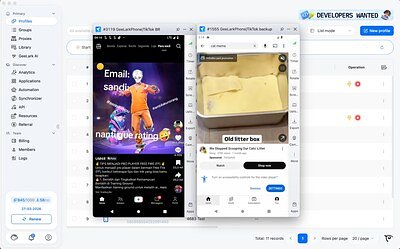
- GeeLark's platform allows marketers to control hundreds of virtual Android smartphones from a single dashboard, automating 'natural in-app actions' like browsing, liking, and commenting.
- The system integrates with AI content generation models such as OpenAI's Sora 2 and others to create and distribute content seamlessly.
- Early adopters report success in managing mobile-native operations at scale, though risks of account bans and reputational damage remain significant.
Experts view cloud phone technology as a powerful but ethically ambiguous tool that could reshape digital marketing, raising concerns about authenticity and user trust in an increasingly automated social media landscape.
The Ghost in the Feed: Cloud Phones Automate 'Authentic' Engagement
SINGAPORE – January 30, 2026 – As the digital landscape of 2026 becomes increasingly dominated by mobile-native platforms, a new breed of technology is emerging that promises to solve one of modern marketing's most complex challenges: scaling engagement authentically. At the forefront of this shift is GeeLark, a Singapore-based firm championing what it calls “cloud-based mobile automation.” The company’s platform offers marketers access to armies of virtual Android smartphones hosted in the cloud, designed to automate the very in-app behaviors that algorithms on TikTok, Instagram Reels, and YouTube Shorts prioritize.
This development signals a potential paradigm shift away from the desktop-centric social media management tools that have defined the industry for over a decade. While those tools rely heavily on official APIs and browser-based interfaces, GeeLark’s approach operates directly within the native mobile apps, aiming to generate signals of genuine user activity—at a scale previously unimaginable. However, this powerful new capability also raises profound questions about the future of authenticity and the line between strategic marketing and sophisticated digital manipulation.
A New Frontier in Mobile Infrastructure
The core of GeeLark's offering is the “cloud phone,” a fully functional Android operating system virtualized on a cloud server. Unlike traditional emulators that run on a local machine and can be flagged for their artificial hardware settings, these cloud phones are designed to appear to social media platforms as distinct, genuine mobile devices. Each instance is equipped with a unique digital fingerprint, including its own device ID, phone number, and IP address, a feature the company markets as “antidetect” technology.
This infrastructure allows a single marketer to control hundreds of what appear to be individual mobile phones from a single dashboard. The primary goal is to automate what the company calls “natural in-app actions” such as browsing feeds, watching videos, liking posts, and leaving comments. This is accomplished through a suite of tools, including a Robotic Process Automation (RPA) system with pre-built templates for platforms like TikTok and Instagram. A “synchronizer” feature further enables users to perform an action on one device and have it instantly replicated across dozens or hundreds of others.
The technological proposition is a direct answer to the limitations of existing solutions. API-based tools are often restricted in the types of actions they can perform, while browser-based workarounds fail to replicate the nuanced micro-behaviors that mobile-first algorithms are built to detect and reward. By moving the entire operation into a native mobile environment, the platform aims to generate more potent engagement signals, helping content gain the visibility and traction that is notoriously difficult to achieve organically.
The AI-Integrated Marketing Machine
Amplifying the power of its cloud phone network, GeeLark has integrated its platform with a suite of advanced AI content generation models. The press release names prominent text-to-video models like OpenAI's Sora 2 and other emerging AIs such as Veo, Kling, Hailuo, and Nano Banana. This integration creates a seamless and formidable workflow, combining content creation and distribution into a single, highly automated process.
In practice, a marketing team could use these AI tools to generate a portfolio of video creatives directly within the GeeLark platform. Without ever switching applications, they could then deploy these videos across a network of social media accounts running on the cloud phones. The platform's automation capabilities could then be used to simulate an initial wave of engagement, theoretically kickstarting the algorithm into showing the content to a wider, organic audience.
This end-to-end system represents a significant leap in operational efficiency. It eliminates the need for physical device farms, unstable emulators, or the logistical nightmare of coordinating global campaigns across different regions and teams. For international brands, it offers the ability to launch, test, and expand campaigns across the globe simultaneously, using geo-proxies to tailor content and engagement to specific locales.
The Authenticity Arms Race
Despite its technological prowess, GeeLark’s platform operates in a precarious gray area that puts it in direct conflict with the terms of service of virtually every major social media platform. Policies from Meta, Google, and ByteDance explicitly prohibit the use of automated systems to artificially inflate engagement, create multiple accounts to mislead users, or circumvent security measures designed to ensure authentic human interaction.
The very concept of “antidetect” technology is a testament to the ongoing arms race between automation providers and platform integrity teams. While GeeLark claims its methods mimic “real mobile user behavior” to minimize suspension risk, it is fundamentally a tool designed to evade detection. For every advancement in creating undetectable bots, platforms are developing more sophisticated algorithms to identify and penalize them.
This raises a critical ethical dilemma for the marketing industry and a philosophical question for the digital public square: what is the meaning of “authentic engagement” when it is performed by a robot? As these tools become more sophisticated, the line between a genuine interaction and a perfectly simulated one blurs, potentially eroding user trust. While marketers may see it as a way to gain a competitive edge, consumers are increasingly wary of inauthentic brand behavior. Recent industry reports note a growing consumer preference for content with a discernible human touch, with many users stating they are less likely to trust brands that rely heavily on undisclosed AI and automation.
A Market Torn Between Opportunity and Risk
The emergence of cloud phone technology is driven by a clear and pressing market demand. Marketers are under immense pressure to perform on mobile-first platforms where traditional playbooks are failing. The promise of a scalable, efficient solution that can master the nuances of platforms like TikTok is incredibly compelling. The market is still nascent, but GeeLark is not alone; competitors such as VMOS Cloud and DuoPlus Cloud Phone are also entering the space, signaling a broader trend.
Early adopters and some user reviews praise the platform for its power and for finally providing a way to manage mobile-native operations at scale without juggling hundreds of physical devices. Use cases have already expanded beyond marketing into social e-commerce, mobile gaming, and Web3 applications where managing multiple online identities is advantageous.
However, this enthusiasm is tempered by significant caution. The risk of sudden and permanent account bans remains a constant threat, as platforms can update their detection methods at any time. Furthermore, the cost and complexity associated with running a large-scale cloud phone operation, including the mandatory use of proxies, can be prohibitive for smaller players. For many established brands, the potential reward of increased engagement may not be worth the reputational risk associated with deploying tactics that could be perceived as a form of sophisticated spam, leaving the market caught between a powerful new opportunity and a substantial, unavoidable risk.
Topics & Related
Generative AI
Automation
Cybersecurity & Privacy
Artificial Intelligence
Software & SaaS
AI & Machine Learning
Fintech
Streaming & Digital Media
Related Company Pulse